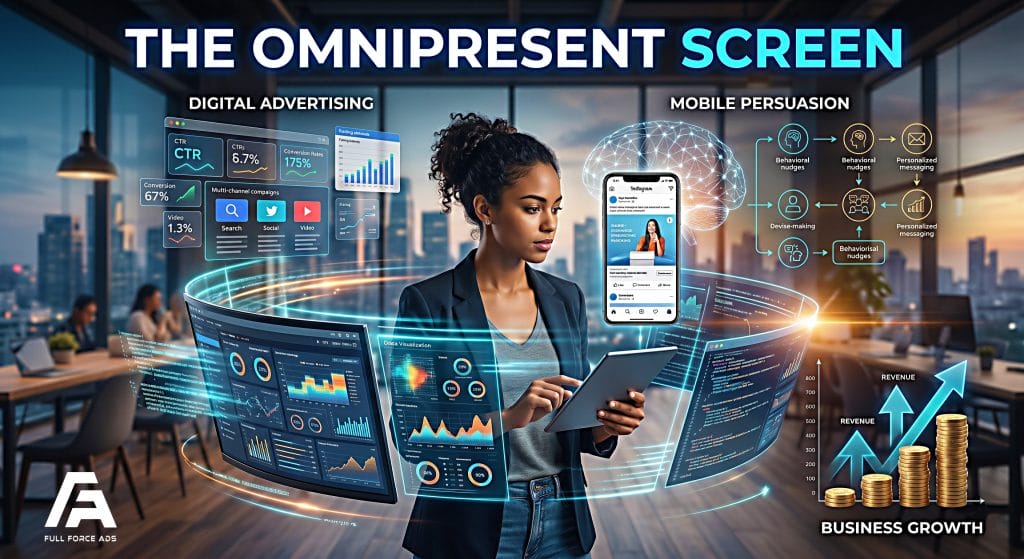
Every morning across the United States, an identical ritual unfolds. Before brewing coffee, turning on the news, or stepping out of bed, millions of Americans reach for their smartphones.
Recent data reveals that U.S. adults spend between 4.5 and 7 hours every day interacting with mobile devices, checking them 186 times daily. This is roughly once every five minutes during waking hours. The mobile device is now the central nervous system of modern consumer life. It is the first thing seen in the morning, the companion on the daily commute, the secondary screen during television viewing, and the final image before sleep.
For businesses aiming to scale, this behavioral shift represents a significant commercial opportunity and an intense battleground. Capturing consumer attention is no longer about buying a billboard on a busy highway or placing an ad in the local Sunday paper. It requires showing up precisely where your target audience spends time, across every screen, application, and digital channel they use.
To win, a brand must understand how to move a consumer from passive scrolling to an active transaction. Achieving this consistently requires deploying sophisticated digital media strategies, clear tracking methods, and robust psychological frameworks.
To persuade a consumer, a brand must first be visible. Modern digital advertising is a complex network of highly specialized media channels. Each channel possesses unique advantages, supports different creative formats, and engages consumers during distinct moments of their daily routine.
Understanding how these channels function, and how to deploy them collectively, is the first step toward building an effective brand presence.
| Channel | Core Strength | Primary Role in the Funnel |
| Streaming TV | High-impact visual storytelling | Broad awareness and emotional connection |
| Digital Video | Captures attention via movement and sound | Deep engagement across mobile and desktop |
| Digital Audio | Reaches screen-free moments | Intimate, highly receptive consideration |
| Mobile Ads | Location and preference integration | Immediate engagement and real-world action |
| Display Ads | Continuous web-wide visibility | Continuous reinforcement and retargeting |
| Native Ads | Editorial style and integration | Higher trust and lower consumer resistance |
Streaming TV places a brand's narrative on the largest screen in the household. As traditional cable subscriptions decline, consumer attention moves to platforms like Roku, Fire TV, and Hulu.
Unlike traditional television advertisements broadcast indiscriminately to entire metropolitan areas, streaming TV ads combine the visual scale of television with the precise targeting data of digital media. These ad placements are generally unskippable, ensuring high completion rates. They allow businesses to present immersive stories to specific households, filtering audiences by intent, income, or lifestyle choices before video delivery begins.
Online video advertising extends beyond the television screen into the mobile apps and websites consumers access throughout the day. Delivered as pre-roll, mid-roll, or outstream placements embedded within text articles, digital video captures user attention through movement and sound.
Video evokes emotion, demonstrates complex product features, and builds an immediate cognitive association with a brand. In a mobile-first environment, short, high-impact video clips cut through digital noise far more effectively than static text or basic images.
Millions of Americans stream music, podcasts, and digital radio via services like Spotify and Pandora while driving, exercising, cooking, or working.
These screen-free moments offer an exceptionally receptive environment for advertisers. Because listeners often consume audio content through headphones or closed environments, audio advertisements achieve an intimacy that visual ads rarely match. Delivering a compelling message during a favorite podcast or daily playlist allows a brand to reach consumers when their visual attention is occupied but their minds are receptive.
Mobile advertising places a business directly onto the device consumers carry everywhere. Spanning in-app placements, mobile web banners, and location-based interstitial ads, mobile advertising reaches consumers throughout their day.
Because smartphones integrate with location data, personal preferences, and immediate purchasing capabilities, mobile campaigns provide an ideal bridge between digital discovery and real-world action.
Display advertising consists of visual banner ads placed across millions of websites and applications. While display banners are a mature digital format, they remain a foundational element of any comprehensive media strategy.
Display ads offer cost-effective reach, making them excellent tools for maintaining continuous brand visibility. They also serve as the operational backbone for retargeting campaigns, keeping a business top-of-mind by reappearing as prospective customers browse the broader web.
Native advertising uses ad formats that match the visual style, form, and function of the media platform where they appear. Frequently found within news feeds, content recommendation engines, or social media timelines, native ads match the look and feel of editorial content.
This structural integration bypasses standard banner blindness, yielding higher click-through rates and deeper user engagement. By providing genuine informational value while matching surrounding articles, native ads build trust and lower the consumer’s natural resistance to marketing messages.
While choosing the right media channels determines where an advertisement appears, your targeting framework dictates who sees it. In modern advertising, buying raw impressions is no longer an efficient strategy. Wasteful spending occurs when budgets are deployed showing home improvement services to apartment renters or luxury automotive ads to teenagers.
To maximize return on investment, businesses must layer sophisticated targeting strategies over their chosen media channels. This ensures that every marketing dollar focuses on individuals who display authentic commercial intent or match precise behavioral profiles.
Every successful digital advertising campaign relies on an understanding of human psychology. In a fast-moving digital ecosystem, human decision-making relies on predictable cognitive shortcuts.
By structuring ad creatives, targeting parameters, and landing page experiences around established psychological principles, businesses can systematically guide consumers toward a purchase decision.
The mere exposure effect is a psychological phenomenon where individuals develop a preference for things simply because they are familiar with them. In the digital environment, a consumer is far more likely to buy from a brand they see repeatedly over time than a brand discovered minutes prior.
This highlights the value of an omnichannel advertising strategy. When a consumer encounters a brand on streaming TV, hears an audio ad on Spotify, and sees a display banner on a news site, the brand builds strong psychological familiarity. When the consumer is ready to buy, this accrued familiarity transitions into consumer trust.
The availability heuristic is a mental shortcut where people judge the safety, reliability, or importance of a business based on how easily they can recall an instance of it. If a brand is easy to remember, it is perceived as a market leader.
Achieving this level of recall requires high-impact creative mediums like sight, sound, and motion. A compelling, visually rich streaming TV or online video ad leaves a lasting mental impression. When a customer faces a problem, a vivid digital memory ensures your business is the first solution that comes to mind.
The principle of reciprocity states that when someone receives value, they feel a natural psychological obligation to give something in return. In digital advertising, this principle works through content-rich native advertising.
Instead of showing an aggressive, pitch-heavy advertisement, a business can serve an informative, native article that helps the reader solve a real problem or understand a complex issue. By providing genuine value upfront without an immediate demand for a sale, you lower buying defenses and make the reader receptive to future commercial invitations.
Human psychology is wired to remain consistent with past actions. If an individual takes a small initial step, they are statistically far more likely to agree to a larger subsequent request.
Smart digital campaigns leverage this tendency by designing progressive conversion paths. Instead of using a first-time display ad to ask for a large enterprise contract, an ad invites the user to download a helpful industry whitepaper or use a free digital calculator. Once the user makes that small initial commitment, retargeting campaigns can guide them toward a discovery call, a product demo, and a full partnership.
Despite the clear power of these digital tools, many businesses fail to see a strong return on their marketing investments. The problem stems from operational fragmentation.
When a business attempts to execute a modern digital strategy internally or splits its initiatives across multiple narrow vendors, critical points of failure emerge.
The Multi-Vendor Penalty
Juggling single-purpose partners—one agency for social media, a separate vendor for streaming TV, an internal employee managing basic search ads, and another third party handling retargeting—creates significant operational friction. Communication breakdowns occur, asset management becomes uncoordinated, and the overarching brand message breaks down.
When marketing channels remain isolated from one another, data cannot flow across the campaign. The streaming TV platform cannot track who clicked on a display banner, and the mobile geofencing campaign cannot communicate with your search retargeting audience.
This lack of integration creates massive analytical blind spots. Advertisers end up over-serving ads to the same individuals, wasting budget, and failing to understand exactly which touchpoint caused the customer to convert.
A significant frustration for business leaders is the lack of transparency in digital ad reporting. Many agencies provide confusing monthly summaries filled with vanity metrics like "total impressions" or "estimated reach," while hiding true performance metrics.
Without knowing exactly which apps served your ads, which geographic zones generated leads, or where every dollar went, it is impossible to optimize a budget. This lack of transparency protects the agency's margins rather than driving client growth.
To solve these persistent operational challenges, sophisticated organizations partner with comprehensive digital advertising agencies capable of unifying execution.
Designed to eliminate multi-vendor friction and deliver transparent, high-performance campaigns, Full Force Ads provides an integrated approach across every digital channel.
There is no one-size-fits-all formula in digital advertising. The optimal channel mix depends entirely on your specific commercial objectives.
| Business Objective | Strategic Channel Mix | Primary Targeting Layers | Expected Outcome |
| Local Awareness | Geofencing, Display, Mobile | Physical locations, high-traffic corridors, target neighborhoods | Dominates local market visibility and drives direct local foot traffic. |
| Conquest Competitors | Geofencing, Addressable | Competitor storefronts, rival customer lists, direct commercial zones | Intercepts active buyers directly from rival businesses and shifts market share. |
| Brand Building | Streaming TV, Video, Audio | Behavioral profiles, demographic data, lifestyle segments | Establishes major market authority and creates memorable brand recall. |
| Website Traffic | Display, Native, Search Retargeting | Relevant keyword searches, content topics, contextual placement | Drives high-intent users to your digital properties at an optimized cost. |
| Retarget Past Visitors | Site Retargeting, Display, Video | Past digital engagement, specific page views, dropped carts | Recovers lost web traffic and guides interested buyers back to complete transactions. |
| Target a Customer List | Addressable, Streaming TV, Display | Verified physical addresses, matching CRM data, lookalike profiles | Strengthens physical outreach campaigns with consistent digital ads. |
Deploying a high-performance digital campaign does not need to be a complicated or stressful process. Full Force Ads uses an organized onboarding framework designed to respect your time and ensure strategic alignment from day one.
[Step 1: Discovery] ──> [Step 2: Custom Mix] ──> [Step 3: Live Launch]
                             ▲                               │
                             └────────── [Step 4: Optimize] ─┘
The process begins with an introductory discovery call focused on learning about your organization. The goal is to understand your business model, define your target audience, identify your core competitors, and clarify your growth objectives. This is an open, professional conversation to see if a partnership makes strategic sense.
Following the discovery call, our strategy team analyzes your market footprint and competitive landscape. We build a comprehensive, custom channel recommendation and targeting blueprint tailored to your goals and budget. We explain exactly which screens to target, which data layers to deploy, and how success will be measured.
Once the strategy is approved and creative assets are ready, our technical team launches the campaign. We handle all programmatic setups, tracking pixel installations, and platform distributions. Most campaigns are live and delivering impressions across selected networks within 5 to 7 business days.
A digital campaign is a dynamic asset that requires ongoing care. We continuously monitor performance, adjusting bids, refining geographic boundaries, and shifting budgets toward the highest-performing channels. Through our weekly reports, you receive regular updates on campaign progress and a clear view of your return on investment.
Attention is the ultimate currency of the modern economy. With consumers spending hours every day focused on mobile devices and connected screens, businesses cannot afford to rely on outdated, fragmented marketing methods. To achieve real scale, you must meet your audience where they live, with a unified message backed by precise intent data.
Partnering with an omnichannel expert like Full Force Ads allows your business to eliminate waste, streamline your operations, and deploy highly targeted campaigns across Streaming TV, Video, Audio, Mobile, Display, and Native platforms under one roof.
The path to scaling your brand begins with a simple conversation. Visit the Full Force Ads Advertising Solutions platform to schedule a live demo, discover your optimal channel mix, and take complete control of your market's digital attention today.