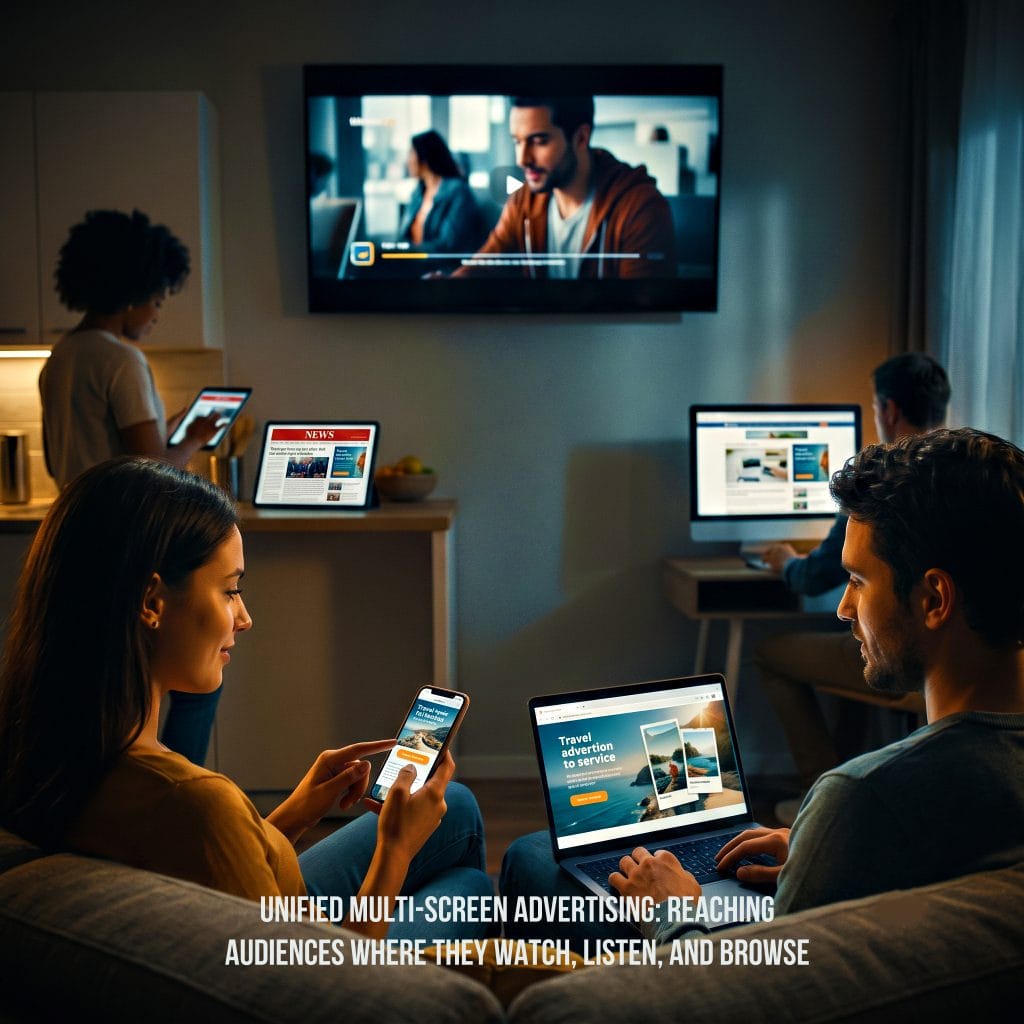
Your customers aren't sitting still. They're streaming a show on the living room TV, listening to a podcast on the drive to work, and scrolling their phone during lunch, sometimes all in the same afternoon. If your advertising only shows up in one of those places, you're only getting part of their attention.
The usual fix is to hire three or four single-channel vendors: one for streaming TV, one for audio, one for mobile. That approach creates its own mess. Reports don't line up, budgets overlap, and nobody can tell you which channel actually drove the sale. A unified system solves that by running every channel through one platform with one set of targeting data behind it.
Full Force Ads builds these campaigns for clients who want their advertising to follow the customer instead of waiting in one spot.
A single banner ad rarely closes a sale on its own. But when someone sees your brand on their smart TV Tuesday night and hears an audio ad during their commute Thursday morning, that repetition starts to feel less like an ad and more like a business they've heard of. Repeated exposure across different contexts builds recognition faster than the same volume of impressions crammed into one channel.
Streaming TV runs video ads on platforms like Roku and Hulu, served to households that match your customer profile rather than blasted to everyone watching. Audio covers Spotify and podcast ads that reach people while they're driving or working out, hours when they're not looking at a screen and their attention isn't split three ways. Mobile places ads inside apps and mobile browsers, built to drive a phone call or a store visit rather than just a click. Display and native round it out: banner ads build name recognition across the sites your customers already read, while native ads are formatted to match the surrounding page so they read more like content than an interruption.
Channels get your ad in front of someone. Targeting decides whether that someone is worth paying for.
| Targeting method | How it works | Best used for |
|---|---|---|
| Geofencing | Draws a virtual boundary around a physical location | Competitor foot traffic, event attendees |
| Addressable targeting | Matches a mailing list to household IP addresses | Reaching an offline CRM list |
| Site retargeting | Shows ads to people who already visited your site | Lowering acquisition costs |
| Search retargeting | Serves ads to people who searched relevant keywords | Catching high-intent buyers |
| Contextual targeting | Places ads on pages about a specific topic | Keeping your brand next to relevant content |
A lot of geofencing out there is really just a big radius drawn around a ZIP code, so you end up paying to reach plenty of people who were never going to walk through your door. Full Force Ads draws boundaries around the actual exterior walls of a location: a competitor's showroom, a convention center, wherever your buyers already are. When a phone enters that boundary, we log the device, start serving ads to it, and track whether that person eventually shows up at your business.
If you already have a physical mailing list, you can match it to household internet connections and reach those same addresses digitally. That's what lets a prospect get a piece of direct mail and then see your video ad show up on Hulu a few days later, same audience, two different formats.
The right mix of channels and targeting depends on what you're actually trying to do. For local awareness, that's display and mobile ads aimed at the neighborhoods and community spots your customers frequent. For competitive conquest, you geofence a competitor's location and put a specific offer in front of the people who walk out their door. For brand building, you pair video and audio so people see and hear you in different settings.
Clients work with Full Force Ads for a few reasons. Everything runs through one partner, so CTV, geofencing, and display all go through the same platform instead of three separate vendors. Reporting comes weekly, so you see where your ads ran and which of them turned into conversions, not a summary at the end of the quarter. And the typical window from signed strategy to live campaign is five to seven business days.
If your customers are already moving between screens, it's worth checking.