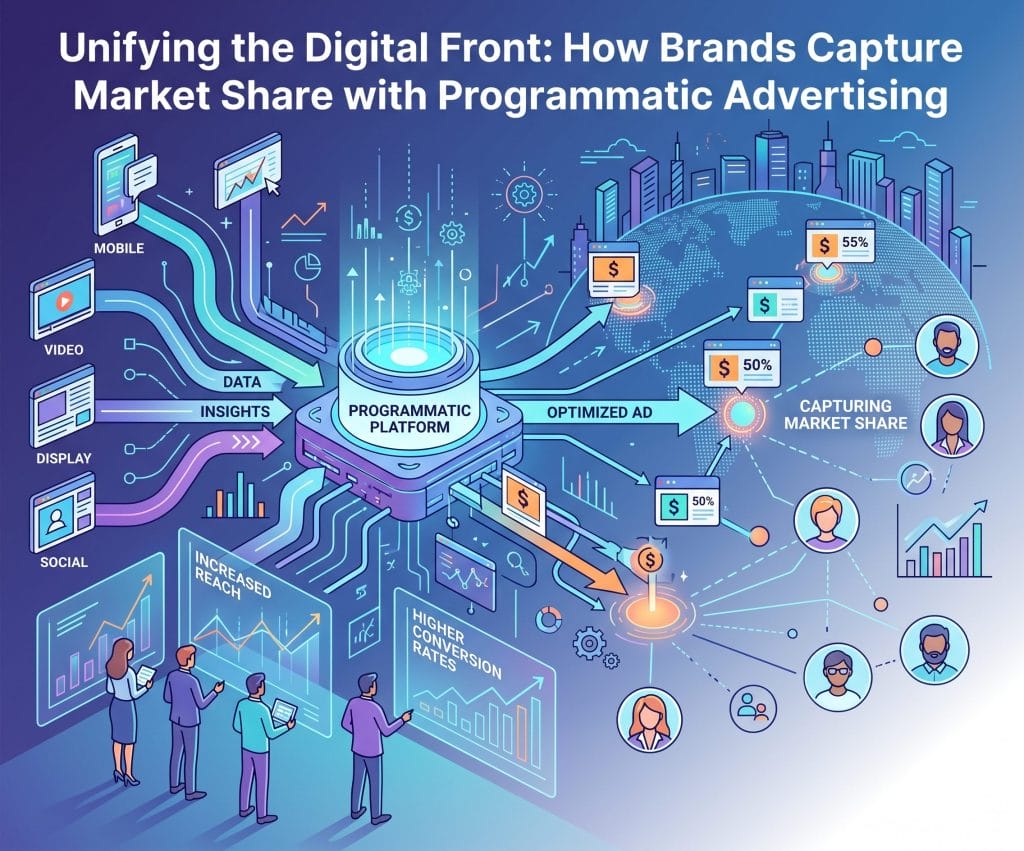
In crowded markets, consumer attention dictates revenue. Yet most businesses approach digital media with fragmented tactics. They split budgets across isolated vendors: one agency for search, another for social media, and a self-serve platform for display banners.
This separation wastes capital. When marketing channels operate in isolation, data sits in silos, messaging conflicts, and ad spend disappears into unmeasured impressions.
Growth requires a single, unified strategy that meets buyers across screens. This guide covers the mechanics of programmatic advertising, buyer psychology, and how Full Force Ads builds campaigns across digital touchpoints to secure customers.
Digital advertising requires a cohesive media footprint. Consumers move between tablets, mobile phones, connected televisions, and desktops. Campaigns must match this fluidity.
The living room television remains a primary tool for brand authority, but the distribution has changed. Linear TV scatters impressions across broad demographics, which introduces waste.
Connected TV (CTV) and Over-The-Top (OTT) media combine video storytelling with digital data precision. Through platforms like Roku, Fire TV, and Hulu, brands deploy unskippable 15- and 30-second video assets.
Because buyers purchase CTV programmatically, you buy access to specific households rather than time slots on a network. The ad appears because the viewer matches your exact buyer profile.
Video consumption also guides mobile and desktop browsing. Using pre-roll, mid-roll, and outstream video placements within text content, brands place messages across premium websites and mobile apps. Video drives higher recall than static imagery, making it a necessary layer for building interest.
Audio advertising reaches consumers in screen-free environments. Through Spotify, Pandora, podcasts, and digital radio, audio ads reach prospects during commutes, workouts, and work hours. These placements deliver messages without visual competition, which helps mid-funnel education.
Smartphones offer deep contextual relevance. Mobile-specific advertising, including in-app placements and local banners, reaches users based on real-time geographical coordinates, connecting digital intent to physical locations.
While social networks restrict data within proprietary platforms, display advertising covers the open web. Banner ads across top-tier websites provide cost-effective visibility. Modern programmatic display acts as the foundational layer of digital marketing, maintaining awareness and driving retargeting campaigns.
Standard ad units sometimes face banner blindness. Native advertising matches the visual design, typography, and editorial style of the host website. Because these ads appear as organic content recommendations on publisher sites, they earn higher click-through rates and reader trust.
Media channels dictate where your message appears. Targeting dictates who sees it. Layering data onto your chosen channels reduces wasted ad spend and directs budgets toward high-value prospects.
Geofencing: This tactic draws virtual perimeters around real-world locations. You can gather the unique mobile device IDs of individuals inside a competitor's showroom, an industry trade show, or a specific neighborhood. This allows you to serve targeted ads on-site and for up to 30 days after they leave.
Addressable Targeting: This option converts physical addresses (like CRM data or direct mail lists) into digital profiles. By mapping addresses against household IP networks, we deliver streaming TV ads, display banners, and video placements directly to the devices inside those homes, replacing or supporting print campaigns.
Search Retargeting: Standard search marketing requires high bids on keyword result pages. Search retargeting captures that intent outside the search results. When a prospect searches for a phrase on Google or Bing, you can serve them display, video, or native ads as they browse the broader internet, capturing intent without paying search click rates.
Site Retargeting: Most first-time website visitors leave without taking action due to distractions or price comparisons. Site retargeting tracks these visitors across the web, displaying tailored messages that address specific objections to bring them back to your site.
Contextual Targeting: This method places ads based on the content of the web page. For example, culinary equipment ads populate alongside recipes and restaurant reviews. Aligning your brand with topics the audience is already reading creates immediate relevance.
Relying solely on basic social media ads creates vulnerability. If ad accounts close or algorithm changes raise costs, revenue drops. A diversified programmatic display approach treats the entire internet as your digital storefront.
Most eCommerce brands use basic dynamic retargeting: a user views a product, and that item follows them on social media for weeks. This ignores the rest of the web where consumers spend most of their time.
Advanced display uses Dynamic Creative Optimization (DCO) to feed live product data into ad assets. If a user abandons a cart, the system generates a display banner featuring that exact item, a live inventory counter, or a shipping incentive. This personalization turns standard banners into direct conversion tools.
Growth requires fresh, qualified traffic alongside retargeting. Programmatic display systems analyze the data profiles of your high-lifetime-value customers to build behavioral models based on reading habits, purchase history, and demographics. Campaigns then introduce your brand to new audiences sharing those same traits.
Creative copy and strategic frameworks guide consumer action. Campaigns must align with established principles of human decision-making.
People develop preferences for things they see often. A unified programmatic strategy creates consistent presence: a prospect hears an ad on a morning podcast, sees a banner on a blog at lunch, views a native recommendation in the afternoon, and watches a CTV ad that evening. This repetition builds trust and familiarity.
Buyers move through distinct psychological phases. Forcing a hard-sell call to action onto a cold prospect creates friction. Channel assignment must match the user's intent:
| Target Goal | Core Psychological Mechanism | Recommended Channels |
|---|---|---|
| Local Awareness | Geographical proximity and physical convenience | Geofencing + Display + Mobile |
| Conquest Competitors | Disruption of habit and superior value proposition | Geofencing + Addressable Targeting |
| Brand Building | High-prestige storytelling and emotional alignment | Streaming TV + Video + Audio |
| Website Traffic | Curiosity gaps and editorial relevance | Display + Native + Search Retargeting |
| Retarget Past Visitors | Reversing procrastination and overcoming friction | Site Retargeting + Display + Video |
| Reach a Customer List | Maximizing customer lifetime value and loyalty | Addressable + Streaming TV + Display |
In B2B and high-ticket B2C sectors, prospects often hesitate due to the risk of a poor purchase. Down-funnel ad creative within retargeting units must reduce this friction. Use these placements to highlight case studies, verified ratings, guarantees, or low-friction discovery options.
Managing multiple single-point agencies or ad managers introduces distinct operational problems.
When vendors operate independently, each claims credit for the same conversion. Your display, video, and social vendors might all report a win for a single transaction. This inflation distorts your calculations for Return on Ad Spend (ROAS) and Customer Acquisition Cost (CAC).
Without a unified platform, you cannot manage cross-channel frequency capping. A single user might see your ad dozens of times in one day across different devices because separate vendors do not sync data. This saturation wastes budget and alienates buyers.
Agility is a competitive advantage. Updating an offer or reallocating capital across multiple separate agencies often requires weeks of email threads and approvals. A unified platform allows immediate adjustments as market conditions shift.
Based in Utah, Full Force Ads provides scaling enterprises with an omnichannel platform that unifies digital campaigns and measures performance.
Unified Management: We run Streaming TV, digital video, audio, geofencing, display, and native placements from a single interface. Capital shifts in real time to your highest-performing channels based on live performance data.
Targeting Infrastructure: Every campaign uses specific targeting layers, including competitor geofences, addressable IP matching for CRM lists, and search intent keyword tracking across the open web.
Reporting Transparency: Full Force Ads provides clear reporting that outlines exactly where your ads ran, who interacted with them, and what actions they took on your site, without hidden markups or vague metrics.
Flexible Budgets: We use flexible budget structures without rigid, multi-year contracts, so your organization can start at a comfortable baseline and scale based on performance data.
Fast Deployment: Our team moves campaigns from initial concept to active status across major media networks within 5 to 7 business days, avoiding onboarding delays.
Our setup process is designed to align with your business goals while respecting your time.
The Discovery Call: A brief conversation analyzing your historic marketing, buyer personas, sales cycle, and current growth bottlenecks.
The Custom Recommendation: Our team builds a tailored media mix and targeting plan for your vertical, goals, and budget, outlining which channels will drive conversion velocity.
Programmatic Deployment: Once you approve the plan and creative assets, we manage the technical setup, tracking loops, and parameters to push the campaign live within 5 to 7 business days.
Continuous Optimization: Our team reviews account performance daily, testing creative variations and refining targeting while providing clear weekly updates.
Operating with separate marketing channels, isolated data, or single-platform tactics lets competitors take market share. Your audience moves between streaming apps, mobile devices, podcasts, and digital sites. Campaigns must meet them at these touchpoints.
Simplify your digital media, use precision data targeting, and run an omnichannel system built to scale.
Contact Full Force Ads today to schedule a demo and receive a custom media plan for your business.