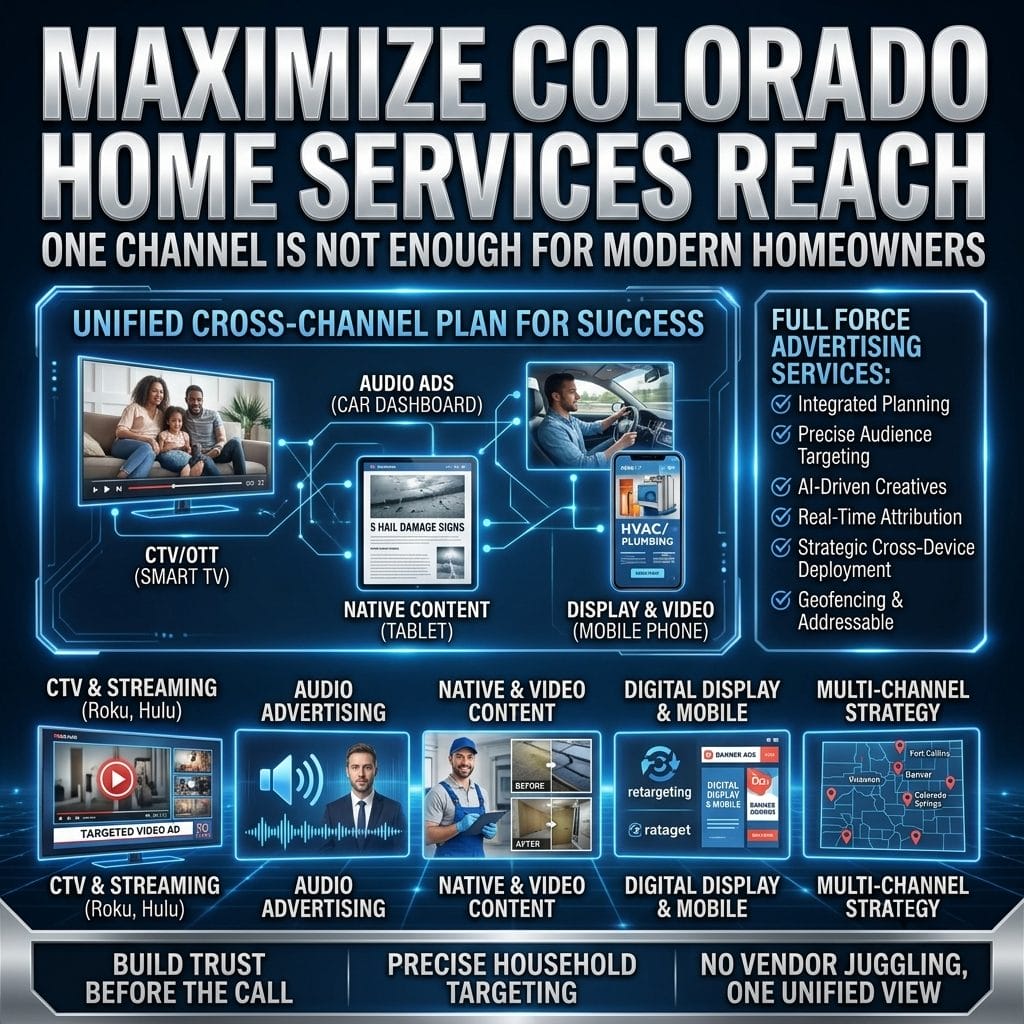
Run an HVAC company in Denver, a roofing crew in Colorado Springs, or a plumbing outfit covering Fort Collins and the Front Range, and you already know the market has changed. Homeowners are online constantly, but reaching the right ones, at the right moment, has gotten harder, not easier.
A single channel used to be enough. A listing in the phone book, a name at the top of a search page, a few referrals. That version of local marketing is gone. Today's homeowner researches a company before calling, listens to podcasts on the drive down I-25, streams shows on a Connected TV device in the evening, and checks a neighborhood app on their phone before letting anyone through the front door.
Winning that homeowner takes more than running ads somewhere. It takes a real cross-channel plan built around how people actually make decisions, and it takes targeting precise enough that the budget isn't burned on people who were never going to call.
Home services aren't sold like consumer goods. Someone buying shoes wants comfort or status. Someone calling a plumber or an HVAC tech wants one thing: assurance that the person walking into their house won't make a bad day worse.
That's the real friction in this category. Homeowners worry about safety, about damage, about getting overcharged, about a fix that doesn't hold. A banner ad with a coupon code doesn't touch any of that.
Video and native content do a better job. Showing the actual technicians, the branded trucks, real reviews, before a homeowner ever needs to dial, means your name already feels familiar by the time the emergency hits. And familiar reads as safe.
Urgency plays a role too. A burst pipe in Aurora at midnight in January, or a dead AC unit in Pueblo on a hundred-degree afternoon, are not calm decisions. The homeowner wants relief right now. Advertising that pairs that moment of chaos with a clear, fast fix, delivered to the right household at the right time, converts far better than anything generic.
A few terms come up constantly in this kind of advertising, and it's worth knowing what they actually mean for a local business:
Connected TV and streaming (CTV/OTT) is television delivered over the internet through Roku, Fire TV, Hulu, and similar apps. Instead of paying for a wasteful regional cable buy, a Colorado business can run a real commercial targeted to specific zip codes or income brackets.
Geofencing draws a virtual line around a real-world location. Anyone whose phone enters that boundary becomes eligible to see an ad. A roofing company can draw a boundary around a Castle Rock neighborhood that just took hail damage and reach exactly those homeowners.
Addressable advertising targets specific households by physical address rather than hoping a postcard doesn't get tossed. Upload a list of addresses, and the system matches those homes to the devices inside them, so the ad shows up on phones, laptops, and streaming TVs tied to that address.
Site retargeting keeps a company's ads in front of someone who visited the website and left without booking. Search retargeting does something similar for people who typed a relevant search, like "furnace repair near me," without ever clicking through, so a business can reach that same intent for far less than a paid search click.
Contextual targeting places an ad next to content that already fits the topic, like a sprinkler-winterizing article for a plumber or landscaper.
Streaming TV builds authority and puts a brand on the biggest screen in the house, filtered by home age, income, and ownership status, so a Fort Collins HVAC company can reach older neighborhoods where systems are more likely to need replacing.
Video, whether pre-roll or a short clip, does the heavy lifting on trust: clean uniforms, background-checked techs, real reviews, in fifteen seconds.
Audio reaches people while their eyes are off a screen. Colorado residents spend real time in the car, commuting I-25 or driving I-70 to the mountains, and that's exactly when a message about a 24-hour emergency line sticks.
Mobile and display are the cheap, high-volume backbone, the layer that keeps a logo and phone number showing up again and again during retargeting. And native content, an article-style piece like "Five warning signs your Colorado roof has hidden hail damage," tends to generate stronger leads than a straight banner, because it solves a problem instead of just pitching a service.
The right message to the wrong person is still wasted spend. A few ways local operators sharpen the target:
Storm tracking geofences the exact subdivisions hit by a hail system, so homeowners in Westminster or Centennial see roofing and exterior ads for weeks afterward. Home improvement center geofencing catches someone buying DIY plumbing parts in Longmont and reminds them same-day installation with a warranty is one call away. Addressable targeting works off a customer list or a purchased list of homes built before 1990 across the Denver metro, putting a brand on every connected device inside those specific households. And retargeting, both search and site, closes the loop with people who already showed intent but didn't book on the first visit.
Full Force Ads has run this exact playbook for home service operators outside Colorado and seen it hold up. A regional pest control company saw a 5 to 1 return on ad spend and doubled revenue over three months using display, video, and native with geo-targeting and retargeting. A kitchen and bath remodeler targeting homeowners over 55 with household income above $150,000 brought cost per lead down to about $7.41, well under industry norms, with 21 showroom visits and 65 site visits directly tied to the campaign. An HVAC company recruiting new clients through addressable audiences and streaming TV beat its click-through goal and drove 82 measured in-person visits.
Most of this falls apart operationally before it fails strategically. Running separate vendors for streaming TV, geofencing, and audio usually means disconnected reporting, overlapping targeting, and spend nobody can fully account for.
Full Force Ads plans, runs, and reports on all of it from one place, with reporting that shows exactly where an ad ran, who saw it, and what they did next, not a vague monthly summary. Campaigns go live in 5 to 7 business days, which matters when a sudden freeze means heating repair ads need to be up now, not in three weeks. And there are no long-term contracts or high minimums, so a business can start small and scale as it works.
If your home service business in Colorado is ready to stop guessing which channel is actually working and build a plan around the ones that are, book a strategy call and we'll map it out together.