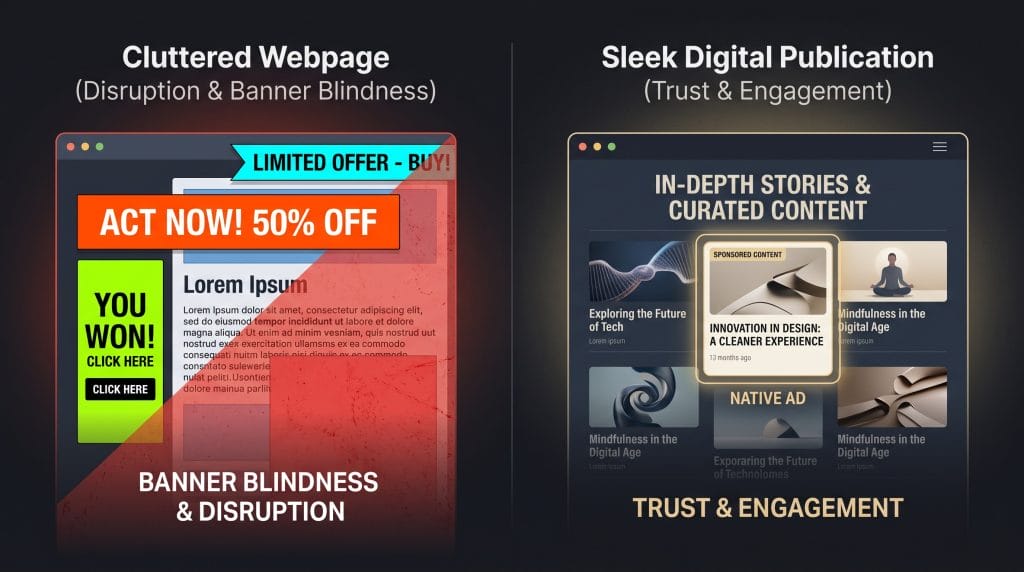
Modern web users have built a fast, automatic filter for online ads. If you buy ads or manage a brand budget in B2B, you already know standard banners are a tough sell. Pushing more money into display slots usually brings smaller returns while annoying the exact audience you want to reach.
Building real brand trust means stopping the intrusive pop-ups and banner flashes. Native advertising works because it sits inside what people are already reading, respects their time, and gives you room to make an actual point.
Banner blindness is not just a habit; it is how the human brain deals with screen clutter. Researchers coined the term in 1998 after eye-tracking studies showed that people skip right over anything on a webpage that looks like an ad.
When reading dense text, our brains run on limited bandwidth. We use selective attention to lock onto what we came for and tune out the rest. Standard display banners, with their flashing borders and giant "Click Here" buttons, trip that filter instantly.
When brands try to force attention with pop-ups or auto-playing video, passive filtering turns into active annoyance. Interrupting someone creates psychological reactance: people feel controlled and instinctively close the tab or block the element. Do that often enough, and users start associating your name with frustration.
Native ads work where standard banners fail because they match how people already read.
When a decision maker visits an industry site, they are there to learn something. Putting your message right in the main article feed fits that mindset. Instead of cutting off the reader, the ad becomes part of the reading list. People judge the content on its actual value rather than closing it on sight.
Native placements also borrow credibility from the host publication. Readers naturally trust established journals, and some of that trust carries over to the companies featured on the site. An informative piece in a respected trade publication builds authority far better than a side-banner ever will.
The mechanical differences between standard banners and native ads show up quickly in the numbers.
| Metric | Traditional Display Banners | Native Advertisements | Practical Impact |
| Average CTR | ~0.05% across industries | 0.20% – 0.38%+ | Native yields 4x to 8x higher click-through rates. |
| Visual Attention | Scanned and skipped immediately | Read like standard editorial content | Native gets 53% more visual attention than display. |
| Consumer Intent | Low intent, frequent accidental clicks | High intent, deliberate reading | Native attracts leads who actually want to read. |
| Brand Lift & Recall | Minimal passive awareness | 82% higher brand lift | Native leaves a lasting impression. |
| Time Spent | Under 1 second on average | 1.0 to 2.5+ minutes reading time | Native gives you time for real B2B storytelling. |
For B2B companies with long sales cycles, raw impression counts matter much less than engagement quality. A standard banner gets a split-second glance before someone scrolls past it. A native article gives you two or three minutes of undivided attention, giving you space to explain complex problems, share real customer outcomes, and offer a clear next step.
Shifting spend from display banners to native placements requires focusing on content value instead of pure ad volume. Here is how to make the transition work.
Retarget readers who finish the article with focused follow-up offers further down the line.
Most digital advertising advice still points businesses toward the same two places: Google search ads and Meta social feeds. For a long time that approach worked well enough, but those channels have gotten crowded, expensive, and harder to track. More importantly, people do not spend their whole day scrolling Facebook or searching for keywords. They stream TV through Hulu in the evening, listen to podcasts on their morning commute, read articles on niche trade sites, and use dozens of mobile apps. If your ads only live on search engines and social feeds, you are missing most of the places your audience actually spends time.
Work directly with reputable publishers or dedicated B2B native networks instead of relying only on programmatic open markets.
Look beyond basic clicks by tracking time on page, scroll depth, and resource downloads.
That gap is why Full Force Ads exists. Based in Utah, we built an independent advertising platform that lets companies buy ads across the entire web instead of renting space inside a couple of big tech silos.
The problem with relying entirely on traditional search and social comes down to three things:
Instead of managing campaigns through separate channels, our platform brings programmatic buying under one roof. That means an ad on a streaming TV app can trigger a follow-up display ad on a user's phone, followed by a sponsored article on a site they visit later, all managed through a single plan. Businesses can work with us directly as a fully managed agency partner or run campaigns themselves through our self-serve portal at FullForceAds.app.
An effective campaign touches prospects at different points in their day. We connect brands to audience inventory across six main formats:
| Format | Channel / Medium | Key Advantage & Application |
| Streaming TV (CTV / OTT) | Hulu, Roku, Fire TV | Places unskippable video ads on screens. Target specific households based on location, income, and interest rather than broad city-wide estimates. |
| Online Video | Websites & Mobile Apps | Delivers pre-roll and mid-roll video across millions of sites for higher recall than static images provide. |
| Digital Audio | Spotify, Pandora, Podcasts, Internet Radio | Reaches people during commutes, workouts, or work hours when they are not looking at a screen. |
| Mobile & Location-Based Media | Mobile Apps | Serves ads inside mobile apps based on real-world location context. |
| Display Banners | High-Authority Web Domains | Provides broad web reach and retargeting across high-authority websites to keep your business top of mind. |
| Native Advertising | News Sites & Industry Journals | Blends sponsored content into the design of news sites. Extra space makes native formats especially useful for complex B2B products or services. |
Reaching the right channels only matters if you are talking to the right people. We use five primary targeting methods to keep ad spend focused:
We keep campaign setups simple and do not lock clients into long-term contracts or massive minimum spend commitments. Most campaigns launch within 5 to 7 business days:
Whether you need a dedicated team to manage media buying end-to-end or prefer hands-on control using FullForceAds.app, Full Force Ads gives you the tools to run targeted campaigns wherever your customers spend their time.