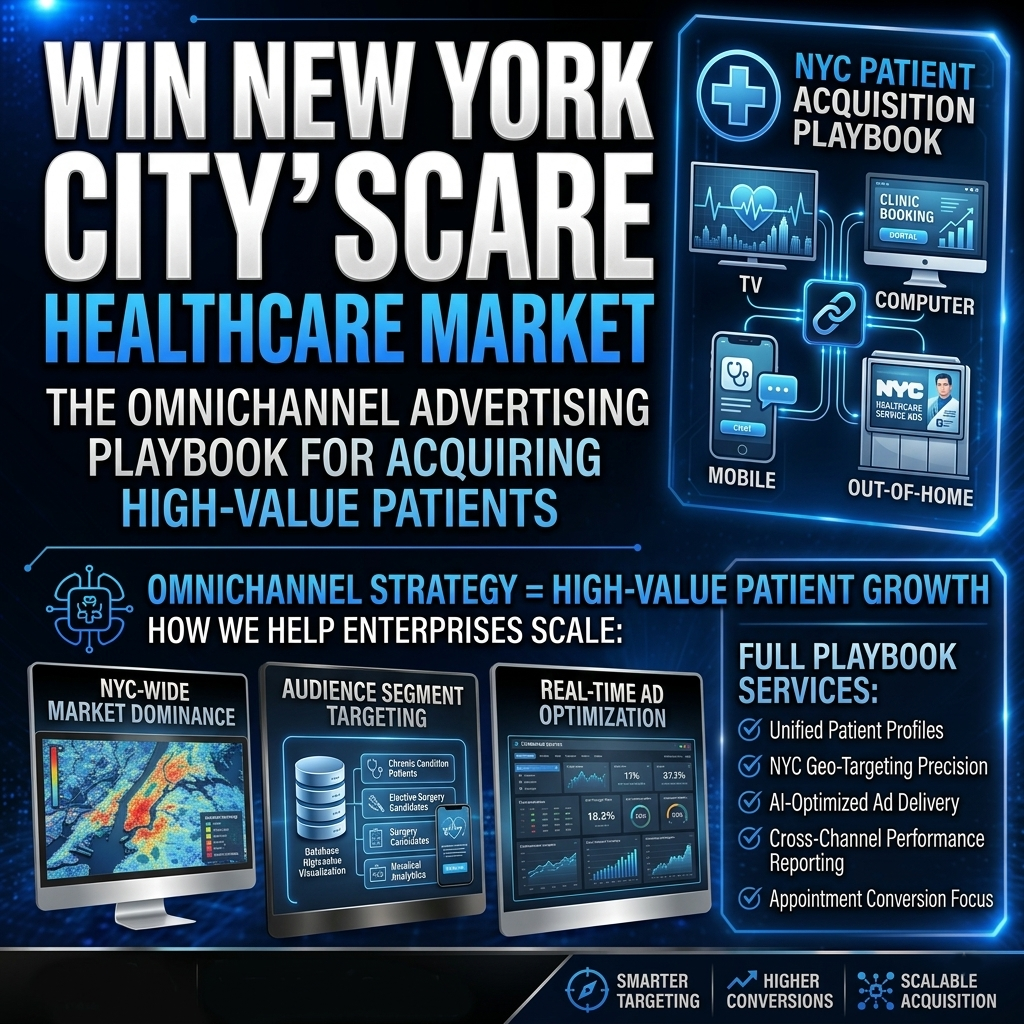
Few markets are harder to win patients in than New York City. An Upper East Side surgical practice, a Brooklyn urgent care network, a Soho wellness center, and a clinic expanding across Long Island are all competing for attention from the same pool of mobile, well-informed, hard-to-reach residents. Precision matters more here than almost anywhere.
Standard digital tactics don't cut it in a city where millions of affluent, skeptical, mobile-first consumers weigh health decisions every day. Healthcare executives, practice administrators, and marketing directors in NYC are dealing with rising acquisition costs, crowded geographic corridors, strict privacy rules, and an audience that jumps between screens all day long.
Capturing share and driving steady patient volume this season takes more than another set of scattered campaigns. What you actually need isn't more ad accounts to babysit. It's one media engine built for tight, multi-screen targeting.
This guide walks through how NYC healthcare organizations can use independent, multi-screen programmatic technology, run through Full Force Ads, to reach and convert high-value patients at the moment their care needs come up.
A New York patient's path to booking is rarely a straight line. Someone weighing orthopedic care, elective cosmetic surgery, functional medicine, or a premium dental service almost never converts on the first touch.
Picture a typical day. On the morning commute, they stream a podcast on the L train from Williamsburg into Manhattan. At lunch in Midtown, they read a lifestyle or finance article on their phone or laptop. That evening, they wind down with Roku, Fire TV, or Hulu in a Park Slope apartment.
                                  [ THE MODERN NYC PATIENT JOURNEY ]
                                                  │
          ┌───────────────────────────────────────┼───────────────────────────────────────┐
          ▼                                       ▼                                       ▼
  [ Morning Commute ]                     [ Afternoon Desk ]                     [ Evening Living Room ]
Digital Audio / Podcasts                  Mobile Web / Display                     Streaming TV / CTV
(Targeted Local Messaging)               (Search/Site Retargeting)                 (High-Impact Brand Video)
          │                                       │                                       │
          └───────────────────────────────────────┼───────────────────────────────────────┘
                                                  ▼
                                 [ High-Intent Conversion / Booking ]
Rely on one channel or a couple of isolated ad formats and the thread snaps. A phone impression in the morning has nothing to do with what that same person sees on their TV that night, so the message never compounds.
To move people from awareness to a booked appointment, you need a presence that follows them across screens. Running unified programmatic through Full Force Ads gives a practice control over the whole media mix: streaming TV spots people can't skip, clean digital audio, mobile placements, and native content, all from one partner instead of five.
For years, healthcare marketers were stuck with rigid inventory or oversaturated ad platforms. Growth now depends on running your own media: transparent reporting, budgets you can move, and optimization across channels without being locked into one vendor.
Juggling separate platforms creates friction, breaks your frequency capping, and splinters your patient data. Put CTV, digital audio, mobile, display, and native under one roof and budget can shift to whatever is working that week, in real time.
If a prospective patient sees your urgent care ad ten times on display and never once on video or audio, you paid for repetition, not persuasion. Managing every channel in one system lets you cap frequency across the whole household, from the living room TV to the phone in someone's hand.
Healthcare leaders can't work off a black box. Full Force Ads shows you where every dollar went: which streaming apps served your CTV spots, which ZIP codes or households converted, and how retargeting turned into online bookings.
To reach patients across the five boroughs and the surrounding suburbs, a campaign has to show up wherever attention already is. Here's how each of the six core channels earns its place.
┌────────────────────────────────────────────────────────────────────────────────────────────────────────┐
│                                   FULL FORCE ADS OMNICHANNEL SUITE                                     │
├──────────────────┬──────────────────┬──────────────────┬──────────────────┬──────────────────┬─────────┤
│   STREAMING TV   │      VIDEO       │      AUDIO       │      MOBILE      │     DISPLAY      │ NATIVE  │
│    (CTV/OTT)     │    (Pre-Roll)    │  (Podcasts/App)  │ (Location/App)   │  (High-Impact)   │ (Feed)  │
└──────────────────┴──────────────────┴──────────────────┴──────────────────┴──────────────────┴─────────┘Connected TV isn't just for national brands with eight-figure budgets anymore. For a specialty clinic, fertility center, or concierge group, it delivers the credibility of TV with the targeting of digital. Full Force Ads runs 15- and 30-second spots you can't skip on Roku, Fire TV, Hulu, and major smart TV platforms. A Manhattan cosmetic surgery practice can serve those spots only to households earning above $250,000 in ZIP codes like 10021, 10075, and 10028, so you're not paying to reach people who will never book.
Streaming TV owns the living room. Digital video catches high-intent users everywhere else: desktops, tablets, and mobile web. Pre-roll, mid-roll, and outstream placements sit inside high-traffic publisher sites, local news, and health portals. An orthopedic center in Queens can run a 15-second pre-roll on minimally invasive joint replacement to people reading wellness articles or local sports coverage.
New Yorkers spend hours commuting, walking, and running in Central Park, Prospect Park, and along the Hudson River Greenway. Audio reaches them when visual ads can't. Non-skippable spots run on Spotify, Pandora, podcast networks, and live digital radio. A therapy group can air a calm 15-second message to financial district professionals during their morning stream and drive them straight to a mobile booking page.
Mobile is where New York searches for care. People use their phones to find same-day appointments, schedule follow-ups, and locate the nearest clinic. Full Force Ads runs in-app, mobile web, and location-based ads. A Brooklyn urgent care network can trigger a mobile ad the moment someone steps inside a defined perimeter, like a competing clinic, a transit hub, or a large residential complex.
Display is the workhorse for brand recall and retargeting. Standard and rich-media banners run across millions of verified sites and apps. For a regional health system or a multi-location dental practice, it keeps CPMs efficient and keeps your name in front of people between the bigger touchpoints.
Native ads match the look and rhythm of the articles around them, which is why they tend to earn more engagement than a standard banner. They run as in-feed recommendations and integrated article placements on news, lifestyle, and health publications. A cardiology clinic can publish a piece like "5 warning signs of cardiovascular fatigue you shouldn't ignore," earn some trust, then invite readers into an online risk assessment.
Where your ad runs is half the job. Who sees it decides your return. Full Force Ads adds targeting on top of every channel so budget doesn't leak.
| Targeting layer | What it does |
|---|---|
| Geofencing | Draws a physical perimeter around competitors, hospitals, events, and venues |
| Addressable household | Matches your patient or CRM address list to every screen in those homes |
| Site retargeting | Re-engages website visitors who left without booking |
| Search retargeting | Reaches people actively searching for specific treatments or conditions |
| Contextual alignment | Places ads next to relevant health, wellness, and lifestyle content |
Geofencing lets you draw a virtual boundary around a real location, down to a few meters. When someone enters, their mobile device ID is captured anonymously so you can advertise to them afterward across their screens.
Three ways this works well in NYC. Conquest competitors by mapping busy urgent care facilities, rival private practices, or crowded hospital waiting rooms. Target intent by fencing athletic clubs, marathon finish lines, and studios like Equinox or Barry's, which is ideal for physical therapy, sports medicine, and chiropractic. And fence medical conferences, health expos, and community wellness events to reach patients and providers at once.
If you already have a database of past patients, dormant leads, or target households, addressable targeting matches those street addresses to IP addresses and household device graphs. You upload your list of NYC addresses, and Full Force Ads serves streaming TV, mobile display, and audio to the devices in those homes, with match rates north of 90%, skipping everyone else.
Site retargeting needs a prior visit. Search retargeting doesn't. It reaches people who searched a keyword anywhere on the web before they ever find you. Someone who searches "best LASIK surgeon near me" or "pediatric dentist Upper East Side" can see your video, audio, or native ad later that day while they browse.
Most first-time visitors to a medical practice site leave without booking or calling, often around 95% of them. Site retargeting keeps you in front of them as they move on. Segment by the page they viewed, say knee replacement versus shoulder surgery, and serve creative that answers that exact question.
Put your message beside content that matches your specialty. A neurology center's ads can sit next to coverage of sleep disorders, migraines, or brain health, so your specialists show up right where the reader is already thinking about the problem.
Different seasons pull different demand in New York. Spring and summer bring elective procedures, allergy care, and sports medicine. Fall and winter bring urgent care, flu prevention, pediatric visits, and the year-end rush to use up insurance deductibles.
Here's how to mix channels and targeting against a specific goal.
| Goal | Channel mix | Targeting | What to expect |
|---|---|---|---|
| Local awareness | Display, mobile, native | Geofencing (ZIP/neighborhood) plus contextual | Owns local attention within 3 to 5 miles of the clinic |
| Conquesting competitors | Geofencing, mobile, display | Fences around competitor clinics | Catches patients looking for shorter waits or better care |
| Brand building | Streaming TV, video, audio | Addressable household plus income filters | Builds credibility with affluent households |
| Immediate bookings | Search retargeting, display, native | High-intent keywords plus in-market filters | Turns active searchers into booked consults |
| Deductible re-engagement | Site retargeting, addressable, mobile | Past-patient CRM lists plus page-level retargeting | Reactivates dormant patients for year-end procedures |
Here's how the pieces fit together for a multi-location specialty group in the NYC metro.
The goal: lift surgical consultation bookings for spine and joint care by 30% over a 90-day seasonal push. The target area covers Manhattan (Midtown, Financial District, Upper West Side) and inner Brooklyn (DUMBO, Williamsburg).
                  ┌─────────────────────────────────────────────────────────────┐
                  │                 MIDTOWN ORTHOPEDICS CAMPAIGN                │
                  └──────────────────────────────┬──────────────────────────────┘
                                                 │
            ┌────────────────────────────────────┼────────────────────────────────────┐
            ▼                                    ▼                                    ▼
   [ STEP 1: AWARENESS ]               [ STEP 2: INTERCEPTION ]              [ STEP 3: CONVERSION ]
 Streaming TV (Hulu, Roku)              Geofencing (Gyms/Clinics)            Search & Site Retargeting
 Broadcast 30-sec Video Spot            In-App Mobile Banner Ads             Dynamic Display & Native Ads
 Household Income > $200k               Active Athletic Venues               Delivers Online Booking Page
Top of funnel: a 30-second spot runs on Hulu and Roku to households earning over $200,000 in the target ZIP codes, with 15-second audio on Spotify during the morning commute pointing to minimally invasive options.
Middle of funnel: geofences go up around top fitness facilities, physical therapy clinics, and competing outpatient centers, with mobile ads offering a free initial video consult.
Bottom of funnel: anyone who searched joint-pain remedies or visited the site without booking gets display and native ads with patient testimonials and a "Book now" calendar link.
The result the practice is after: a lower cost per acquisition and a steady, high-margin flow of consults through the seasonal push, instead of the boom-and-bust of a single channel.
Healthcare organizations are structured differently, so Full Force Ads works both ways.
If you want it handled, our strategists build the channel mix, set up the geofences, run ad operations, and optimize daily against live response data.
If your team wants the controls, FullForceAds.app gives them direct access. Upload creative across CTV, video, audio, mobile, and display in minutes. Draw geofences right on a map of the city. Watch live metrics with full reporting. Adjust daily budgets and bids on the fly.
Either way, you keep your media independence and skip the legacy channel markups.
Traditional ad buying drags on for weeks of contracts, publisher approvals, and creative reformatting. Full Force Ads gets a multi-channel campaign live in 5 to 7 business days.
┌────────────────────────────────────────────────────────────────────────────────────────────────────────┐
│                                     THE 4-STEP LAUNCH FRAMEWORK                                        │
├───────────────────┬───────────────────┬───────────────────┬────────────────────────────────────────┤
│ STEP 1            │ STEP 2            │ STEP 3            │ STEP 4                                 │
│ Discovery Call    │ Strategy Plan     │ Campaign Launch   │ Optimize & Scale                       │
│ (Goals & Scope)   │ (Channel Mix/Geos)│ (Live in 5-7 Days)│ (Weekly Reporting & Real-time Bidding) │
└───────────────────┴───────────────────┴───────────────────┴────────────────────────────────────────┘New York's healthcare market rewards speed, better tech, and a clear message. Old ad tactics leave you exposed to aggressive regional competitors and the urgent care networks opening on every other block.
A multi-screen campaign lets your clinic show up across every borough, reach patients on every device, and build a patient pipeline you can actually predict.
Ready to put streaming TV, video, audio, mobile, display, and native to work? Book a demo with Full Force Ads, or log in to FullForceAds.app and launch your next campaign.