Beyond the walled gardens: How enterprise brands win with full-funnel omnichannel programmatic advertising
Traditional digital advertising is fundamentally broken for brands looking to scale past search and social. For over a decade, marketing teams have been funneled into a simple binary: dump budget into social feeds or deposit it into search engines.
As acquisition costs rise, ad blockers multiply, and privacy updates break third-party tracking, relying entirely on closed networks—often called "walled gardens"—is a risky, expensive strategy.
To build sustainable revenue today, you need to reach people wherever they spend time online. That means delivering targeted messages across Connected TV (CTV), digital audio, mobile apps, native placements, display, and online video.
Full Force Ads, an agency headquartered in Utah, offers an alternative. Operating an independent omnichannel programmatic engine, Full Force Ads helps brands break away from walled-garden dependency, cut acquisition costs, and reach high-intent audiences on any screen.
Part 1: The walled garden trap and the independent programmatic advantage
Look at how people actually consume media on a typical day:
If your advertising strategy stops at social feeds and search results, you miss more than 70% of your audience's screen time.
+-----------------------------------------------------------------------+
| THE DAILY DIGITAL CONSUMPTION CYCLE |
+-----------------------------------------------------------------------+
| Morning | Mid-Day | Late Afternoon | Evening |
| Streaming TV / | Mobile Web & Apps | Digital Audio | Connected TV |
| Digital Audio | Display / Native | Podcasts | Premium Video |
+-----------------------------------------------------------------------+
| [ Full Force Ads Unified Programmatic Coverage Across Every Touchpoint ] |
+-----------------------------------------------------------------------+
The limits of platform-centric ads
Social platforms and search engines operate as closed ecosystems. They price their own inventory, grade their own homework on performance metrics, and restrict data export. As more competitors bid on the same ad units, CPMs and CPCs naturally rise.
These closed models also waste money through poor targeting. Relying on broad platform demographics means you often pay for impressions served to bots, click farms, or people outside your actual service area.
Tracking gaps compound the problem. When every vendor operates in a silo, every platform claims credit for the same conversion. You end up double-counting ROI without knowing which touchpoint actually moved the needle.
The Full Force Ads model
Full Force Ads takes a different route. Instead of acting as a broker for public ad exchanges or relying on social networks, Full Force Ads runs an independent, multi-channel programmatic system built for full-funnel reach.
By unifying ad inventory across millions of websites, mobile apps, CTV platforms, and audio streaming services, Full Force Ads lets brands manage frequency-capped, cross-device campaigns from a single dashboard.
For mid-market and enterprise teams that want hands-on control, the company also operates FullForceAds.app, a self-serve platform giving internal marketing teams direct access to programmatic inventory, real-time bidding, and custom audience filters.
Part 2: Channel activation: Reaching audiences on every screen
A solid programmatic setup requires two things: access to good ad placements and precise audience data.
Full Force Ads distributes campaign messaging through six primary media channels:
                      FULL FORCE ADS
               OMNICHANNEL INFRASTRUCTURE
                            |
   +------------------------+------------------------+
   |                                                 |
[ MEDIA CHANNELS ] [ TARGETING ENGINE ]
• Streaming TV (CTV) • Geofencing
• High-Impact Video • Addressable Household
• Digital Audio • Site Retargeting
• Mobile In-App & Web • Search Retargeting
• Display & Banners • Contextual Alignment
• Native Content
Living room TVs remain the most prominent screen in the house. Connected TV brings the sight and sound of classic television together with the digital targeting of online ads.
Full Force Ads puts your brand on TV screens through targeted, unskippable spots across platforms like Roku, Fire TV, Hulu, Pluto TV, Tubi, and major network apps.
Video captures attention through sight, sound, and movement. Full Force Ads places pre-roll, mid-roll, and outstream video across verified publishers, news portals, and mobile video environments.
Interactive overlays and brand-safety filters keep video placements focused on engagement rather than passive scrolling.
Screen fatigue is real. Millions of potential customers spend hours listening to audio while driving, exercising, cooking, or working.
Full Force Ads reaches these listeners on Spotify, Pandora, iHeartRadio, top podcast networks, and digital radio. Audio ads drive high recall because they reach people in quiet, focused moments when they are actively listening.
Phones are the main screen most people interact with all day. Full Force Ads delivers messages directly inside the mobile apps and sites your audience opens dozens of times a day.
Using location data, SDK integrations, and device mapping, mobile campaigns deliver timely ads based on real-time location and activity.
Banner ads offer a practical way to maintain visual touchpoints and run retargeting sequences. Full Force Ads places display units across major news sites, trade publications, and regional media outlets.
Dynamic creative optimization (DCO) adjusts banner creative on the fly based on viewer location, weather, past site visits, or recent searches.
Most users ignore standard banner shapes. Native ads bypass this by matching the typography, design, and layout of the site hosting them.
Hosted through Full Force Ads, native units look like sponsored articles, recommended readings, or integrated content cards. They earn higher click-through rates and work well for educational content, product breakdowns, and long-form storytelling.
Part 3: Precise targeting solutions: Reaching the right people
Placing an ad on a good site only works if the right person sees it. The targeting layers available through Full Force Ads help cut wasted spend by focusing impressions on people with real buying intent.
| Targeting Solution | Ideal Use Case | Strategic Mechanism |
| Geofencing | Conquesting competitors, targeting events, localized foot traffic | Traces physical polygon perimeters around real-world locations to capture mobile device IDs |
| Addressable Household | Account-based marketing (ABM), direct mail amplification | Matches street address lists to household IP networks across all connected devices |
| Site Retargeting | Re-engaging warm leads, lower-funnel conversion optimization | Serves dynamic ads across all channels to users who left your site without purchasing |
| Search Retargeting | Capturing active demand, upper-funnel intent capture | Reaches users across the open web who recently searched for industry keywords |
| Contextual Targeting | Privacy-first brand alignment, niche B2B/B2C outreach | Matches ads in real-time to the page content, article topic, and sentiment being read |
Geofencing: Turning physical locations into digital audiences
Geofencing is one of the most useful options in modern programmatic ad buying. Instead of broad zip-code boundaries that waste money on non-prospects, Full Force Ads draws precise digital perimeters around specific physical locations.
Addressable advertising: Connecting offline data to digital ads
If you have a customer address list, a direct mail database, or a target account list, addressable targeting bridges your offline data to digital media.
Full Force Ads matches physical address lists against location-graph data to identify household IP networks and connected devices at those locations.
Search retargeting: Reaching active searchers across the web
Standard search ads only reach people while they are on a search engine page. Search retargeting extends that reach across the rest of the web.
Full Force Ads tracks keywords people search across thousands of independent search bars and sites. When someone searches for terms related to your products, Full Force Ads tags that user and serves your video, display, or native ads as they keep browsing other sites. You reach active search intent without paying high pay-per-click rates on search engines.
Site retargeting: Converting warm website traffic
Over 90% of first-time site visitors leave without taking action. Site retargeting keeps your brand in front of those prospects as they browse elsewhere.
A light tracking tag on your site builds custom retargeting pools based on user actions (such as viewing a specific product page, abandoning a cart, or reading an article). Custom retargeting ads then nudge those visitors back to finish what they started.
Contextual targeting: Content-matched privacy-first advertising
With third-party tracking fading, contextual targeting provides a reliable alternative. Full Force Ads uses natural language processing to read and categorize page content in real time.
If someone is reading an article about fleet management software, Full Force Ads can serve your logistics software ad on that exact page—giving you contextually relevant placement without relying on personal tracking profiles.
Part 4: Strategy frameworks: Common campaign scenarios
Here is how omnichannel campaigns look when applied to three common business situations.
+-----------------------------------------------------------------------------------------+
| CROSS-CHANNEL STRATEGY MATRIX |
+-----------------------------------------------------------------------------------------+
| PRIMARY GOAL | RECOMMENDED CHANNEL & TARGETING MIX |
+----------------------------+------------------------------------------------------------+
| Conquest Competitors | Geofencing + Addressable Household + Mobile Display |
| Local Foot Traffic | Geofencing + Display + Mobile Location-Based |
| National Brand Authority | Streaming TV + High-Impact Video + Audio |
| Drive Qualified Web Traffic| Display + Native Content + Search Retargeting |
| Direct Mail Digital Boost | Addressable Household + Streaming TV + Native |
+-----------------------------------------------------------------------------------------+
Scenario A: A local service business looking to win market share from competitors
The Challenge: A multi-location business wants to win customers from local competitors and drive visits to its showrooms.
The Strategy: A combined Geofencing and Mobile campaign.
Digital polygon fences go around competitor locations and busy commercial areas. Mobile devices entering those zones receive localized display ads offering incentives to visit the client's showroom. Addressable geofencing then targets nearby neighborhoods matching household income criteria with CTV ads. Foot-traffic attribution tracks how many tagged users later visit the showroom in person.
Scenario B: A B2B company scaling account-based marketing (ABM)
The Challenge: A software company has a target list of 5,000 corporate accounts. Email open rates are falling, and social ads are producing weak leads.
The Strategy: An Addressable + Search Retargeting campaign.
The company uploads its corporate address list into Full Force Ads. Addressable mapping targets corporate headquarters and employee residential locations with CTV and native ads aimed at decision-makers. Search retargeting targets people searching for industry pain points across trade publications. Prospects who visit the site to download a whitepaper enter a site retargeting pool to receive follow-up video ads throughout their evaluation cycle.
Scenario C: An e-commerce brand building national awareness
The Challenge: A direct-to-consumer brand wants national visibility, podcast reach, and intent-driven traffic without relying entirely on social media algorithms.
The Strategy: A multi-channel mix of Streaming TV, Audio, and Native placements.
30-second commercial spots run on Hulu and Roku for broad household reach. Companion audio ads air on Spotify and podcast networks during key hours of the day. Native articles run on digital lifestyle magazines to explain product benefits, while search retargeting catches people reading product reviews and directs them straight to custom landing pages.
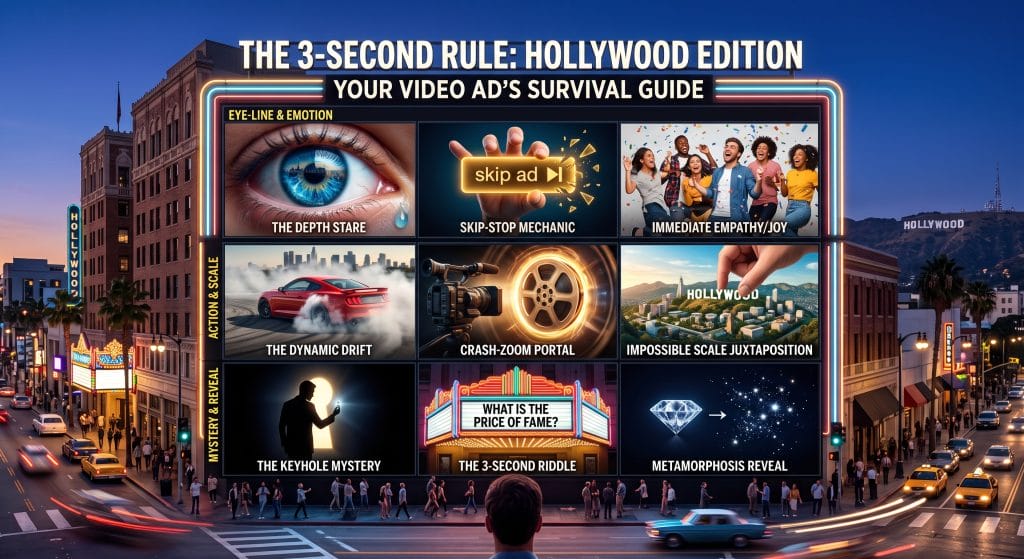
Part 5: The first 3 seconds: Retaining viewer attention in video ads
Even the best targeting setup won't save a campaign if your video creative fails to hold attention.
In competitive video markets, viewers decide whether to skip or ignore an ad within the first three seconds.
+-------------------------------------------------------------------------+
| THE 3-SECOND VISUAL ATTENTION TIMELINE |
+-------------------------------------------------------------------------+
| Second 0:01 | Second 0:02 | Second 0:03 |
| HIGH-CONTRAST ACTION | TEXT OVERLAY + BRAND | PATTERN BREAK / HOOK |
| Immediate Movement | Immediate Context | Emotional / Visual Twist|
+-------------------------------------------------------------------------+
| RESULT: User Attention Retained Past The Skip Window |
+-------------------------------------------------------------------------+
To keep viewers watching past the skip button on CTV, pre-roll, and mobile video, structure the first three seconds around clear visual hooks:
People automatically tune out predictable ad formats. If your video opens with a slow fade-in, a static logo, or a quiet landscape, viewers tune out immediately. Start instead in the middle of movement or action, use rapid camera movement, or open with an unexpected visual angle.
Over 60% of mobile video ads are watched with the sound turned off. If your video needs audio to make sense, most mobile viewers will miss the point. Burn bold typography directly onto the screen in the first second so viewers get the core message right away, even on mute. High contrast and bright color grading also help the video pop against app feeds.
Human eyes automatically gravitate toward faces. Putting a face with an authentic expression (surprise, intense curiosity, genuine excitement) in the opening frame increases retention. Skip the staged stock-photo smiles; natural reactions hold attention much better.
Programmatic tools allow for dynamic creative tweaks. Including local details in the frame within three seconds—like a city name, regional landmark, or weather reference—tells the viewer the message is relevant to them.
Part 6: Operating with Full Force Ads
Full Force Ads combines inventory access, targeting tools, and campaign management into one operational workflow.
+-----------------------------------------------------------------------+
| FULL FORCE ADS PARTNERSHIP VALUE |
+-----------------------------------------------------------------------+
| Single Partner Simplicity | Execute Streaming TV, Audio, Mobile, |
| | Display, and Native from one platform. |
+---------------------------+-------------------------------------------+
| Advanced Targeting Engine | Geofencing, Addressable, Retargeting, and |
| | Contextual strategies included. |
+---------------------------+-------------------------------------------+
| Transparent Analytics | Detailed weekly reporting; know exactly |
| | where every dollar is spent. |
+---------------------------+-------------------------------------------+
| Agility & Speed | Launch fully optimized campaigns in days, |
| | without long-term lock-in contracts. |
+-----------------------------------------------------------------------+
One point of contact across channels
Managing separate vendors for TV, search, audio, and display leads to extra admin, disjointed messaging, and messy reporting. Full Force Ads combines planning, buying, creative delivery, and optimization into a single strategy.
Clear performance reporting
Many ad networks hide actual media costs inside bundled prices, making it hard to see true CPMs, vendor markups, or placement quality.
Full Force Ads provides clear reporting. Weekly performance updates show where your ads ran (by site, device, and channel), who saw them, how viewers interacted, and what sales or leads resulted.
Flexible spend without long contracts
Campaigns need room to adjust. Full Force Ads avoids high spend minimums and long-term contracts. You can test channels, adjust targeting parameters, shift budgets toward what works, and reallocate capital between channels in real time.
Quick campaign launches
Onboarding shouldn't take months. While traditional agencies take weeks to get organized, campaigns with Full Force Ads launch in five to seven business days.
Part 7: The onboarding process
Getting started with Full Force Ads follows four straightforward steps:
We discuss your business model, customer lifetime value, target territory, demographics, and sales goals to evaluate growth opportunities together.
Our team builds a channel mix (Streaming TV, Audio, Mobile, Display, Native) and targeting plan (Geofencing, Addressable, Retargeting) built around your goals and budget.
Once creative assets are ready, we configure bidding strategies, upload target parameters, and launch your ads across selected networks. Campaigns go live within 5 to 7 business days.
Your campaign manager tracks performance daily, adjusting bid prices, creative variations, and placements. Weekly reports give you clear visibility into performance and ROI.
Frequently asked questions
What makes Full Force Ads different from traditional agencies?
Full Force Ads focuses on independent programmatic execution across the open web, Connected TV, audio, mobile, and display. Instead of staying trapped inside search engines and social networks, we give businesses access to precise targeting tools (like geofencing, addressable mapping, and search retargeting) without hidden markups or closed-network restrictions.
How does FullForceAds.app complement fully managed services?
Our agency team provides full-service planning, creative execution, and campaign optimization. FullForceAds.app provides a self-serve platform for in-house teams, media buyers, and agencies that want direct control over programmatic bidding, setups, and targeting rules.
How precise is geofencing?
Geofencing uses location data to draw custom digital boundaries around physical buildings, such as competitor storefronts, trade show venues, or dealerships. Devices inside those boundaries are tagged for targeted ads across apps and websites, offering far higher accuracy than broad zip-code targeting.
How does addressable targeting match direct mail lists to digital ads?
Our addressable system matches physical street addresses against location-graph data and IP networks. This lets us serve CTV spots, mobile ads, and display units directly to devices linked to those specific households.
Can small or mid-sized businesses afford Streaming TV ads?
Yes. Unlike traditional broadcast TV that requires buying entire regional cable markets, programmatic Streaming TV lets you buy ads on a per-household basis. You pay only to reach targeted households in your service area, making CTV practical for growing businesses.
Transform your digital advertising strategy
Relying entirely on crowded social feeds and expensive search platforms limits how far your brand can grow. To lower acquisition costs and expand your reach, you need to show up everywhere your audience spends time online.
Whether you want to conquest local competitors with geofencing, run unskippable CTV ads, reach customer lists through addressable targeting, or manage your own programmatic buys via FullForceAds.app, Full Force Ads provides the channels, technology, and team to execute.
Take control of your media strategy, stop wasting ad spend, and reach your audience across every screen.
Ready to scale your reach?
Visit Full Force Ads Advertising Solutions today to schedule your discovery call and get started.