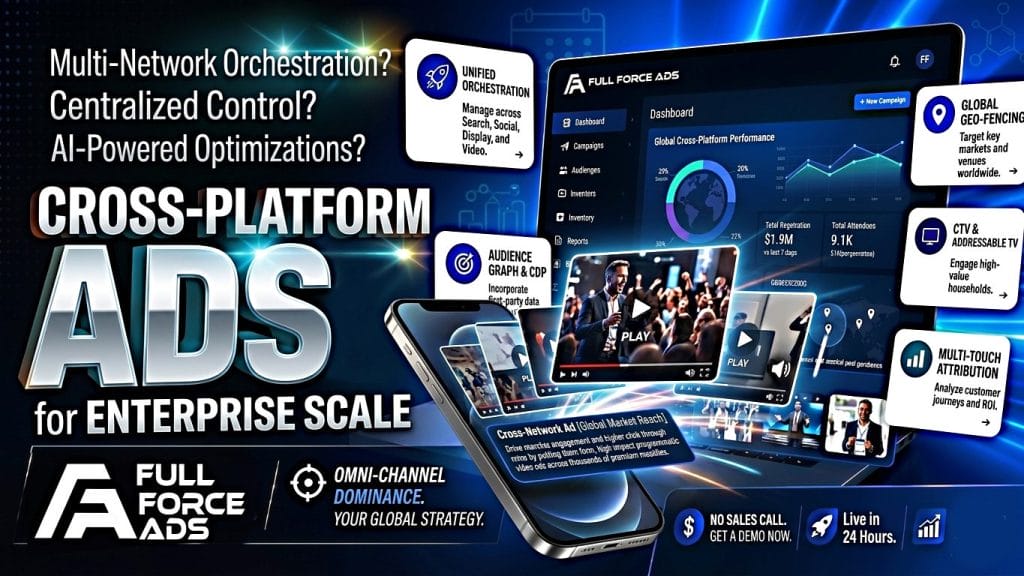
Consumers move across digital environments constantly. In a single morning, a prospect might listen to a podcast on Spotify, read local news on a mobile app, browse industry content during lunch, and stream a documentary on Hulu at night.
Mid-market enterprises run into friction here. Siloed search budgets and uncoordinated social campaigns can't follow buyers across those platforms. Disconnected vendors dilute messaging, trap data in separate systems, and waste money on metrics that don't connect to revenue.
The answer is replacing isolated media buying with unified multi-screen targeting — programmatic systems, physical-to-digital targeting, and structured creative testing working together to build predictable pipelines.
Rather than buying a blanket slot on a cable channel, you can target specific household profiles — B2B decision-makers, families in certain income brackets — regardless of the streaming app they're watching. This combines the storytelling power of video with digital measurement.
While CTV handles the home television, digital video captures attention on desktops, tablets, and phones. Pre-roll, mid-roll, and outstream placements within editorial articles maintain narrative continuity across sessions. Hook the viewer in the first three seconds, state the value proposition, and establish brand identity before they scroll.
Consumers spend hours away from screens — commuting, working out, cooking. Programmatic audio places messages directly into headphones on Spotify, iHeartRadio, and podcast networks. There's no visual competition, which drives stronger message retention.
Smartphones go wherever users go. Mobile campaigns engage users inside in-app ecosystems and location-aware apps, serving ads based on browsing behavior and real-time location to drive action when it's most relevant.
Banner ads across websites provide cost-effective reach and frequency control. Display keeps your brand visible as users browse so you stay in consideration when they decide to buy.
Native ads match the visual form of the host website and appear within content feeds and news streams. Because they blend with editorial articles, they sidestep banner blindness and achieve higher click-through rates for technical or high-consideration products.
| Targeting method | Core mechanism | Primary use case |
| Geofencing | Virtual perimeter mapping via mobile GPS signals. | Competitor conquesting, live events, retail interception. |
| Addressable | Offline CRM data matched to household IP networks. | Account-based marketing, direct-mail matching. |
| Site retargeting | Pixel tracking based on lower-funnel site behaviors. | Cart recovery, lead nurturing. |
| Search retargeting | Keyword intent capture outside of traditional search pages. | Capturing active intent at lower cost-per-click. |
| Contextual | Page-level metadata and natural language analysis. | Cookie-less alignment with niche industry verticals. |
Drawing custom perimeters around competitor storefronts, trade shows, or target neighborhoods isolates the mobile devices entering those boundaries. Once a device enters, the platform captures its advertising ID and can serve targeted ads during the visit or for up to 30 days after.
Competitor conquesting example: A commercial equipment manufacturer maps geofences around competitor showrooms. When procurement officers walk those lots, their devices are tagged. For the next three weeks, those prospects see video ads highlighting the manufacturer's faster delivery timelines — reaching buyers during active evaluation.
Upload a CRM list of addresses and the platform matches them to household IP networks, letting you serve ads across every connected device in that home or office. This bypasses changing IP addresses and mirrors your offline accounts or direct mail lists.
Most first-time visitors leave without converting. Site retargeting segments them by behavior. A casual homepage visitor gets a broad brand ad. A prospect who visited your pricing page or abandoned a cart gets a testimonial or a direct offer.
Top-tier keywords in traditional search results are expensive. Search retargeting tracks the terms users enter across e-commerce portals and research directories, then targets those people with display, video, or native ads after they leave the search engine — at a fraction of the cost-per-click.
Contextual targeting analyzes page metadata and content to place ads alongside relevant articles, matching the user's current mindset without relying on cookies.
Enterprise buying decisions go through committees with long, risk-averse processes. Adjust creative assets to address specific friction points as the deal progresses through stages.
Early-stage ads should focus on the costs of operational stagnation rather than product features — use native and video placements to highlight common industry inefficiencies. As prospects move into evaluation, shift to third-party validation: case studies, industry reports, and clear ROI metrics to reduce perceived risk. Final-stage creative should focus on ease of onboarding, implementation support, and smooth integrations to remove the last objection.
Sales teams can use this same asset library as pre-call warm-up material, sending case study videos and explainers before calls to improve connection rates.
To build a predictable acquisition system, test one variable at a time.
Identify the visual format that drives the highest baseline attention. Run identical audience targeting and copy across three formats — a 15-second explainer video, a minimal dynamic display banner, and a text-integrated native card. Once you have a reliable sample, lock in the winner by cost-per-acquisition and retire the others.
Using the winning format, run three message angles against each other:
Keep the winning visual and message angle, then test variations on supporting text and the CTA button — "Schedule a Demo" versus "Get a Custom Plan" — to optimize conversion rate.
Closed ad ecosystems hide where your ads actually appear, exposing brands to low-quality mobile apps and clickbait domains. These platforms bundle performance metrics in ways that mask the fact that reported clicks often come from accidental mobile taps rather than real buyers.
To protect spend, use programmatic campaigns with unfiltered reporting data. That means domain-level audits showing exactly which websites, podcasts, or streaming apps hosted your ads; device-level breakdowns isolating performance differences between CTV, mobile, and desktop; geographic cohort analysis by ZIP code; and frequency capping to prevent prospect oversaturation.
Consolidating media buying into a transparent, multi-layered programmatic platform cuts waste and builds long-term scale. To see how a unified strategy applies to your business, visit Full Force Ads Custom Advertising Solutions to schedule a discovery session.