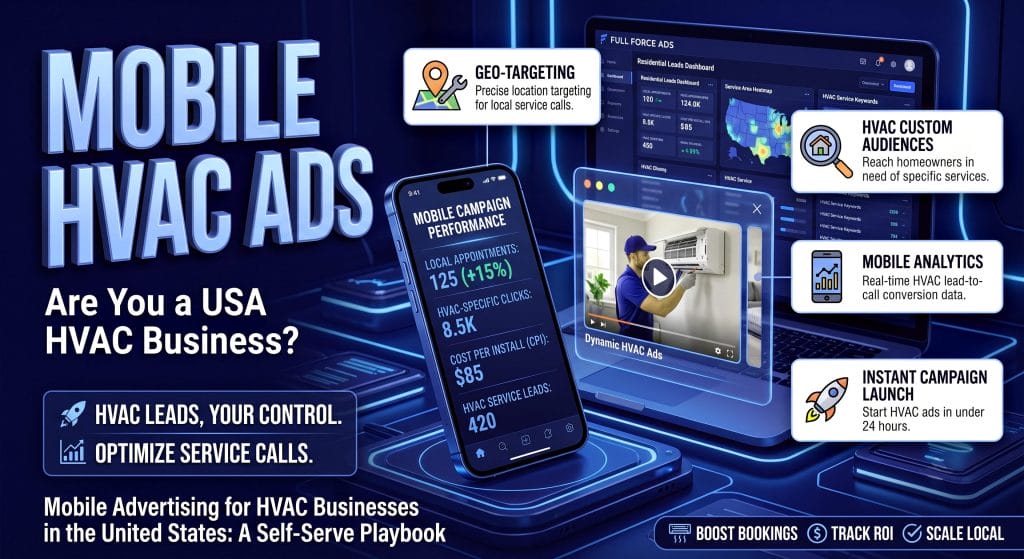
When the thermostat swings, so does the demand for heating, ventilation, and air-conditioning services. In a market that's as seasonal as it is competitive, HVAC contractors need a fast, flexible, and measurable way to reach homeowners right where they spend the most time — on their mobile devices.
This guide walks you through a self-serve mobile advertising strategy built for the U.S. market, with practical steps, compliance checkpoints, and a proven launch framework from FullForceAds.com.
| Statistic (2024) | What It Means for HVAC |
| 71% of U.S. adults own a smartphone; 54% are "mobile-first" internet users. | Your audience is already on the phone, scrolling between videos, social feeds, and local search results. |
| 68% of local service searches end in a phone call within an hour. | Mobile ads that include a "Tap-to-Call" button can convert interest into appointments instantly. |
| 44% of homeowners say they'd choose a contractor that offers online scheduling. | A mobile-friendly landing page and integrated booking widget are now expectations, not nice-to-haves. |
When a furnace breaks on a cold night or a heat wave spikes the thermostat, homeowners reach for the device that's in their hand. A well-crafted mobile ad can be the first point of contact that nudges them toward your brand — before they even think about calling a competitor.
Most HVAC marketers default to Google Ads or Meta (Facebook/Instagram) because they're familiar. However, self-serve mobile platforms — programmatic mobile networks, SDK-based in-app placements, and mobile-only DSPs — offer distinct advantages:
| Benefit | Traditional (Google/Meta) | Self-Serve Mobile |
| Budget Flexibility | Minimum daily spend, often high CPMs for competitive keywords. | Day-by-day pacing, micro-budgets as low as $5–$10 per day. |
| Creative Freedom | Limited to static images or short video specs; strict policy reviews. | Native ad formats that blend with app content, interactive rich media, and dynamic creative optimization (DCO). |
| Data Ownership | Aggregated reports; data siloed behind platform dashboards. | Direct access to click-through, call-tracking, and post-click conversion APIs for your own CRM. |
| Speed to Market | Campaign approval can take 24–48 hrs, especially for restricted services. | Instant launch after creative upload; most platforms provide real-time validation. |
Key Takeaway: For HVAC firms that need to react to sudden weather alerts, a self-serve mobile solution lets you spin up a highly targeted blast in minutes, not days.
To get the most from your budget, stack these targeting layers within a single audience profile on your self-serve DSP. Start with geography: focus on a ZIP-code radius of 5–15 miles around your service area and exclude high-rise apartments where no central residential HVAC exists. Layer in demographics by targeting homeowners aged 30–65 with a household income of $50K+ — these are the primary decision-makers for home repair budgets. Add behavioral signals to reach users on home-improvement, DIY, weather, and energy-monitoring apps who show active interest. Use contextual and weather-based triggers to fire ads automatically when the local temperature exceeds 85°F for cooling or drops below 32°F for heating. Finally, refine by device: exclude tablets, since over 85% of local-service calls originate from phones.
Hook viewers in the first three seconds by showing a relatable pain point — a shivering child, a sweaty office — and immediately promising relief. Keep on-screen copy to 3–5 words in large, high-contrast fonts readable on a 5-inch screen. Add a local touch by inserting the city or neighborhood name (e.g., "Houston's #1 AC Repair"); personalization lifts CTR by an average of 18%. Feed multiple headlines, images, and CTAs into the platform's dynamic creative optimization (DCO) engine so it automatically serves the highest-performing combination. Include a phone icon — users instinctively tap the handset symbol, making it an effective visual cue for tap-to-call campaigns.
When using independent self-serve mobile ad networks, your landing pages and site content still need to meet search quality and Advertising Experience Optimization (AEO) best practices to secure organic visibility and build trust.
| Evaluation Area | How to Satisfy |
| Experience | Use genuine photos of your technicians, real service vans, and before/after shots. Add short video testimonials from local customers. |
| Knowledge | Publish a blog series on "Seasonal HVAC Maintenance" with author bios that list certified qualifications (NATE, HVACR). |
| Authority | Secure backlinks from local home-services directories, chambers of commerce, and reputable news outlets that quote your expert insights. |
| Trust | Display up-to-date licensing numbers, insurance certificates, and a clear privacy policy. Use HTTPS and maintain a fast-loading (≤ 2s) page. |
| AEO (Ad Experience) | Avoid intrusive pop-ups and auto-play audio on your mobile landing pages. Use a single, clear CTA above the fold. |
Track these metrics from day one. A cost-per-lead under $20 is achievable for well-targeted HVAC campaigns — top performers hit $10–15. Aim for a first-call resolution rate above 70%, which signals good alignment between ad and landing page. Return on ad spend of 4x–7x is typical once targeting is dialed in. Factor in customer lifetime value of $1,200–$2,500, driven by repeat maintenance visits, when deciding whether to scale.
FullForceAds.com offers a process that lets you take a mobile campaign live in a single workday.
Need assistance? FullForceAds.com/launch-strategy provides ready-made checklists, template assets, and dedicated account specialists to review your creatives in under an hour.
A family-owned AC repair shop in Phoenix, Arizona ran a self-serve mobile campaign during a heat wave using FullForceAds.com's platform with a $2,900 test budget.
The creative was a 12-second vertical video showing a scorching desert street, a technician arriving in a branded van, and a prominent "Same-Day Repair, Call Now" CTA. Targeting covered an 850 sq mi grid around the metro area, focusing on homeowners aged 30–55, with a weather trigger activated when the daily max exceeded 95°F. The landing page was mobile-optimized with a "Free Diagnostic" form and a dedicated tracking number.
The campaign delivered 120,000 impressions and 1,260 clicks (1.05% CTR). Of those clicks, 280 were tap-to-call conversions — 22% of total clicks — at a cost per lead of $12.50, well under the shop's $20 target. Those calls translated into 45 booked jobs at an average ticket of $350, generating $15,750 in revenue and a 5.4x ROAS.
The shop credited the real-time weather trigger for a 38% surge in calls during the hottest weekend of the month, proving that timely mobile placements routinely outpace static search campaigns when urgent HVAC needs arise.
Rotate seasonal creatives across spring (air-filter changes), summer (AC tune-ups), fall (heat-pump inspections), and winter (furnace emergencies) to stay relevant year-round. Use short customer video clips thanking your technician — they tend to outperform polished studio ads because they read as authentic on mobile. Test "Instant Quote" forms using progressive profiling (one question at a time) to reduce abandonment on small screens. Link your campaigns to an optimized Google Business Profile to capture secondary search volume when users look up your brand after seeing your ad. Monitor call duration: short calls often mean the ad promised something your landing page or front desk didn't deliver.