Relying exclusively on mainstream ad networks is no longer the growth strategy it used to be. The digital advertising market is crowded, ad costs bounce around unpredictably, and platform algorithms lock performance inside black boxes. Marketers hand over substantial budgets only to receive basic surface-level metrics that fail to prove whether an ad actually brought people through the door or closed high-value sales.
To grow, businesses need precision targeting, multi-screen reach, and total transparency across their media spend.
Full Force Ads is an independent digital advertising company headquartered in Utah. Rather than forcing you to manage campaigns across fractured platforms or rely on third-party tech stacks with heavy markups, Full Force Ads offers a single platform that reaches your target audience across every screen and channel.
Taking control of your ad inventory changes your whole growth trajectory. Here is how independent programmatic media works, how precision targeting actually operates, and how to build a media setup that delivers measurable ROI.
Why modern businesses need independent media channels
To persuade modern consumers, your advertising must exist where their attention actually sits: everywhere. People move between devices constantly. A prospect might stream a podcast on their morning commute, browse news articles on a phone at lunch, watch a show on Connected TV (CTV) in the evening, and buy something on a tablet before bed.
Restricting your ad spend to single-channel systems introduces blind spots into your funnel. Independent programmatic media buying fixes this fragmentation by connecting brands directly to real-time bidding (RTB) exchanges across every device.
A typical multi-screen journey moves through distinct moments in a consumer's day:
Full Force Ads gives you direct access to six core media channels, managed under one roof with consolidated cross-device tracking.
Streaming TV puts your brand on the biggest screen in the house with unskippable placements on platforms like Roku, Fire TV, Hulu, Peacock, and YouTube TV. This combines the visual weight of traditional television with the pinpoint targeting and tracking of online ads.
Video advertising relies on sight, sound, and motion across pre-roll, mid-roll, and outstream placements on major websites and mobile apps. These formats draw viewers in and boost brand recall with prospective buyers. Audio advertising reaches listeners during screen-free moments, running campaigns on Spotify, Pandora, digital radio, and podcast platforms. Whether someone is driving, working out, or doing chores around the house, digital audio gets your message across without fighting visual clutter.
Mobile advertising meets your audience on the phone they carry everywhere through targeted placements inside mobile apps, mobile web environments, and location-aware networks. Display banners across vetted websites remain the steady workhorse for cost-effective scale, ongoing brand recall, and site-wide retargeting. Finally, native advertising breaks through ad fatigue with formats that match the style, layout, and context of the surrounding editorial content. They get higher click-through rates because they blend in naturally instead of interrupting the reader.
Precision targeting: reaching buyers, not just impressions
Reaching millions of screens means nothing if those screens belong to unqualified viewers. Traditional mass-market advertising wastes budget by broadcasting to broad demographic averages.
Full Force Ads skips generic age-and-gender demographics by layering targeting technologies. By pairing intent data with hyper-local signals, every ad dollar goes toward verified prospects.
Here is how those targeting options break down:
Deep dive: hyper-local geofencing and conversion zones
Standard ad platforms restrict geographic targeting to broad zip codes or radius circles that capture miles of empty space. Building-level geofence precision solves that problem.
Using spatial mapping tools, virtual geofences are drawn along the actual contours of buildings (think competitor auto dealerships, hospitals, trade show centers, or retail venues). When mobile devices enter that mapped area, they enter an active target pool. Zero wasted impressions land outside the building perimeter.
Conversion zone tracking handles physical attribution. When someone who saw your ad walks into your store or office, the system records a real-world foot traffic conversion. That gives you measurable ROI that goes far beyond basic online clicks.
Strategy by business objective: custom media mixes
Cookie-cutter campaign setups almost always fail. Advertisers need custom media mixes mapped directly to specific commercial goals. Here are six setups engineered for clear growth objectives:
Objective A: Rapid local brand awareness
Objective B: Directly taking competitor market share
Objective C: Scalable brand building and category authority
Objective D: Driving high-intent web traffic
Objective E: Maximizing prospect conversions (retargeting)
Objective F: Monetizing first-party customer lists
Industry application: tailored use cases
Different industries use programmatic cross-channel campaigns in distinct ways:
Automotive dealerships focus on steering buyers away from rival brands and driving showroom visits by building geofences around competing auto malls. They serve competitive trade-in and financing offers to car shoppers walking competitor lots, then set up conversion zones around their own showroom to track foot-traffic lift directly.
Personal injury and legal practices capture prospective claimants during critical decision windows by mapping emergency care centers, medical facilities, and regional courthouses. They layer contextual search retargeting around relevant legal terms to deliver clear, empathetic video and display messaging.
Home service providers (HVAC, roofing, plumbing, pest control) maximize service territory density in target neighborhoods by uploading customer address lists into addressable targeting setups. They run Streaming TV ads to entire blocks before service crews arrive, raising response rates for field sales teams.
Technical architecture: unstructured data
Many advertising intermediaries license third-party software that packages user data into broad, pre-aggregated audience segments. When data gets jammed into rigid categories, nuance disappears, and ad buyers pay inflated costs for imprecise audience buckets. Standard platforms force you into pre-packaged buckets like "Automotive Enthusiasts," leading to wasted spend.
Full Force Ads uses a platform built around unstructured data to deliver true targeting precision. Instead of forcing your brand into arbitrary categories, the platform ingests raw data, including specific search keywords, exact location timestamps, and granular contextual metadata.
This infrastructure offers three major operational benefits:
Flexible execution: managed services vs. self-serve
Every team operates with different internal capabilities, skill sets, and priorities. Full Force Ads offers two distinct access models:
Fully Managed Services serves businesses and in-house marketing teams that want enterprise-grade programmatic execution without taking on extra operational overhead. The team acts as your dedicated ad ops layer, handling custom channel planning, campaign setups, continuous optimization across exchanges, and transparent weekly reporting on metrics like impressions, completions, and foot traffic conversions.
Self-Serve Control via FullForceAds.app offers hands-on control for media buyers, growing agencies, and in-house marketing teams. Through the platform login, media managers can access DSP capabilities directly without enterprise platform fees, upload geofencing maps and addressable CRM lists, configure multi-screen channels, and monitor performance metrics to adjust bids dynamically from a single dashboard.
Evaluating the platform
Selecting an ad strategy requires evaluating operational realities. Here is how standard vendor practices compare with Full Force Ads:
Step-by-step: executing a campaign
Launching a targeted cross-screen ad campaign with Full Force Ads follows four steps:
Eliminating measurement errors and protecting data integrity
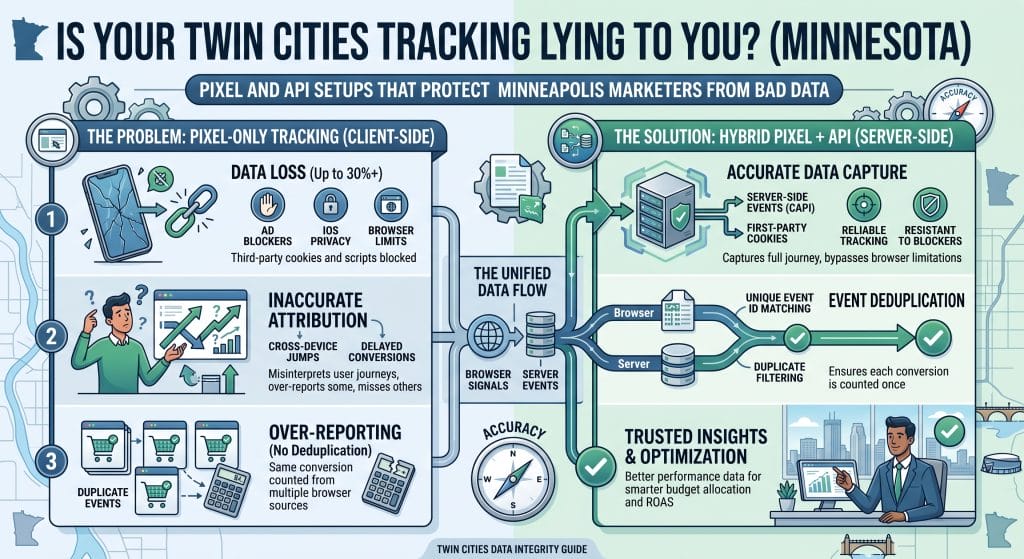
Beyond ad delivery, marketing teams regularly battle data discrepancies caused by broken pixel tracking and API integrations. When web tracking fails, brands end up making critical budget decisions based on inaccurate data.
Full Force Ads integrates server-side tracking, Conversion API (CAPI) configurations, and direct pixel setups. Protecting your data pipeline ensures every click, impression, and conversion recorded across your analytics mirrors verified user activity. This foundational accuracy allows you to scale ad budgets with total confidence.
Take command of your media strategy
Modern growth demands precision, cross-screen adaptability, and complete visibility into where your ad dollars go. Relying on outdated, single-channel platforms leaves your business vulnerable to rising ad costs and unpredictable platform changes.
Partnering with an independent programmatic provider like Full Force Ads unlocks building-level geofencing precision, unskippable Streaming TV reach, addressable household targeting, and real-world foot-traffic attribution, all managed from a single platform.
Whether you prefer fully managed services or direct execution through FullForceAds.app, you can eliminate wasteful ad spend and grow your business cleanly.
Visit Full Force Ads today to explore the platform, schedule a strategy demonstration, and build a digital media campaign that delivers real business growth.