The digital ad market is broken. For years, growing businesses have been stuck with two options: pay rising prices inside big-tech platforms, or wade through a mess of programmatic vendors, brokers, and ad exchanges.
When ad spend stops working or hits artificial reach limits, marketers start asking uncomfortable questions. Why are customer acquisition costs climbing while actual growth flattens out? Why does scaling past a certain regional threshold feel like running into a wall?
The problem is not digital advertising as a concept. It is the bloated, inefficient machinery sitting behind legacy platforms.
Full Force Ads, an agency out of Utah, uses a multi-screen setup to clear these bottlenecks. Operating its own platform alongside managed services, the company gives brands direct access to inventory across Streaming TV, Video, Audio, Mobile, Display, and Native placements. That means no reliance on Google Ads, Meta Ads, or standard SEO tactics.
If you want to scale across the country without running into ad delivery stalls, you have to rethink how you handle reach, targeting, and inventory.
Centralizing media across screens
Most ad strategies suffer from fragmentation. A brand might buy Connected TV through one vendor, mobile banners through another, streaming audio through a third, and retargeting through a fourth. The result? Users get hammered with the same ad, impressions get wasted, tracking breaks down, and middleman fees pile up.
Real scale requires pulling every channel under one roof. When you buy across every screen from a single system, you control frequency, map out customer touchpoints, and see where conversions come from.
Streaming TV (CTV and OTT) gets your message onto the biggest screen in the house through Roku, Fire TV, Hulu, and smart TV apps using unskippable 15- or 30-second spots. Unlike traditional broadcast television, streaming TV mixes visual impact with digital targeting. You do not have to buy broad age groups. Instead, you serve ads to specific households based on intent, physical location, store visits, or existing customer lists.
Digital video keeps attention on smaller screens across mobile apps, desktop sites, and news outlets. Pre-roll and mid-roll ads sit directly inside video streams. Outstream video opens up as users scroll through article text, creating video inventory beyond standard video player windows.
Screen-free time makes up a huge chunk of daily media use. People spend hours listening to audio on Spotify, Pandora, digital radio, and podcasts. Streaming audio reaches people when their eyes are elsewhere, which helps build brand recall. It also lets you run sequential messaging, like serving a mobile display banner seconds after a user finishes an unskippable Spotify ad.
Phones go everywhere your customers go. Mobile strategies need to look beyond static banners and focus on location-aware placements inside popular apps. Location tools trigger ads the moment someone steps inside a specific area, while interactive mobile formats encourage clicks without disrupting what the user is doing.
Display banners stay useful for cheap, broad reach and retargeting. They provide steady touchpoints across millions of websites and apps, keeping your brand visible while keeping your overall costs down.
Native ads solve banner fatigue by matching the design and layout of the site hosting them. Appearing as sponsored articles, recommended reads, or feed posts, they draw higher click-through rates because they blend naturally into reading material.
Targeting options
Buying space on the right channel is only half the work. Getting the message in front of the exact person who wants your product is what actually makes a campaign profitable.
Geofencing draws tight digital borders around physical places down to the property line. You can map out competitor stores, trade shows, auto lots, or commercial blocks to catch device IDs as people walk in. From there, you serve ads across TV, Mobile, Display, and Video for up to 30 days after they leave, while tracking how many people actually walk into your physical store afterward.
Addressable targeting connects direct mail lists or customer databases to household devices. You upload physical addresses, and the system matches them against household data. Your ads land directly on devices running inside those specific homes, cutting out wasted spend on unqualified addresses.
Roughly 97% of first-time website visitors leave without buying anything or filling out a form. Site retargeting uses tracking pixels to follow those visitors across the web, reminding them of your product as they read the news, play mobile games, or watch shows.
Search retargeting tracks purchase intent by targeting people based on the exact search terms they used across publisher sites. This lets you catch buyers while they are actively searching, before they close a deal with a competitor.
Contextual targeting reads page text, video transcripts, and page tags in real time. Ads drop onto pages that directly match what you sell, keeping placements relevant without depending on third-party tracking cookies.
Channel strategy
Matching channels to specific business objectives keeps budget from going to waste:
For local awareness and foot traffic, run Geofencing, Display, and Mobile together to cover geographic zones and drive store visits.
To pull customers from competitors, combine Geofencing around rival locations with Addressable Targeting to reach active buyers.
For broad brand building, run Streaming TV, Video, and Audio together for maximum coverage across living room and personal screens.
To drive site traffic, use Display, Native, and Search Retargeting to capture people searching for what you offer.
To bring back lost site visitors, pair Site Retargeting, Display, and Video to nurture leads until they buy.
For account-based marketing, match Addressable Targeting, Streaming TV, and Display to target specific households or commercial addresses on your target list.
Fixing regional spend stalls
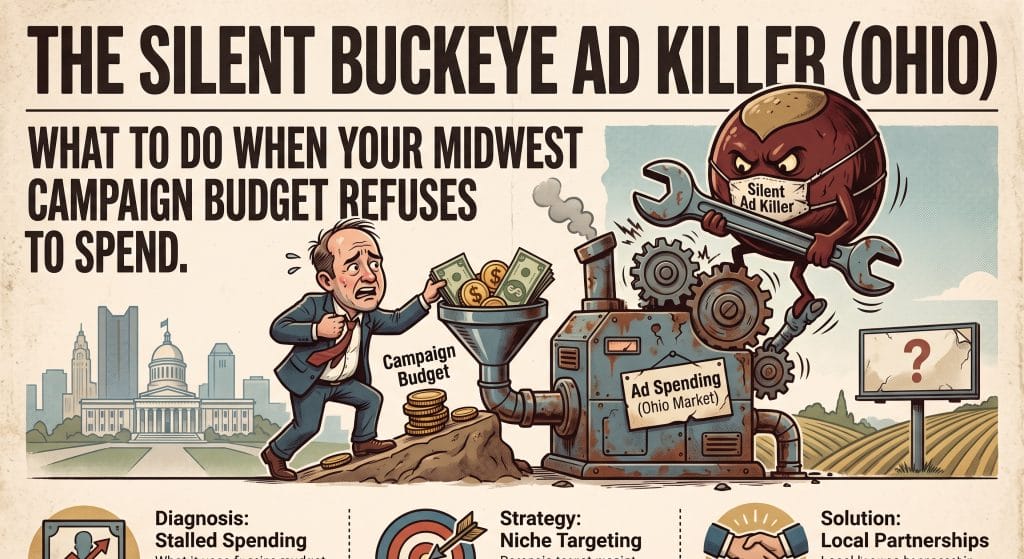
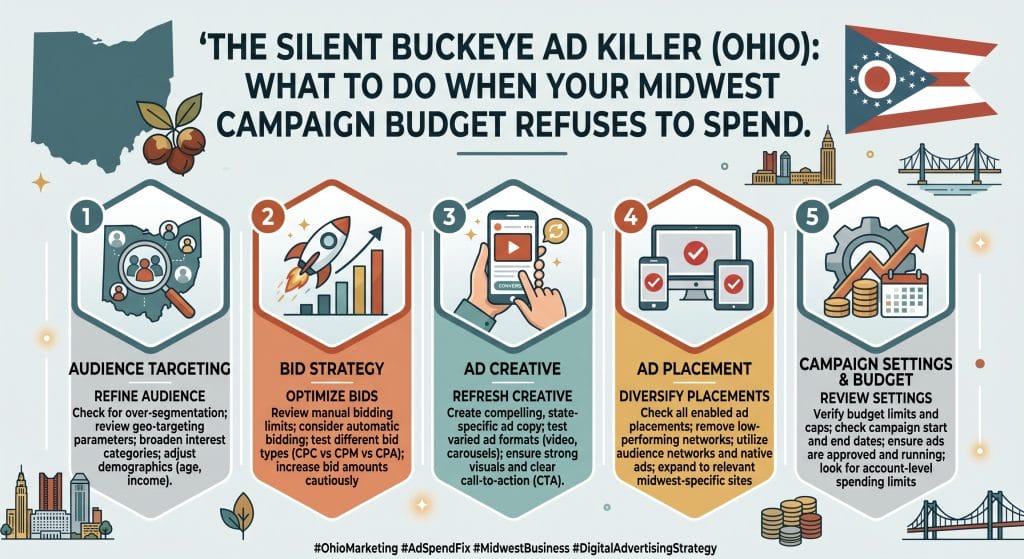
Businesses operating in competitive regional markets like Ohio frequently run into delivery stalls. You set up a campaign, set a budget, pick your targeting, and launch. Then nothing happens. The campaign sits there spending 10% or 20% of its daily budget, stalling out completely.
This happens when local inventory gets choked by heavy political spend, national ad buys, or platform restrictions. During election seasons or peak retail quarters, broadcast channels and big tech platforms fill up fast. Bidding prices skyrocket, and mid-sized regional advertisers get priced out.
Legacy platforms usually rely on a single exchange. When enterprise budgets buy up local inventory, smaller bids get pushed to the back of the line. At the same time, stacking too many targeting rules (like narrow geographic limits, tight age ranges, income cutoffs, and third-party audience data) shrinks your available audience down to almost nothing. Fixed-bid setups also fail when market prices shift, causing automated systems to simply stop buying.
Full Force Ads gets around this by sending bids across multiple supply platforms at the same time through an independent pipeline. If one exchange backs up, bids move through secondary paths so delivery does not stop. Rather than locking money into rigid buckets, budgets shift dynamically into Streaming TV, Audio, or Native spots if mobile inventory gets tight. Dynamic bid rules keep your campaign winning impressions without blowing up costs.
Managed services and platform options
Full Force Ads acts as a full media planning, buying, and management team. The process starts by looking at your margins, target buyer profiles, key metrics, and sales cycles. Campaigns go live within 5 to 7 business days. Performance gets checked constantly so budgets, creative assets, run times, and targeting can be adjusted on the fly. Dashboards show where your ads ran, which publishers took your impressions, and what conversions came out of it. You get flexible terms without getting locked into multi-year commitments.
If your internal team or agency wants direct control over buying, Full Force Ads also provides FullForceAds.app. The self-serve platform gives you direct access to the same targeting tools, screen inventory, geofencing parameters, and reporting dashboards so you can run campaigns on your own timeline.
Frequently asked questions
What makes Full Force Ads different from Google or Meta?
Full Force Ads avoids walled gardens like Google or Meta entirely. It uses a dedicated multi-channel platform to access inventory across Streaming TV, digital audio, native articles, mobile apps, and geofenced zones from a single dashboard.
How does Geofencing differ from standard radius targeting?
Standard radius targeting draws a wide circle around a zip code or city, wasting money on people who do not fit your audience. Geofencing maps custom borders around exact physical boundaries, targeting only the people who physically step foot inside those locations.
How long does it take for a campaign to go live?
Most campaigns go live within 5 to 7 business days once the strategy is approved and assets are delivered.
Are long-term contracts required?
No. Full Force Ads uses flexible terms and clear budget structures so you can start small, test performance, and scale up as you see a return on ad spend.