The playbook for growing a business has changed. For years, brands relied almost entirely on Google and Meta: buy keywords, run feed ads, optimize for clicks.
Rising ad costs, stricter privacy rules, lower organic reach, and crowded feeds changed that math. Relying on those two platforms means paying more money to reach smaller, less engaged audiences.
Growing a brand now requires meeting consumers across every screen they use: connected TVs in their living rooms, morning podcasts, industry publications, and mobile apps.
This multi-channel approach, known as omnichannel advertising, offers a sustainable route for acquiring customers.
When your ad budget stays the same, growing your revenue comes down to what happens after someone clicks. That means fixing the leaks in your funnel between the initial ad click and the moment a customer actually reaches out.
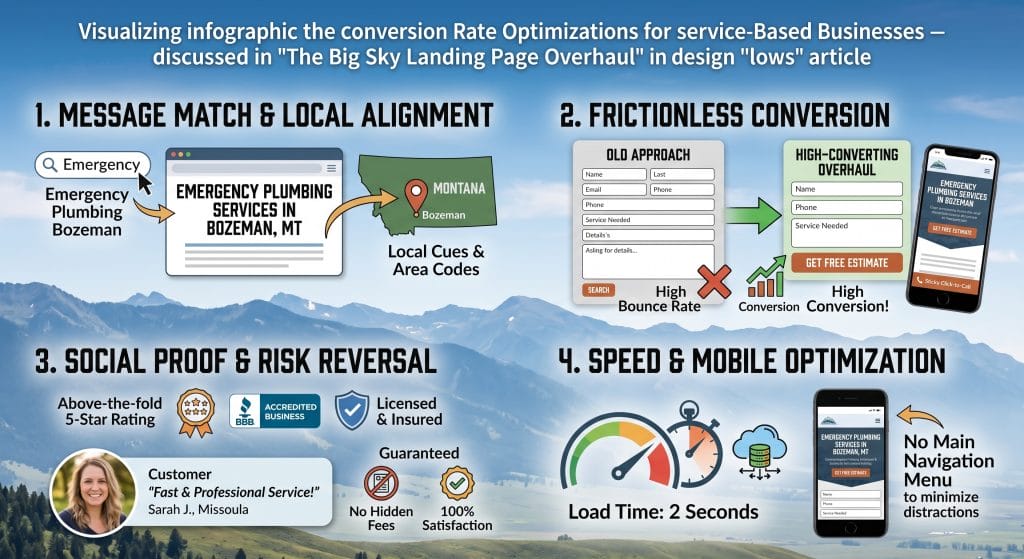
The Big Sky Landing Page Overhaul targets high-ticket local businesses operating across Montana, from roofing and trade contracting in Bozeman to specialty legal work, outfitters, and regional logistics in Missoula or Billings. Making these adjustments costs nothing in extra ad spend, but it directly improves your conversion rates.
Ad headlines rarely match the headline on the landing page. That mismatch confuses visitors and drives up your bounce rate. Fix it by matching the main header on your landing page directly to the exact keyword or ad copy the user clicked. If your Ad says "Emergency Roofing Repairs in Bozeman," your page header needs to say "24/7 Emergency Roofing Repairs in Bozeman," not a generic tag line like "Quality Service You Can Trust."
Asking visitors to "Submit a Request" or "Contact Us" feels like an invitation to get spammed with sales calls. Replace those generic buttons with clear, low-pressure actions. Change "Submit" to "Get Your Instant Estimate," or swap "Contact Us" for "See Open Booking Slots."
Generic quotes without context do not build local trust. Put real regional proof directly under your main headline or contact form. You might add a simple note like "Serving Gallatin and Park Counties since 2008," embed a map showing recent jobs completed around Flathead Lake, or feature short customer reviews that mention local landmarks or specific Montana winter conditions.
Standard header menus with links to your home, about, services, or blog pages give paid visitors too many ways to walk away. Remove the top navigation menu entirely on landing pages built for paid traffic. The page should give people only two choices: complete the main action or close the tab. Stripping out menu links by itself regularly boosts conversions by 10% to 20%.
Single-step forms with seven or eight fields look overwhelming on a phone screen. Switch to a dynamic two-step form instead. Start with an easy choice using simple tap buttons, such as picking "Residential" or "Commercial" under "What type of project is this?" Once the user clicks through that first step, ask for their details on the second screen with a prompt like "Where should we send your quote?"
More than 65% of local service ad clicks come from mobile phones, where slow photos or buried phone numbers kill conversion rates. Compress your images and clean up heavy code to keep mobile load times under two seconds. You should also fix a button to the bottom of the screen on mobile devices so visitors can tap to call you at any point.
| Metric | Typical starting range | Target after updates | Main factor driving the change |
| Landing page conversion rate | 3% to 5% | 10% to 15% or higher | Better headline alignment and multi-step forms |
| Mobile bounce rate | Over 65% | Under 40% | Faster load speeds and fixed tap-to-call bar |
| Cost per acquisition | Current baseline | 30% to 50% lower | More leads from the same click volume |
Full Force Ads, an independent agency based in Utah, designs multi-channel advertising strategies to reach specific audiences across all of these touchpoints. Rather than just managing basic search or social ads, Full Force Ads builds custom programmatic campaigns and offers a self-serve platform at FullForceAds.app.
Most people do not spend their day scrolling a single app feed or typing transactional keywords into a search bar.
A typical day looks more like this:
Marketing strategies that focus exclusively on search or social miss hours of prime attention across those other screens.
Programmatic advertising automates media buying. Instead of paying for static ad slots on single websites, it uses real-time data to target specific audiences across streaming TV, online video, digital audio, mobile apps, display, and native formats.
| Advertising strategy | Target approach | Primary channels | How it measures success |
| Traditional search / social | Keywords and platform profiles | Search pages, social feeds | Direct clicks (last click) |
| Full-funnel omnichannel | Physical location, CRM lists, streaming habits | Streaming TV, audio, video, native, display, mobile | View-through conversions, foot traffic, multi-touch attribution |
Consolidating media buying through one partner avoids the headaches of managing a dozen separate vendor dashboards. Everything stays synchronized in a single view.
Full Force Ads structures campaigns across six core channels to cover every major digital touchpoint.
As households cancel traditional cable in favor of streaming, TV has become a practical performance channel. Ads run on platforms like Roku, Fire TV, Hulu, Pluto TV, and major network apps. These spots are unskippable and boast completion rates over 95%. Unlike linear television that buys broad geographic markets, streaming TV lets you target specific households based on income, purchasing habits, and street address.
Pre-roll ads, mid-roll placements, and outstream video embedded directly within article pages capture visual attention on news portals, lifestyle sites, and niche web applications.
Audio formats reach people when they cannot look at a screen: driving, working out, cooking, or sitting at a desk. These campaigns place audio spots on Spotify, Pandora, iHeartRadio, podcast networks, and internet radio stations.
Paired with hyper-local location data, mobile ads reach users in real time as they open apps, games, and mobile websites near physical points of sale.
Banner ads handle the heavy lifting for retargeting and baseline brand visibility across millions of websites and apps, keeping your brand familiar to past visitors.
Native ads match the visual style and editorial layout of the publication where they appear. Because they blend into the surrounding content, native formats get higher click-through rates than traditional banners. They work best for educational articles, case studies, and thought leadership.
Running ads on top channels only works if those ads land in front of the right people. Layering data strategies over these media placements helps target specific audiences down to the household level.
Geofencing draws virtual boundaries around specific physical locations. When a consumer carrying a smartphone enters that area, their device ID is logged, allowing you to serve ads to them while they are there or for up to 30 days after they leave.
Addressable targeting matches physical customer or lead lists (direct mail databases, trade show leads, past customer files) to online screens. Uploaded street addresses are mapped to specific properties, serving video, display, or CTV ads exclusively to the devices connected to the Wi-Fi network at those locations.
Most first-time visitors leave a site without buying or filling out a form. Site retargeting serves follow-up video and display ads across news sites, weather portals, and apps to bring those past visitors back to finish what they started.
Search retargeting tracks the specific keywords consumers type into search engines, letting you serve display, native, or video ads to those users as they browse the broader web.
Contextual algorithms scan webpage text for specific topics and themes, placing your ads alongside content directly related to your products or services.
Based in Utah, Full Force Ads combines fully managed agency services with software options.
Managing internal media spending across separate programmatic platforms usually requires dedicated training, technical certifications, and expensive minimum spending requirements. On the flip side, traditional agencies can mean high monthly retainers, slow adjustments, and zero transparency into where your money actually goes.
Full Force Ads addresses this through two tracks:
Here are six field-tested campaign setups built for specific business goals:
Builds local presence and drives foot traffic to physical locations using geofencing, mobile in-app ads, and display networks. Fences around local shopping hubs show targeted offers on mobile devices, while display retargeting follows users home to build brand recognition.
Reaches active shoppers visiting direct rivals using competitor geofencing and addressable targeting. Fences around competing store locations capture device IDs to deliver direct comparison offers and promotions.
Establishes brand presence across an entire region or national footprint using streaming TV, digital audio, and video. Unskippable 15- and 30-second TV commercials on services like Hulu and Roku run alongside audio spots on Spotify and Pandora.
Drives targeted traffic to landing pages using search retargeting, native articles, and contextual display. Captures users who recently searched for industry-specific terms and shows them informative native content within the news articles they read.
Re-engages site visitors who left without filling out a form or completing a purchase using site retargeting, sequential video, and mobile display. Segments visitors based on the specific pages they viewed to show relevant client testimonials, case studies, and offers.
Reaches key decision-makers at corporate addresses using addressable targeting, native content, and connected TV. Converts client account lists into physical office addresses to serve executive-level media straight to devices inside those corporate offices.
Ad campaigns bring prospects to your website, but the page experience determines whether that traffic turns into revenue.
A local client spent significant budget driving traffic through display and search ads, but their landing page conversion rate sat at 1.8%. The page was cluttered, took over 4 seconds to load on mobile connections, and forced users through long drop-down menus just to ask for an estimate.
The team made a few simple fixes to the page layout:
Without adding a single dollar to the monthly ad budget, the page updates led to immediate efficiency gains:
Launching a campaign with Full Force Ads follows a straight line: