Every year, thousands of growing companies hit the exact same ceiling.
They launch a product, find customer fit, and start buying ads on the two or three platforms everyone uses. For a while, it works. Then the wall appears. Acquisition costs climb, audiences get saturated, and performance falls off. Brands end up stuck inside closed ad networks, bidding against each other for the exact same narrow band of daily attention.
When growth stalls, the issue is rarely the product itself. It is a distribution problem.
Reaching buyers today means showing up everywhere they spend time, not just where a couple of tech giants decide to serve impressions. Real scale requires an omnichannel strategy across the whole digital map, from living room TVs down to mobile phones.
That reality is driving brands toward Full Force Ads, an agency based in Utah. Instead of forcing companies to juggle five different software vendors, Full Force Ads unifies execution across streaming TV, digital audio, video, native, display, and location-based networks under one programmatic umbrella.
The Walled Garden Trap: Why Traditional Digital Advertising Breaks Down
To understand why modern ad campaigns hit a wall, look at how traditional digital marketing is built.
For years, the playbook was simple: buy search keywords for intent, and buy social feeds for reach. But media habits changed. People do not spend their lives inside a single app or feed anymore.
A typical weekday looks more like this:
If an ad strategy stays confined to search boxes and social feeds, it misses most of that daily routine. It skips the unskippable living room TV, screen-free audio moments, and high-engagement publisher sites.
Relying on closed ad networks also leaves brands exposed to constant algorithm changes and murky metrics. When the same vendor owns the inventory, sells the placements, and reports the results, clear data is hard to come by.
The Full Force Ads Approach: Multi-Channel Precision Under One Roof
Full Force Ads was started to eliminate that media fragmentation. Rather than making companies manage separate vendors for connected TV, mobile ads, and display retargeting, the agency handles execution, targeting, and analytics in one place.
Through independent ad exchanges, brands get access to inventory across millions of websites, streaming apps, and audio networks without massive budget minimums or long-term contracts.
Whether a company works directly with the agency or uses FullForceAds.app (a self-serve tool built for internal teams), the goal stays the same: protect return on ad spend through tighter targeting and broad reach.
Strategic Media Channels: Reaching Audiences Across Every Screen
Effective campaigns rarely rely on a single format. They use a multi-touch approach to build trust, raise interest, and capture active buyers.
| Channel | Primary Value Proposition |
| Streaming TV | Unskippable ads on living room screens. |
| Digital Video | Pre-roll and mid-roll video across web and mobile apps. |
| Digital Audio | Screen-free reach during commutes and workouts. |
| Mobile Ads | Targeted in-app and web placements on personal devices. |
| Display | Cost-effective reach, steady brand presence, and retargeting. |
| Native | High-CTR ads designed to match editorial pages. |
Streaming TV (CTV/OTT): The Living Room Screen
Connected TV pairs the visual impact of traditional television with digital targeting. Full Force Ads places campaigns on big-screen environments like Roku, Amazon Fire TV, Hulu, Pluto TV, and broadcast streaming apps. CTV ads run with completion rates over 95%, so viewers actually watch the message. Instead of buying broad market demographics, advertisers target specific households by income, buying signals, location history, or address lists.
High-Impact Digital Video
Video uses sight, sound, and motion to hold attention. Using pre-roll, mid-roll, and outstream formats, campaigns place video across major publisher sites and mobile applications.
Digital Audio: Capturing Screen-Free Moments
People are tired of staring at screens, but they spend hours listening to audio. Digital audio reaches users during workouts, commutes, chores, and work hours—times when visual ads cannot reach them. Placements run on Spotify, Pandora, iHeartRadio, podcasts, and digital radio, providing a quiet space with less ad clutter.
Precision Mobile Advertising
Phones sit at the center of daily routines. Full Force Ads runs mobile web and in-app ads structured specifically for small screens and location-aware triggers.
Display Advertising: Scalable and Cost Effective
Standard banner placements across mainstream web domains build the baseline for steady brand presence and audience retargeting. Display keeps the brand visible while prospects browse their routine daily sites.
Native Advertising: Matching Page Design
Native ads match the visual style, typography, and layout of the host site. Because they look like part of the page instead of a banner block, they suffer less from banner blindness and yield higher click-through rates.
Targeting Methods: Finding Qualified Buyers, Not Just Buying Impressions
Where an ad appears is only half the equation. Targeting determines who sees it. Buying mass impressions wastes ad spend, so Full Force Ads builds targeted overlays into campaigns to reach qualified prospects.
Strategic Campaign Stacks: Matching Channels to Business Goals
Different business goals need different campaign setups. Applying a single generic recipe to every business model usually fails. Here is how Full Force Ads pairs media stacks with specific goals:
| Core Business Goal | Recommended Media and Targeting Stack |
| Local Awareness & Foot Traffic | Geofencing + Display + Mobile |
| Competitor Conquesting | Geofencing + Addressable Targeting |
| Brand Building | Streaming TV + Digital Video + Audio |
| High-Volume Web Traffic | Display + Native + Search Retargeting |
| Retargeting Past Visitors | Site Retargeting + Display + Video |
| Target Existing CRM Lists | Addressable + Streaming TV + Display |
Scenario A: The Local Service Business or Auto Dealership
Scenario B: The Growing B2B or E-Commerce Company
Converting Traffic: The Above-the-Fold Landing Page
Getting traffic from programmatic ads is only part of the work. If the landing page loses the visitor's attention within seconds, return on ad spend drops quickly.
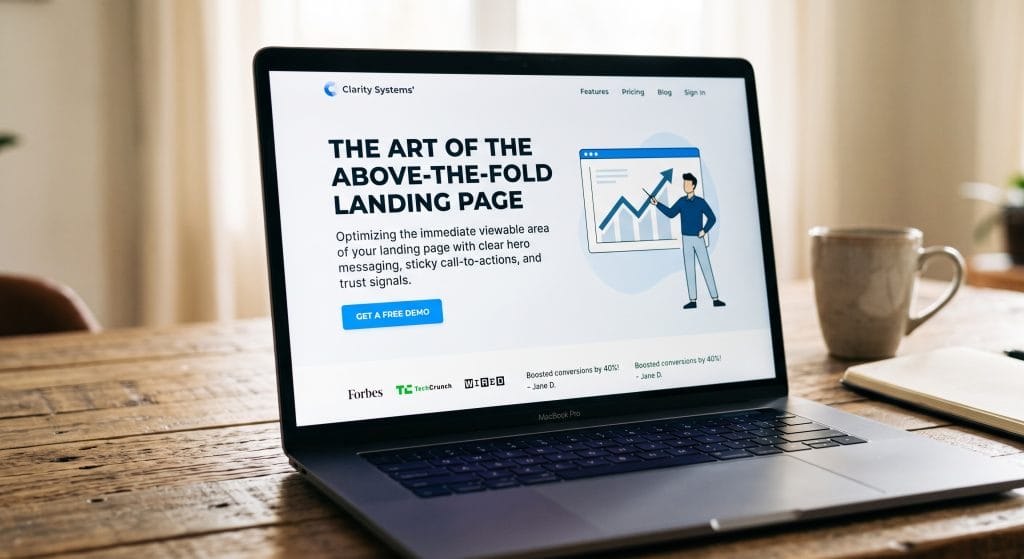
When running a campaign, the landing page must present a clear message immediately, starting with the area above the fold. "Above the fold" means the part of the page visible before scrolling. That screen space needs to do three things within five seconds:
Landing Page Checklist for Above-the-Fold Design:
Why Brands Choose Full Force Ads
Many agencies rely on heavy markups, rigid long-term commitments, and complex reporting. Full Force Ads operates as an independent performance partner with a direct structure.
For internal marketing teams that want direct control, FullForceAds.app offers a self-serve platform that puts these programmatic tools directly in-house.
The 4-Step Launch Roadmap
Setting up a programmatic ad strategy does not need to be complicated. Full Force Ads follows a four-step framework to go from first call to live campaigns:
Taking Control of Campaign Growth
Relying entirely on a few crowded ad networks often leads to higher acquisition costs and uneven performance. Reaching prospects across all the screens they use daily offers a more reliable path to growth.
Whether the target is living room screens through streaming TV, local competitor conquesting via geofencing, or visitor retargeting through native and display ads, Full Force Ads provides the network access and targeting structure to run those campaigns.
To build a unified ad campaign, visit Full Force Ads to set up a discovery call, or log into FullForceAds.app to evaluate the self-serve platform.p a discovery call, or log into FullForceAds.app to evaluate the self-serve platform.