If you run a business right now, you are probably stuck in a bidding war. Customer acquisition costs go up every quarter while returns from standard digital ads level off. You put money into the same crowded channels as every competitor in your industry and hope the algorithms work in your favor.
Most marketing agencies will not tell you this, but people do not use media the way they did in 2015. Nobody spends all day inside one app or one social feed anymore. They watch Hulu on a Roku while checking scores on their phone, listen to podcasts on Spotify during their commute, and read news across independent websites.
To win market share, you need an omnichannel approach that reaches buyers where they actually pay attention, without locking you into overpriced, closed platforms. Programmatic advertising and full-service platforms like Full Force Ads help growing U.S. companies do just that.
Over the last ten years, businesses got used to relying on self-serve social platforms and basic search ads. Those tools worked well in the early days of digital marketing, but using them exclusively leaves a big blind spot. When every competitor bids on the same keywords or targets the same broad demographics, auction prices spike and people tune out your ads.
Running campaigns on separate platforms also splits up your data. You see clicks in one dashboard and impressions in another, with no way to tell how those touchpoints work together to bring someone into your store or onto your checkout page.
Managing multiple vendors or disconnected ad accounts creates three main problems. First, you lose control over ad frequency. Without one central platform, you cannot limit how often the same person sees your ad across different devices, so you annoy your best prospects with twenty impressions in a day while missing other good buyers. Second, broad demographic targeting wastes money on people with no intent to buy or who live outside your service area, which drags down your return on ad spend (ROAS). Third, many older agencies hide behind vague reports full of vanity metrics like reach and impressions, avoiding hard numbers around foot traffic, qualified leads, and revenue.
Businesses do not need more disconnected tactics. They need one system that puts data, creative, and ad placement under one roof.
Picture reaching your ideal customer throughout a normal Tuesday without being obnoxious.
At 7:30 AM, they drive to work listening to a true-crime podcast and hear a 30-second audio ad introducing your brand. At 12:15 PM, they read a local news story on their phone during lunch and see a native ad that matches the layout of the page. At 8:00 PM, they sit down to watch a show on Hulu on their living room TV, and your full-screen commercial plays during a break without a skip button.
With Full Force Ads, you can run ads across every major digital screen and audio channel from one central plan.
Television did not die; it moved online. Connected TV and over-the-top platforms like Hulu, Roku, and Amazon Fire TV put your brand on the biggest screen in the house. Traditional cable forces you to pay for an entire zip code regardless of who is watching. Streaming TV targets specific households with unskippable, high-definition commercials sent only to homes that fit your buyer profile.
Sight, sound, and motion still persuade people better than static text. Pre-roll, mid-roll, and outstream placements on major websites and mobile apps catch viewers when they are already paying attention, whether you need to demonstrate a complex product or build brand recognition.
People are tired of staring at screens, and digital audio has grown as a result. Running ads on Spotify, Pandora, iHeartRadio, and popular podcasts lets you reach people while they work out, commute, or cook dinner. Because listeners usually wear headphones, audio ads feel direct and stick in their memory.
People carry their smartphones everywhere. Mobile advertising goes beyond basic banners to include in-app placements, mobile web ads, and location-based messaging. Since phones stay in pockets all day, mobile ads bridge the gap between seeing an ad online and walking into a store.
Banner ads across millions of vetted websites and apps remain a cost-effective way to stay visible and retarget past visitors. When backed by solid audience data, display keeps your brand in front of buyers while they make up their minds.
Most people ignore loud, flashy banner ads. Native advertising avoids banner blindness by matching the look and editorial style of the site around it. Because native ads appear as recommended articles or normal feed posts on reputable publications, they earn higher click-through rates and work well for educational or story-driven content.
Buying ad space on Streaming TV or major news sites is only half the job. Even a great commercial fails if the wrong person sees it. Channels are just where your ads show up; targeting is how you make sure your budget goes toward actual prospects.
Based in Utah and working with companies across the country, Full Force Ads runs its own advertising platform instead of reselling basic social or search tools. That setup lets you layer detailed targeting onto any media channel.
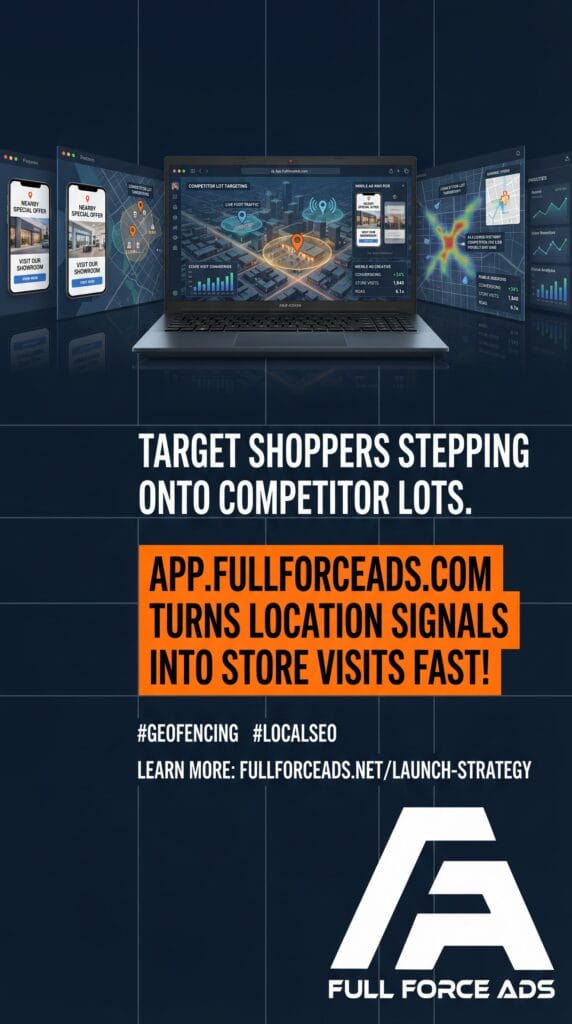
You can draw a virtual boundary around a competitor's store, a trade show, or specific neighborhoods, and send ads straight to the phones of people who walk inside.
When someone enters your boundary, the system logs their device anonymously. You can show them ads right away and keep reaching them for up to 30 days afterward. Conversion zones also track when someone who saw your ad later walks into your store or office, so you can tie ad spend directly to foot traffic.
Direct mail costs a lot, moves slowly, and is hard to measure. Addressable advertising takes your CRM list, customer database, or mailing list of street addresses and matches them to exact property lines using GPS and tax-assessor records. Within days, you can send Streaming TV, video, and display ads to every phone, tablet, laptop, and smart TV in those specific homes. You get the accuracy of direct mail with the speed and tracking of digital media.
Many businesses think the only way to reach active searchers is by paying steep cost-per-click rates on search engines. Search retargeting gives you another route. When people search specific high-intent keywords across the open web, the platform captures that activity and shows display, video, or native ads to those same buyers while they read news, browse websites, or watch videos, usually for much less than a search click costs.
Between 96% and 98% of first-time website visitors leave without filling out a form, calling, or buying anything. A small tracking pixel on your site lets you follow up with relevant ads as those prospects browse other sites, bringing them back when they are ready to buy.
With stricter privacy rules and third-party cookies going away, contextual targeting has become a practical way to reach interested buyers. Instead of relying on past browsing history, contextual tools read the text, tone, and topic of a webpage or video in real time. If you sell commercial construction equipment, your ads show up next to articles about infrastructure and heavy machinery, which keeps your brand in safe, relevant places.
Picking a single ad channel based on gut instinct instead of a plan is a common mistake. A local medical clinic needs a very different setup than a regional B2B manufacturer or a multi-location retail chain.
Smart advertisers combine channels and targeting layers around their main goal:
Companies have different internal resources. Some leadership teams want an outside partner to handle everything from media planning to weekly bid adjustments, while in-house marketing teams often want hands-on control.
Full Force Ads supports both setups. If you want experienced execution without hiring an internal media-buying team, managed campaigns put their staff in charge of strategy, channel picks, audience building, launch, and ongoing adjustments. Most campaigns go from a discovery call to live impressions in 5 to 7 business days, which avoids the multi-week delays common at traditional agencies. If your marketers want direct speed and control, they can log into FullForceAds.app, build custom audiences (like targeting people based on what they searched yesterday), and launch campaigns themselves without agency bottlenecks.
Whether you want a managed team or a self-serve tool, buying programmatic inventory directly without middleman markups saves money from day one.
If you have hired a traditional marketing agency before, you probably recognize the frustration of rigid 12-month contracts, high minimum budgets, and vague monthly PDFs full of jargon that never connects to revenue.
When deciding where to put your ad budget, look for five basic standards. First, get unified execution under one roof. Using one vendor for video, another for display, and a third for local ads leads to communication gaps and finger-pointing when numbers dip, whereas running everything on one platform lets you shift budget toward whichever channel performs best that week. Second, rely on real data instead of guesswork. Impressions are useless if they go to bots or people outside your market, so campaigns should use concrete signals like store visits, verified home addresses, recent search intent, and page context.
Third, demand clear reporting. You should know where your ads ran, who saw them, how often they appeared, and what actions followed, with weekly reports that replace black-box metrics with clear numbers on cost per acquisition, foot traffic, and sales pipeline. Fourth, look for flexible budgets without lock-in contracts. Agencies confident in their results do not need punitive agreements; you should be able to start with a test budget, check the numbers, and scale up once the return makes sense. Fifth, value speed to market. Opportunities do not wait six weeks for slow onboarding; a capable partner moves from strategy call to live ads in about a week.
Running multi-channel programmatic ads does not mean rebuilding your entire marketing department. A simple four-step process keeps things moving:
Social media and search engines act as closed platforms. They only show your ads inside their own apps or search results, where heavy competition drives up auction prices. Programmatic advertising through Full Force Ads puts your ads across the open internet, including Streaming TV networks (Hulu, Roku, Fire TV), audio apps (Spotify, Pandora), mobile apps, and millions of websites, using targeting tools like geofencing and household address matching.
Unlike broadcast TV or big agency retainers that require tens of thousands of dollars upfront, programmatic platforms work with flexible budgets and no long-term contracts. You can start with a targeted local or audience-specific budget, track the results, and increase spend as returns grow.
Traditional media agencies often need four to six weeks to plan, negotiate, and launch a campaign. Programmatic execution gets most campaigns live within 5 to 7 business days after the initial strategy call.
Yes. With geofencing and conversion zones, campaigns anonymously track when a phone that saw your ad later enters your store, clinic, dealership, or office, linking digital impressions directly to real foot traffic.
Yes. Alongside full-service managed campaigns, marketers can use FullForceAds.app, a self-serve platform for building audiences (such as targeting people based on recent searches) and launching campaigns on their own.
The companies gaining market share right now are not always spending the most money; they are spending where competitors are not looking. Moving beyond crowded social feeds to put your brand across Streaming TV, digital audio, mobile, native, and display, backed by geofencing, household address data, and search retargeting, keeps your business in front of buyers wherever they go.
If you want to lower acquisition costs and reach high-intent buyers across every screen, check out Full Force Ads and book a low-pressure discovery call to map out a plan for your business.