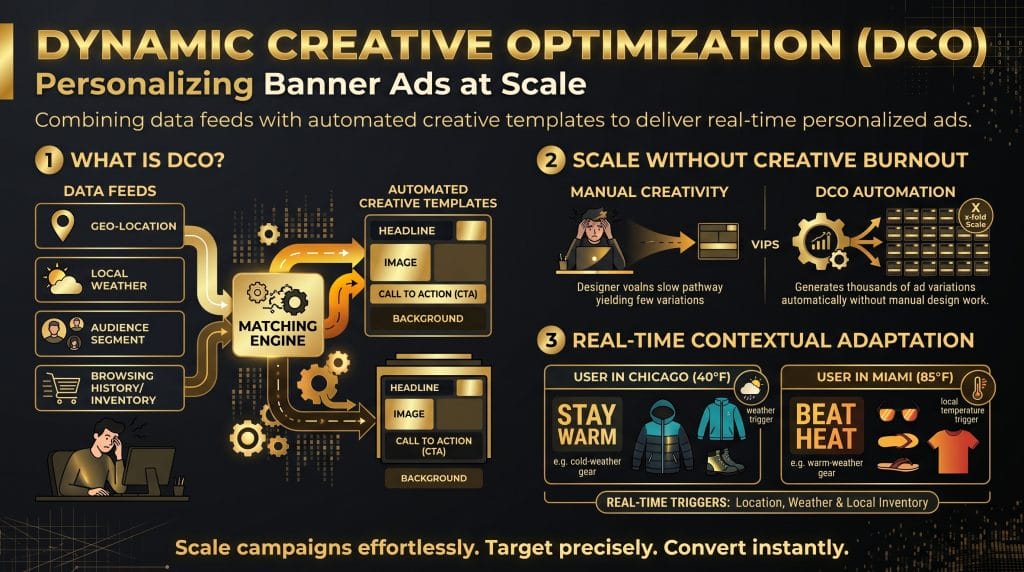
Dynamic Creative Optimization (DCO) marks a clear shift in display advertising, moving campaigns from fixed banners to personalized ad creative served in real time. For mid-market brands, agencies, and fast-growing companies, it solves a constant operational headache: getting relevant ads in front of different audience segments without running up huge production bills.
Instead of making everyone look at the same generic banner, a DCO engine builds custom ads on the fly the moment an impression opens up. It pulls together data signals like location, browsing history, and contextual cues, then pairs them with modular design assets to serve targeted visuals and copy across websites, phones, and apps.
If you are setting up enterprise campaigns across connected channels, you can see how these tactics fit into a broader media strategy over at Full Force Ads Advertising Solutions.
Dynamic Creative Optimization is a programmatic method that uses live data to build, deliver, and tune individual ad creative components on the fly.
Traditional display production usually means a designer spends days building static .jpg or .gif files across a dozen standard shapes. DCO works like a set of building blocks instead. Designers build a single master layout out of interchangeable parts:
When an ad slot opens up, the decision engine checks incoming signals like IP location, local weather, previous site visits, or current inventory levels. It grabs the right combination of creative assets from a master content sheet, snaps them into place, and serves the finished ad in a fraction of a second.
       ┌─────────────────────────────────────────────────────────────┐
       │                   DATA SIGNALS & FEEDS                      │
       │   [Geo / Weather]   [Behavioral]   [Product Catalog Feed]   │
       └──────────────────────────────┬──────────────────────────────┘
                                      │
                                      ▼
                       ┌──────────────────────────────┐
                       │   DCO DECISIONING ENGINE     │
                       │   Rules & Machine Learning   │
                       └──────────────┬───────────────┘
                                      │
              ┌───────────────────────┼───────────────────────┐
              ▼                       ▼                       ▼
    ┌───────────────────┐   ┌───────────────────┐   ┌───────────────────┐
    │  CREATIVE VAR A   │   │  CREATIVE VAR B   │   │  CREATIVE VAR C   │
    │  Location: Salt   │   │  Behavior: Past   │   │  Context: Local   │
    │  Lake City        │   │  Shopper          │   │  Message: Nearby  │
    │  Message: Nearby  │   │  Message: Complete│   │  Message: VIP     │
    │  Store Event      │   │  Your Order       │   │  Special Pass     │
    └───────────────────┘   └───────────────────┘   └───────────────────┘
The system also runs a constant feedback loop. While the campaign is live, multivariate algorithms track clicks, conversions, and acquisition costs. When one creative combination consistently outperforms the rest, the engine automatically routes more traffic to it and dials back the lower-performing variations.
Most people have trained themselves to ignore generic sidebar banners. Marketers call it banner blindness, but really it is just human nature: when an ad has nothing to do with what you are looking for, you scroll past it. Personalized ads cut through that noise simply by paying attention to context.
| Marketing Metric | Traditional Static Display Ads | Dynamic Creative Optimization (DCO) |
| Relevance | Broad, identical messages sent to everyone | Targeted, contextual creative matched to user segments |
| Production Speed | Weeks spent designing every size by hand | Hours spent uploading master templates and asset feeds |
| Scalability | High labor costs for every new variation | Infinite variations generated automatically from data feeds |
| Optimization | Manual reviews followed by manual asset swaps | Real-time automated testing that shifts traffic on the fly |
| Ad Fatigue | High; people see the exact same banner repeatedly | Low; creative swaps automatically based on triggers |
Four main layers make dynamic banner campaigns work together:
┌─────────────────────────────────────────────────────────────────────────┐
│                          DYNAMIC CREATIVE FEED                          │
│     Structured data: Product IDs, headlines, image URLs, landing pages    │
└────────────────────────────────────┬────────────────────────────────────┘
                                     │
                                     ▼
┌─────────────────────────────────────────────────────────────────────────┐
│                            MODULAR FRAMEWORK                            │
│     Flexible container supporting fluid layouts and asset placement     │
└────────────────────────────────────┬────────────────────────────────────┘
                                     │
                                     ▼
┌─────────────────────────────────────────────────────────────────────────┐
│                            DECISION ENGINE                              │
│     Rules-based or algorithmic routing based on audience profile        │
└────────────────────────────────────┬────────────────────────────────────┘
                                     │
                                     ▼
┌─────────────────────────────────────────────────────────────────────────┐
│                        AUTO-OPTIMIZATION LOOP                           │
│     Algorithmic shifts favoring high-converting creative variants        │
└─────────────────────────────────────────────────────────────────────────┘
This spreadsheet or database acts as the single source of truth for your content. Usually stored as a CSV, XML file, or Google Sheet, it lists every product variant, headline option, image path, landing page URL, and audience tag.
Designers build a flexible HTML container instead of dozens of fixed layouts. This frame uses fluid text boxes and responsive positioning, so long headlines, different image sizes, and custom buttons all render cleanly on desktop screens, tablets, and phones.
The decisioning engine checks incoming context against rules you set up beforehand. Typical setups include:
As ads serve, performance metrics flow back into the system. If Headline A paired with Image B produces 40% more sales than Headline B with Image A, the system sends a larger share of future impressions to the winning pair.
Personalization relies on the raw signals available the moment a page loads. You can group these triggers into four main categories:
                                  DATA TRIGGERS
                                        │
        ┌───────────────────┬───────────┴───────────┬───────────────────┐
        ▼                   ▼                       ▼                   ▼
  ENVIRONMENTAL         GEOGRAPHIC              BEHAVIORAL          FIRST-PARTY
  * Local Weather       * ZIP / Radius          * Site Visits       * CRM Lists
  * Time of Day         * Location Type         * Search Intent     * Purchase History
  * Device & OS         * Regional Market       * Page Context      * Household Data
While display banners are the classic home for dynamic creative, modern campaigns usually span several channels at once. Full Force Ads, based in Utah, handles end-to-end media execution to connect brands with active buyers across multiple screens.
They run media buying, location targeting, and campaign optimization through a single platform setup.
| Media Channels | Targeting Solutions |
| Streaming TV (CTV / OTT) | Geofencing Targeting |
| Digital Video (Pre/Mid-roll) | Addressable Household Matching |
| Streaming Audio | Site & Search Retargeting |
| Mobile Web & In-App | Contextual Content Matching |
| Display Network | First-Party CRM Integration |
| Native Advertising | Behavioral Intent Segmenting |
Consolidating media buying under one roof helps avoid the friction of managing half a dozen single-channel vendors:
Dynamic creative works best when it hits the right audience. Campaigns can layer several targeting methods together:
For agencies and in-house media teams that prefer to manage campaigns directly, FullForceAds.app offers a self-serve platform interface.
Through FullForceAds.app, teams can upload creative assets, configure audience parameters, adjust bids, and track performance data across programmatic inventory sources in real time.
Running a dynamic campaign takes coordination between strategy, creative design, and data management.
┌─────────────────────────────────────────────────────────────────────────────┐
│                       DCO IMPLEMENTATION WORKFLOW                           │
└─────────────────────────────────────────────────────────────────────────────┘
  Step 1: Campaign Planning & Logic Definition
  └── Define objectives, target personas, and audience matrices.

  Step 2: Creative Asset & Framework Assembly
  └── Build responsive HTML5 master shells and dynamic copy/image feeds.

  Step 3: Platform Integration & Dynamic Feed Setup
  └── Link dynamic feeds to the ad server engine; validate trigger paths.

  Step 4: Multi-Channel Programmatic Deployment
  └── Launch campaigns across targeted display, mobile, video, and audio channels.

  Step 5: Automated Testing & Continuous Optimization
  └── Monitor real-time performance; iterate creative assets using campaign data.
Different marketing goals require different combinations of channels and targeting. Here is how standard configurations line up:
| Business Objective | Primary Channels | Targeting Layer |
| Local Market Dominance | Mobile + Display | Geofencing + Search |
| Conquest Competitors | Mobile + Display | Geofencing Radius |
| Addressable Household | Streaming TV + Display | Addressable CRM Match |
| High-Intent Conversion | Display + Native | Search + Site Retarget |
Evaluating dynamic campaigns requires looking at metrics across every stage of the buyer journey:
| Category | Key Metrics |
| Awareness Metrics | • Complete View-Through Rate (VTR) across CTV and Video • Audio Listen-Through Rate (LTR) • Effective Cost Per Thousand Impressions (eCPM) |
| Engagement Metrics | • Click-Through Rate (CTR) by Creative Variant • Interaction Rate & Dynamic Element Engagement • Cost Per Click (CPC) across Display & Native Formats |
| Conversion Metrics | • Conversion Rate (CVR) & Cost Per Acquisition (CPA) • Return On Ad Spend (ROAS) • Offline Foot-Traffic Lift & Attributed Walk-Ins |
As tracking norms shift and third-party cookies fade out, dynamic creative relies more heavily on contextual cues, privacy-compliant location parameters, first-party data, and automated routing engines.
Modern media teams are adopting unified programmatic tools that balance creative flexibility with privacy-safe targeting. By pairing dynamic ad frameworks with multi-screen delivery across Streaming TV, Video, Audio, Mobile, Display, and Native channels, brands can maintain tailored, effective ad campaigns at scale.
To see how dynamic creative and multi-channel targeting can improve your media results, visit Full Force Ads Advertising Solutions to schedule a strategy consultation and platform demo.