
We hear it every week, sometimes every day.
"We tried digital ads. They didn't work."
And every time we dig into what actually happened, the campaigns, the creative, the targeting, the landing pages, the attribution setup,the same truth surfaces: the problem was never digital advertising.
It was the strategy behind it.
Wrong audience. Wrong message. Wrong moment. Or a tracking setup so broken that winning campaigns were being turned off because the data said they weren't working.
Saying digital ads don't work because your campaign failed is like saying telephones don't work because nobody answered when you dialed a random number. The channel isn't the problem. The diagnosis is missing.
In 2026, the digital advertising landscape is more complex, more competitive, and more fragmented than it has ever been. CTV, native, geofencing, paid search, programmatic display, social, each channel has its own auction dynamics, creative requirements, attribution model, and audience behavior.
Most brands approach this complexity the same way: pick a platform, set a budget, run some ads, and wait to see if customers appear. When they don't, the conclusion is that digital advertising doesn't work.
That conclusion is a misdiagnosis.
Digital ads are an amplifier. If you amplify a weak offer, a generic message, or a broken funnel, you don't get a slow failure,you get a fast, expensive one. The platform didn't fail. The input was wrong.
The brands that consistently win with digital advertising aren't spending more. They're diagnosing more accurately before they spend at all.
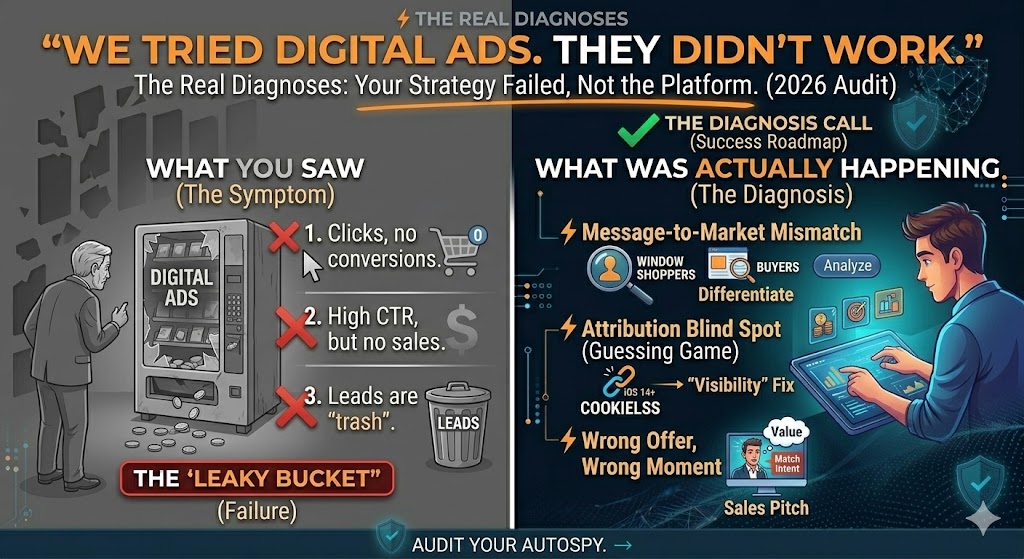
When a client tells us their ads failed, we run what we call the 30-Minute Roadmap, a structured audit that identifies the exact point of failure across three specific areas. The same three problems appear, in different combinations, in almost every failed campaign we've ever reviewed.
The symptom: High click-through rate, zero conversions. Traffic is coming in. Nothing is closing.
The diagnosis: You're attracting window shoppers and repelling buyers. A hook that's too broad generates curiosity clicks from people who were never going to purchase. You're paying for traffic that was never qualified to begin with.
This is one of the most common and most expensive mistakes in digital advertising, optimizing for clicks when the real problem is audience specificity. The algorithm will always find people who will click. The question is whether those people are capable of becoming customers.
The fix: Run a Differentiation Stress-Test on your creative. Your ad's opening message should be specific enough to disqualify people who aren't a fit, not just attract everyone who might be vaguely interested. The goal is not maximum reach. It's maximum relevance to the buyer most likely to close.
If your video ad hook doesn't speak directly to a specific pain point your best customers experience, it's working against you. Tighten the message until the wrong people scroll past and the right people stop.
The symptom: Sales are increasing at the business level, but the ad dashboard is reporting zero conversions. Campaigns get paused. Sales drop. The ads were actually working, you just couldn't see it.
The diagnosis: You're trapped in what we call the Guessing Game. iOS 14+ privacy changes, browser-level tracking restrictions, and cookie deprecation have severed the visible path between ad exposure and purchase for a significant percentage of customers. If your attribution relies entirely on pixel-based tracking, you are missing a substantial portion of your actual conversion activity.
This is particularly acute for brands running CTV, native, or geofencing campaigns where the conversion path spans multiple devices and significant time delays between ad exposure and purchase.
The fix: Shift your primary performance metric from platform-reported ROAS to MER (Marketing Efficiency Ratio) and Blended CAC. These business-level metrics capture total revenue output relative to total marketing input,regardless of whether every individual conversion was tracked by a pixel. When platform data goes dark, business-level metrics stay honest.
Supplement with server-side tracking to recover signal loss at the technical level, and use conversion zone reporting for location-based campaigns to verify physical foot traffic driven by digital exposure.
The symptom: Strong ad performance metrics, low cost-per-click, solid CTR, qualified audience, but users arrive and leave within five seconds. No conversions. No engagement. Nothing.
The diagnosis: Your ad made a promise your landing page didn't keep. The ad created an expectation, a specific offer, a particular tone, a defined next step, and the page delivered something different. That friction is enough to kill the conversion entirely, even when the audience was perfectly qualified and the creative was strong.
This mismatch is especially common when brands run educational native ads that warm up a cold audience, then land those visitors on an aggressive, high-pressure sales page. The intent shift is jarring. The trust that the ad built disappears in seconds.
The fix: Map the emotional and informational journey from ad to landing page. The intent of the ad must match the experience of the destination. If the ad is educational and empathetic, the page should continue that conversation, not pivot to a hard close. If the ad names a specific problem, the page should immediately acknowledge and address that exact problem before asking for anything.
Message continuity between ad and landing page is not a design decision. It is a conversion decision.
The 30-Minute Roadmap exists because diagnosis has to come before execution. Launching more ads into a broken funnel doesn't fix the funnel,it accelerates the burn rate.
Before increasing any budget, run your current setup through these three questions:
If the answer to any of these is uncertain, you have a diagnosis problem, not a budget problem. Fix the foundation first. Then spend.
Why do digital ads fail even when you have a good product? Digital ads most commonly fail due to three diagnosable strategy errors: a message that attracts clicks but not buyers (message-to-market mismatch), an attribution setup that hides real conversions (attribution blind spot), or a landing page that breaks the promise made by the ad (leaky bucket). A strong product cannot compensate for broken strategy execution.
What is a message-to-market mismatch in advertising? A message-to-market mismatch occurs when ad creative attracts a broad audience interested in the topic but not qualified to purchase. It typically produces high click-through rates with low or zero conversion rates. The fix is tightening the hook to speak specifically to the buyer's pain point rather than general interest.
How do iOS privacy changes affect digital ad attribution? iOS 14+ privacy restrictions limit pixel-based conversion tracking, breaking the visible path between ad exposure and purchase for a significant percentage of users. Brands relying solely on platform-reported ROAS may pause or kill campaigns that are actually driving revenue. Switching to MER and Blended CAC provides attribution that survives signal loss.
What is a leaky bucket landing page in marketing? A leaky bucket landing page is one where qualified traffic arrives from an ad but immediately exits without converting. It typically results from a mismatch between the tone, offer, or intent of the ad and the experience delivered on the destination page, creating friction that destroys the trust built by the creative.
What should you do before increasing your digital ad budget? Before scaling spend, audit three areas: the specificity of your creative message, the reliability of your attribution model, and the message continuity between your ads and landing pages. Scaling spend into a broken funnel accelerates losses rather than growth.
Digital advertising works. Diagnosis is what most brands skip. Do the audit before you do the spend.
