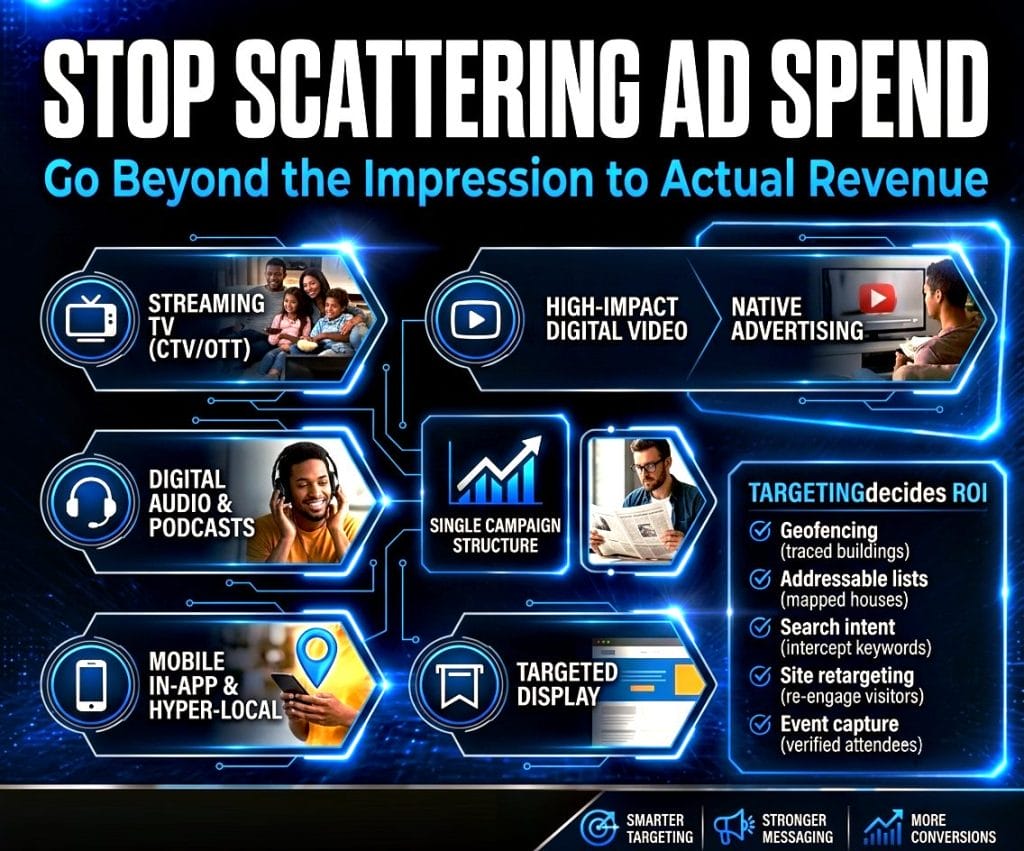
Your customers don't pay attention in one place anymore. They watch Roku in the morning, catch a podcast on the drive, scroll apps at lunch, and read industry blogs on a laptop at night. Advertising that only shows up in one of those spots is leaving money on the table.
Ten years ago you could run a single channel, Google Search or local print, and capture enough of the market to grow every year. Now the buying journey is spread across screens. Run in only one of them and you're handing market share to competitors who show up everywhere your buyer looks.
Winning takes more than ads. It takes a coordinated set of channels aimed at the right people, with budget going only where it can convert. This guide walks through how to move from scattered, wasteful spend to a multi-channel approach that returns predictably.
Plenty of owners and marketing leads go looking for the one channel that fixes everything.
Channels don't work in isolation. Almost nobody sees one banner ad and buys something expensive on the spot. Real decisions build over time, across several exposures.
When someone catches your brand on streaming TV, then hears you in a podcast, then sees a native ad in an article they're reading, you start to feel like you're everywhere. That impression makes a business look established and trustworthy before a rep ever picks up the phone.
Running all of this through one platform, like Full Force Ads, means you're not stitching together five vendors and five dashboards. You see the whole campaign in one place.
Each channel plays a different role in moving someone from first awareness to a signed deal. Here's what each one does well.
Big-screen impact with digital precision. Streaming TV opened television up to advertisers who could never touch broadcast rates. Instead of paying to reach a crowd that's mostly not your customer, you run 15- or 30-second video on Roku, Hulu, Fire TV, and Apple TV, aimed at the exact demographic or area you want. The ads don't skip.
Video holds attention better than static formats. Placed before or during content people are already watching, it builds product understanding fast and carries emotional weight a banner can't.
This reaches people when their screens are off. Someone driving, working out, or cooking still has their ears free. Spotify, Pandora, and podcasts put you in an intimate setting, and spoken messages tend to stick, because listeners build a real habit with the shows and hosts they follow.
Mobile is the one device people keep on them all day, and it's well past banner ads on phone websites. It now covers rich in-app placements, interactive formats, and location-aware targeting that reaches someone when they're physically near a place that matters to you.
Cheap, broad reach and the backbone of retargeting. Banners across busy sites get a bad rap when they're the whole plan, but they're hard to beat for keeping your brand in front of people and pulling retargeting conversions.
Native placements take on the look and editorial style of the site they sit on, so they don't read as interruptions. That's why they usually earn higher click-through rates than standard display.
Channels are where your message shows up. Targeting decides who sees it.
Dumping budget on a broad demographic like "men 30 to 55 in Utah" is how ad money disappears with nothing to show for it. Programmatic targeting gets far more specific, so most of your spend lands on people who could actually buy. Those methods fall into a few buckets: location-based, list-based, and intent-based.
| Targeting method | How it works | Best used for |
|---|---|---|
| Geofencing | Draws a virtual boundary around a physical location (a competitor, an event, a trade show). | Capturing competitor foot traffic and local conquesting. |
| Addressable | Matches a list of physical addresses (CRM data, direct mail lists) to the devices in those households. | Account-based marketing and client-list campaigns. |
| Site retargeting | Follows people who visited your site and re-serves them ads elsewhere online. | Winning back warm leads who left without converting. |
| Search retargeting | Reaches people who recently searched industry keywords on a search engine. | Catching high-intent buyers before a competitor does. |
| Contextual targeting | Places your ads on pages and videos about relevant topics. | Matching your message to a relevant editorial setting. |
Legal services is one of the most competitive categories in all of advertising, which makes it a good place to see these tactics work together.
For years, most firms leaned on two things online: paid search and local SEO. But in competitive markets, a single click on a keyword like "personal injury lawyer" or "car accident attorney" can run $150 to $350.
When one click costs as much as a nice dinner out, leaning only on search is a gamble. Here's how firms use broader programmatic channels through Full Force Ads to sign high-value cases for far less.
Instead of waiting for an injured person to search on Google three days after an accident, a personal injury firm can draw geofences around local ERs, urgent care centers, tow yards, and auto repair shops.
When a device spends time inside one of those boundaries, its ID gets captured anonymously. Over the next few days and weeks, that person sees video and native ads laying out what to do after an injury. By the time they're ready to hire someone, your firm is the name they know.
For estate planning, corporate litigation, or family law, firms often keep lists of high-net-worth households or commercial property owners.
With addressable targeting, the firm uploads that mailing list into the campaign. The system maps those exact addresses to the devices inside those homes and offices, then runs streaming TV and audio straight to the decision-makers. The firm builds real authority long before a legal need comes up.
Instead of bidding directly on the priciest keywords, search retargeting picks up people who searched phrases like "what to do after a truck accident" or "best divorce lawyer near me." Once they leave the search engine, your firm reaches them with display, native, and video across millions of news sites and apps, for a tiny fraction of what that search click would have cost.
Different goals call for different channel mixes. Trying to solve every objective with the same mix wastes budget. Here's a rough guide for matching outcomes to channels.
| Business objective | Core channel mix | Targeting layers |
|---|---|---|
| Conquesting competitors | Geofencing, mobile, native | Location-based geofencing around competitor sites, plus contextual |
| Local brand awareness | Streaming TV, video, audio | Local geo-radius, plus demographic layers |
| B2B / account-based marketing | Addressable, display, native | Addressable CRM matching, plus search retargeting |
| Driving website conversions | Display, search retargeting, native | Keyword intent, plus contextual relevance |
| Recapturing direct leads | Site retargeting, display, video | First-party pixel retargeting, plus cross-device identification |
Running a multi-channel campaign well takes the right infrastructure, programmatic access, and someone optimizing it as it runs. When you're choosing a partner, hold out for these five things.
Stop spreading budget across disconnected channels you can't measure. Whether you want to win local competitors, launch streaming TV, or bring past visitors back with retargeting, Full Force Ads has the technology and the team to grow your business predictably.
Next step: visit Full Force Ads to book a demo and talk through a channel mix built around your goals.