The modern automotive dealership lot extends far beyond asphalt and string lights. It is a digitally saturated battleground where buyers change their paths to purchase by the minute. Long before walking into a showroom, customers spend dozens of hours researching models, comparing trim packages, evaluating trades, and reading local reviews online.
For dealership principals, general managers, and marketing directors, this shift forces a new reality. Broad broadcast television, generic billboards, and untargeted radio spots fail to maintain a healthy closing ratio. To win market share, dealerships must capture the attention of high-intent buyers exactly when and where they make decisions.
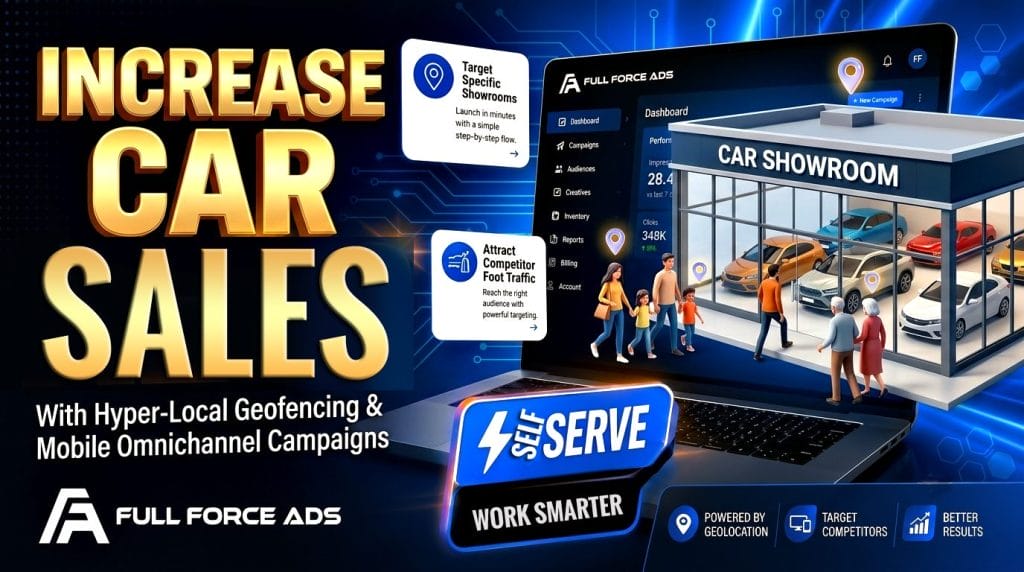
Dealerships achieve this market conquest through precise, building-level digital geofencing paired with a mobile advertising strategy. Using location data, you can draw highly accurate boundaries around competitor lots, auto shows, service centers, and high-income neighborhoods. This process serves compelling messages directly to the devices in buyers' pockets.
Executing tricky location campaigns requires a unified approach rather than fragmented messages across siloed software platforms or unresponsive agencies. Automotive brands need an enterprise-grade strategy to dominate regional campaigns. Partnering with a specialized team that handles omnichannel distribution from a single interface turns location data into showroom foot traffic. Dealerships looking to establish this edge can deploy advanced targeting capabilities through Full Force Ads Advertising Solutions.
To use location-based mobile advertising effectively, you must understand the technical difference between standard radial targeting and true, building-level geofencing.
[ Radius Circle Includes: Highways, Fields, Residential, AND Target Lot ]
Plaintext
⎾‾‾‾‾‾‾‾‾‾‾‾‾‾‾‾‾‾‾‾⏋
| Competitor Showroom |  <- Captures only high-intent buyers on-site
⎿___________________⏛
Virtual fences match only the exact property lines.
Many legacy advertising vendors offer crude radius drops disguised as geofencing. They place a map pin and draw a one-mile or three-mile circle around it. This approach wastes ad budgets. A broad radius captures commuters driving 70 miles per hour down an adjacent interstate, families visiting a nearby grocery store, or residents in nearby apartments. These people are coincidental data points, not buyers.
Advanced geofencing utilizes spatial mapping to trace the exact property boundaries of a location. When a consumer crosses this virtual boundary with an active mobile device, the system logs their unique mobile ad ID (MAID) within an anonymized audience pool. This yields precise targeting accuracy. You can target three distinct environments:
The geofencing approach starts close to home — trace the property boundaries of rival showrooms and outdoor inventory lots within a 30-mile radius and serve ads to anyone who walks onto those lots. Regional auto shows, car auctions, and enthusiast meetups are equally worth targeting since the people there have already self-selected as active car buyers. But some of the highest-intent prospects aren't shopping at all yet: transmission shops, tire centers, and independent mechanics are full of vehicle owners staring down a costly repair bill and quietly wondering if it's time to trade up.
This capability transforms advertising into a surgical strike. You no longer guess who might look for a car based on broad demographic data. Instead, you identify people whose physical behavior proves they shop for a vehicle right now.
Conquesting intercepts a buyer who is already deep in the consideration phase on a competitor's lot and redirects them to your inventory. This requires an understanding of consumer psychology and mobile behavior.
Shoppers standing on a competitor's lot frequently experience high cognitive load and emotional friction. They may feel frustrated by a lack of available inventory, put off by aggressive sales tactics, or shocked by dealer markups. This vulnerability represents a clear window of opportunity, provided your mobile creative matches their immediate need.
To disrupt a competitor’s sales process, your mobile display ads, native placements, or short-form video creative must offer an immediate point of differentiation. Three creative angles perform best:
The most direct message is the inventory counter-offer: "Looking for a [Model Name]? We have 15 in stock across town with zero dealer markups. View our live inventory." For someone who just came from a lot with limited stock or inflated prices, that lands. A strong trade-in message works the same way — "Don't accept a lowball trade offer. Get a certified cash value from us in 90 seconds before you sign anything" — because every buyer with a trade-in is thinking about it. Round it out with a financing counter-punch: "We beat competing financing rates by up to 1%. Check your pre-qualified payment options instantly on your phone."
Deploying these action-oriented messages directly into the apps, mobile web browsers, and video streams that consumers browse while waiting for a finance manager introduces a powerful alternative at the exact moment of decision-making.
Mobile advertising extends beyond standard banner ads on websites. To engage a high-intent buyer, a dealership must utilize the full spectrum of mobile-accessible media channels. Consumers move seamlessly between apps, streaming music platforms, video players, and websites.
An effective campaign layers multiple mobile formats to maximize frequency and recall:
Standard mobile banner ads drive immediate visual recognition of an offer or vehicle incentive. Pairing them with native advertising yields higher engagement. Native ads adjust to the design and typography of the host mobile application or news feed. Because they blend with editorial content, they achieve superior click-through rates and bypass the banner blindness that smartphone users develop.
Sight, sound, and motion evoke an emotional connection to a vehicle. Serving short, 15-to-30-second unskippable pre-roll and mid-roll video ads inside popular mobile applications ensures prospects view your latest lease specials or truck promotions. Whether a prospect checks local sports scores, watches a news clip, or plays a mobile game in a rival’s waiting room, your video creative places your dealership front and center.
The car-buying journey extends into screen-free moments. Consumers listen to Spotify, Pandora, podcasts, and digital radio while commuting or exercising. Integrating digital audio advertising into your mobile mix reaches buyers when their eyes are off the screen but their headphones are in. A compelling audio spot, backed by data-driven targeting, plants the seed of your dealership's superior customer service or lifetime powertrain warranty before the buyer pulls into a physical lot.
While geofencing physical locations provides near-instantaneous conquest leads, a mature digital strategy layers multiple targeting solutions to move buyers through every phase of the sales funnel. Combining location data with digital intent data ensures you spend ad dollars only on interested parties.
Plaintext
[ Search Retargeting ]         -> Captures consumers researching vehicle keywords
          │
          ▼
[ Building-Level Geofence ]    -> Captures consumers physically visiting car lots
          │
          ▼
[ Site Retargeting ]           -> Nurtures consumers who visited your inventory pages
          │
          ▼
[ Addressable Targeting ]      -> Reaches a specific physical list of local households
Long before visiting a physical showroom, buyers signal intent through search engines. They look for queries like "best SUV for families," "truck lease deals near me," or "hybrid crossover reviews." Through search retargeting, your dealership captures these specific keywords at the individual element level. If a local consumer spent 48 hours researching a competitor's specific model online, your mobile display and video ads appear across their mobile apps, positioning your alternative model as the smarter choice.
Contextual targeting ensures your advertisements appear alongside relevant, brand-safe editorial content. If a local user reads an article on an automotive blog comparing mid-size trucks, or watches a video breaking down the towing capacity of a specific vehicle class, your contextual ads automatically populate on that page. This aligns your message with the consumer’s current mental focus, increasing the likelihood of engagement.
Most users who visit a dealership’s digital inventory pages do not fill out a lead form on their first visit. They browse a few vehicle detail pages (VDPs), check the trade-in calculator, and close the tab. Site retargeting keeps your dealership front of mind. As those visitors browse other apps, check the weather, or stream video content, tailored ads featuring the exact vehicles they viewed re-engage them and draw them back to convert.
Every mature dealership possesses first-party data: lists of leased vehicle owners whose contracts near termination, past service customers driving aging vehicles, and cold leads who walked out six months ago without buying.
Through addressable targeting, you upload these physical mailing addresses into a secure programmatic system. The platform maps those physical addresses to the exact digital devices tied to those specific households. Your dealership delivers customized digital offers across streaming television, mobile apps, and home computers directly to the exact families you want to reach.
Clicks do not buy cars; people buy cars. A campaign that generates thousands of accidental clicks from a mobile application but results in zero physical showroom visits is a failure of strategy.
Advanced programmatic platforms utilize Conversion Zone Tracking to provide true foot traffic attribution.
Plaintext
[ Step 1: Target Zone ]      ──> Shopper enters a competitor's geofenced lot and sees your mobile ad.
                                  │
                                  ▼
[ Step 2: Conversion Zone ]  🔀 Shopper leaves that lot and drives directly onto YOUR dealership lot.
                                  │
                                  ▼
[ Step 3: Attribution ]      ──> The platform logs a verified physical visit driven by your digital ad.
When a device enters a geofenced Target Zone and receives your mobile advertisement, the system tracks that device’s unique ID. If that same device subsequently enters a predefined Conversion Zone—a precise geofence drawn around your showroom and lot—the platform records a verified physical visit.
This data changes marketing accountability. Dealership principals no longer guess if their digital spend drives real-world results. Instead, weekly transparent reporting shows clear data:
This reporting eliminates the hidden methodologies of legacy agencies, allowing your leadership team to make agile, data-backed decisions regarding inventory allocation and marketing spend.
Many auto dealers remain locked into restrictive contracts with legacy marketing agencies that rely on outdated, pre-packaged audience segments and slow execution cycles. These agencies operate with large monthly budget minimums and take weeks to update creative when a factory incentive changes.
In automotive sales, a week-long delay in updating an ad campaign means lost market share. If a major competitor runs out of a sought-after inventory line, or if a manufacturer announces a weekend-only financing offer, your dealership needs to launch targeted campaigns immediately.
A programmatic partner eliminates these bottlenecks by operating with structural advantages engineered for speed:
Running display, streaming video, and geofencing through three separate vendors creates gaps in attribution and inconsistencies in message frequency. Top-tier platforms handle all of it from one engine, which keeps targeting consistent and makes cross-device attribution actually useful. Budget flexibility matters too: rigid monthly minimums protect the agency, not the dealer — the right partner should earn your business month after month based on verified showroom traffic and conversion data, not a contract you signed six months ago. And when the market shifts, you need ads that shift with it. Programmatic operations get new creative, updated geofences, and fresh keyword strategies live in days, not weeks.
If your dealership is ready to transition away from speculative branding and move toward high-intent, location-based conquesting, a structured roadmap ensures efficiency from day one.
| Strategic Goal | Recommended Digital Channel Mix | Target Location/Audience | Primary Conversion Metric |
| Local Brand Awareness | Geofencing, Mobile Display, Native Placements | High-traffic regional retail hubs, shopping districts, and partner venues. | Impression frequency, website traffic, and local search lift. |
| Competitor Conquesting | Geofencing, Addressable Targeting, Mobile Video | Exact property lines of rival dealerships and regional auto malls. | Verified showroom visits via Conversion Zone tracking. |
| Used Inventory Liquidation | Search Retargeting, Mobile Display, Native Ads | Local users actively searching for terms like "used trucks for sale" or "reliable pre-owned SUVs." | Vehicle Detail Page (VDP) views and lead form completions. |
| Service Drive Expansion | Addressable Targeting, Streaming TV, Mobile Web | Past customer database lists of owners driving vehicles older than four years. | Service bay appointments booked and inbound service phone calls. |
| High-Value Lease Retention | Addressable Targeting, Display, Video | Current lessees whose contracts expire within 90 to 180 days. | Showroom appointments, appraisal requests, and lease renewals. |
By aligning specific media channels with defined business objectives, dealerships avoid generic, multi-purpose campaigns that dilute ad spend. Every dollar spent ties directly to a specific audience segment, an appropriate channel mix, and a measurable real-world outcome.
The automotive market does not stand still. Every day your dealership relies on broad, untargeted digital impressions is a day your direct competitors use precise location data to peel away your buyers. Moving toward an agile, hyper-targeted mobile strategy is a fundamental operational necessity for any dealer intending to protect and expand their regional footprint.
Implementing this standard of advertising does not disrupt your existing internal workflow, nor does it require your marketing director to master the complexities of real-time bidding exchanges. It simply requires collaboration with a team that spends years refining the infrastructure of programmatic execution.
The process begins with a discovery call designed to analyze your market, evaluate your competitor footprint, and audit your current digital strategies. From there, a customized, data-backed recommendation outlines the exact channel mix and geofencing parameters required to capture your local buyers.
To see how building-level precision, transparent attribution, and multi-channel targeting transform your dealership’s monthly sales velocity, visit Full Force Ads Advertising Solutions and schedule a strategy demonstration for your market today.