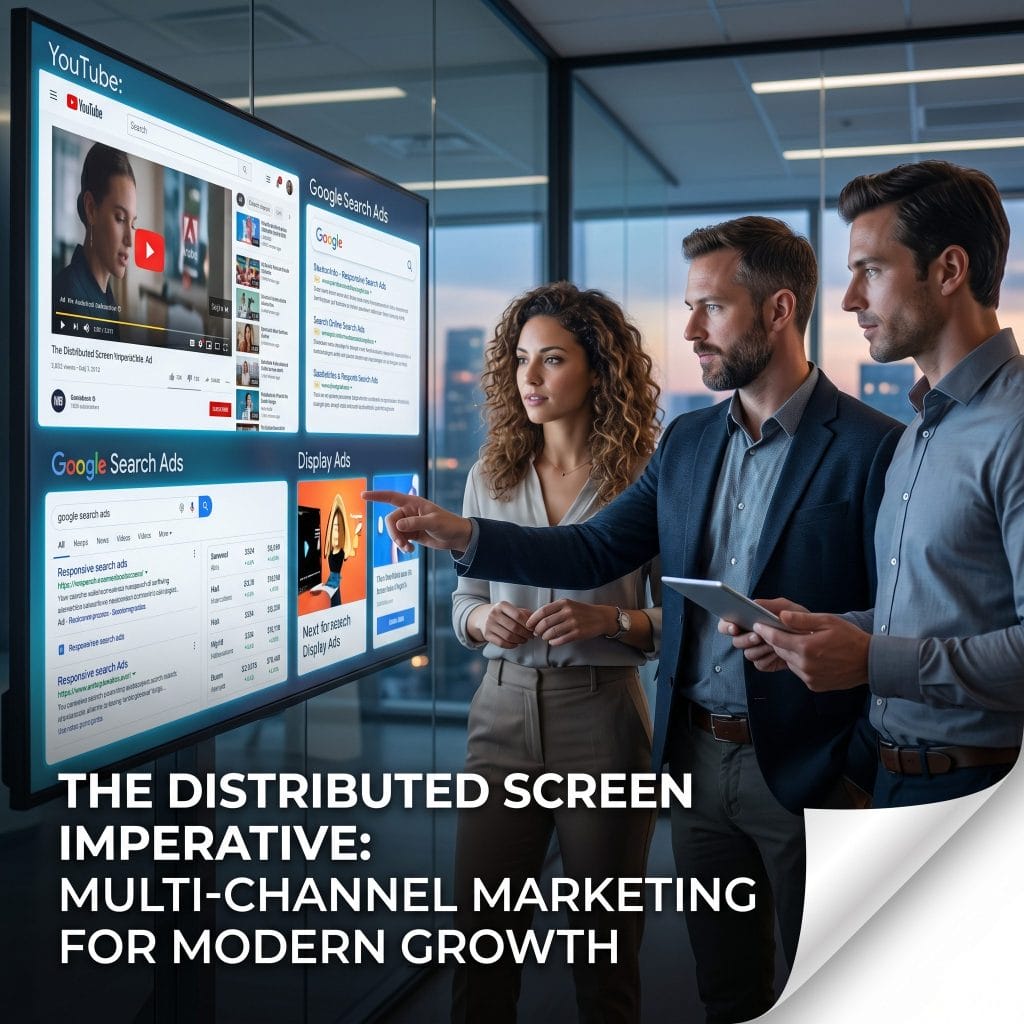
For entrepreneurs and mid-market executives, digital marketing feels like a bad bargain. You have access to the most sophisticated consumer tracking and media distribution infrastructure ever built, but managing it turns into a grinding multi-front war of administrative attrition.
Modern consumers do not live in a single digital silo or wait around to see a single ad. They live across devices:
Traditional advice says you have to hire a massive tech stack or a small army of specialized agencies: one for SEO, one for paid social, one for display banners, and an independent broker for connected TV.
That creates a structural nightmare. The real cost is not the capital. It is the cognitive load of managing disjointed vendor communications, overlapping audience data, and contradictory PDF analytics reports. When every vendor claims credit for the same customer conversion, your marketing budget turns into expensive guesswork.
Efficiency means moving away from tactical fragmentation. You have to run strategic omnichannel campaigns controlled from a single operational dashboard.
A lot of legacy marketing circles treat display advertising as a low-value commodity. Rookie media buyers look at display ads only through direct-response click-through rates, which misses a huge opportunity.
When you run display through a programmatic framework, it becomes the cost-effective anchor for your digital ecosystem. There are two financial wins:
Display banners hold a continuous market presence across millions of websites and apps without burning premium capital. Using display as a high-frequency, low-cost touchpoint primes your target market. When that audience later sees higher-cost media (like video or streaming TV ads), conversion speed goes up.
Most first-time website visitors leave without filling out a form or making a purchase. Without a display infrastructure running in the background, the capital you spent to get that initial traffic is gone. Display advertising works as an automated safety net. It tracks and re-engages those anonymous visitors, keeping your brand visible as they browse the web and pulling them back into your sales funnel at a fraction of the initial cost.
[Initial Prospect Web Search / Content Consumption]
│
▼
[High-Intent Traffic to Website] ──(95%+ Bounce/Leave)──┐
│ │
▼ (Conversion) ▼
[Immediate Revenue] [Site Retargeting via Display]
│
▼
[Automated Nurture Cycle]
│
▼
[Low-Cost Bottom-Funnel Conversion]
Pairing the economical footprint of display ads with targeting data shifts your strategy from buying impressions to securing qualified human attention.
Channels (whether audio streams, television screens, or mobile applications) are just delivery pipes. The value of digital advertising lives inside the data layers running through those pipes. To protect your budget, campaigns have to move past primitive zip-code and basic demographic filters. Precision takes five advanced targeting setups:
Legacy location targeting relies on crude radial boundaries. A vendor draws a half-mile circle around a landmark, sweeping up highway traffic, residential neighborhoods, and irrelevant bystanders.
Advanced geofencing solves that with custom-drawn, building-level polygon tracing. If your ideal customers walk the floor of a specific trade show, step into a competitor’s showroom, or frequent a commercial hub, the system traces the exact architectural footprint of that property. Every mobile device crossing the virtual threshold gets logged anonymously. You can then serve ads to those individuals at the venue, or on their home TVs days later.
Direct mail has great targetability but comes with high printing costs, delivery delays, and no interactive tracking. Addressable household targeting bridges offline precision and digital agility. By taking a physical list of customer addresses (from your CRM, real estate records, or business lists) modern platforms map those physical locations directly to the specific IP networks and connected devices running inside those homes. You serve targeted digital ads across every screen in a household, getting the hyper-targeting of direct mail with the dynamic tracking and lower costs of digital media.
Search retargeting catches prospective buyers based on the exact keywords and phrases they type into search engines, showing them relevant ads after they leave the search results page.
The system pairs that intent data with site retargeting. When a prospect lands on your digital properties, the advertising ecosystem tracks their behavior, noting which service pages they viewed and which services they ignored. The system then automatically serves creative updates matching their interests to take apart objections across the open web.
A message is only as good as the environment where it shows up. Contextual targeting uses algorithms to scan the text, metadata, and structural topics of websites. If you sell commercial HVAC solutions, your ads belong next to articles on commercial real estate trends, energy efficiency regulations, or facility management best practices, not celebrity gossip columns. Lining your brand up with the topics your audience reads makes your advertising feel like a natural extension of the page.
Once you align low-cost display assets with advanced targeting data, the next step is syncing across devices. Real market presence happens when a brand owns every primary screen in a consumer’s daily life, building omnipresence on a mid-market budget across six core digital channels:
Your media mix has to match your specific operational objectives. The table below shows how businesses combine advanced channels and precise targeting to solve real marketing problems:
| Operational Business Objective | Recommended Channel Mix | Primary Strategic Advantage |
| Hyper-Local Foot Traffic & Awareness | Geofencing + Display + Mobile | Converts physical proximity into digital engagement, tracking real-world storefront visits from exposed prospects. |
| Competitive Conquesting | Geofencing + Addressable Targeting | Targets the physical footprints of your direct competitors’ locations and their known customer bases. |
| Enterprise Brand Building | Streaming TV + Video + Audio | Delivers high-impact storytelling across premium media platforms to build institutional trust and authority. |
| High-Intent Lead Generation | Display + Native + Search Retargeting | Capitalizes on active search behaviors, capturing inbound interest and converting it through contextual ad placements. |
| Bottom-Funnel Pipeline Velocity | Site Retargeting + Display + Video | Prevents pipeline stagnation by re-engaging previous website visitors who left before converting. |
| Precision Account-Based Marketing (ABM) | Addressable + Streaming TV + Display | Restricts ad spend to a verified list of high-value target households or corporate offices across their active screens. |
A lot of vendors overcomplicate digital marketing. They hide behind confusing jargon, demand massive ad spend minimums, and lock clients into long-term contracts that protect the agency rather than the business.
Headquartered in Sandy, Utah, Full Force Ads launched in 2015 to break that broken agency model. The firm gives small and mid-sized businesses direct access to the same programmatic ad networks used by global brands, without the corporate red tape or inflated price tags.
| Typical Programmatic Vendor | Full Force Ads |
| • $10K+ Fixed Monthly Minimums | • Flexible, Scalable Budgets |
| • Blind Zip-Code Targeting | • Building-Level Geofencing |
| • Impressions-Only Metrics | • Real Foot-Traffic Reports |
| • Juggling Multiple Vendors | • Unified Multi-Channel Hub |
| • Long 6-Month Contracts | • Month-to-Month Partnerships |
| • Opaque Monthly PDF Reports | • Transparent Weekly Reporting |
Consolidating your digital advertising through Full Force Ads strips out the friction of managing fragmented campaigns:
Building an advertising campaign takes a systematic onboarding process designed to align media execution with your financial goals:
Every campaign starts with an open conversation. We look at your business model, work through your target audience, review past marketing challenges, and map out your core growth goals.
We pass on one-size-fits-all templates. Our strategy team builds a custom channel mix and targeting architecture tailored to your geographic market, industry dynamics, and budget.
Once you approve the strategy, our operations team handles the technical setup, connects the tracking data, and launches your creative across selected ad exchanges within 5 to 7 business days.
We continuously watch and adjust your targeting parameters, creative performance, and budget allocations to maximize conversions. Every week, you get transparent performance metrics showing how your investments drive growth.
The real cost of marketing for an entrepreneur isn’t just the financial investment. It’s the constant distraction. Every hour you spend analyzing broken data dashboards, tracking down missing ad creative, or managing disconnected vendors is an hour stolen from running your team and scaling your operations.
Digital advertising doesn’t have to be an exhausting, fragmented struggle. By combining the cost-effective consistency of modern display networks with high-impact streaming and precise targeting data, you can build an efficient marketing operation that runs entirely under one roof.
Let go of the administrative headaches of fragmented marketing. Partner with a team focused on clear execution and measurable growth.
Visit Full Force Ads today to review our capabilities, look at our platform solutions, and schedule a live demo with our strategy team. Turn your marketing from a stressful operational burden into a predictable growth operation.