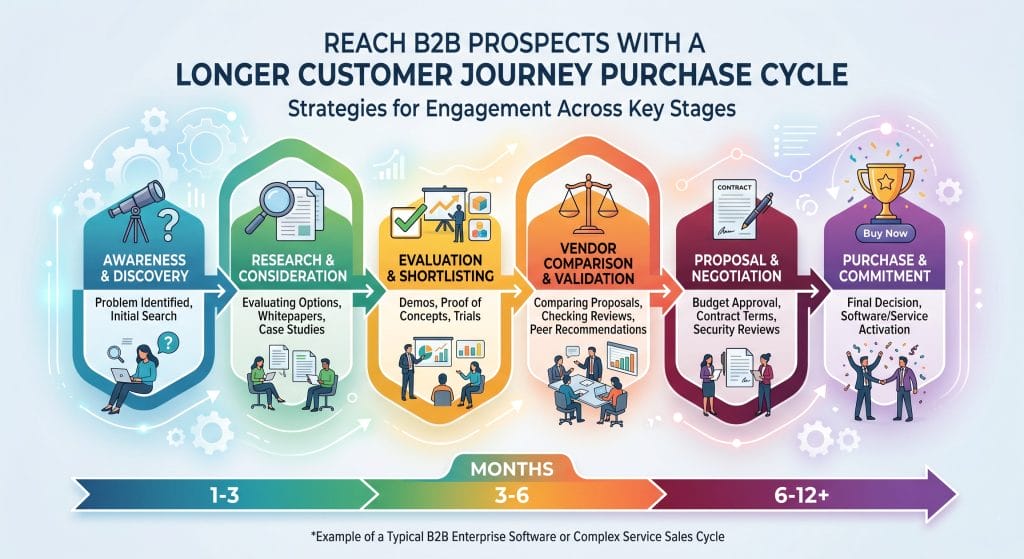
B2B buying takes patience. Slick digital ads and whitepapers no longer capture a lead, pass it to sales, and close a deal in a few weeks. The modern B2B customer journey takes months, involves separate departments, and requires consensus from six to ten decision-makers. Finance, procurement, IT, and end-users all bring different priorities and objections to the table.
Treating that long journey as a linear funnel wastes ad spend. A six-to-twelve-month cycle calls for a layered digital advertising strategy that matches how the buying committee’s focus shifts over time.
B2B purchases move through a tangled web of research and internal debate. Digital advertising has to guide buyers through four distinct phases.
[ Problem Identification ] ──► [ Evaluation of Options ] ──► [ Risk Mitigation ] ──► [ Procurement ]
Prospects at this stage feel operational inefficiencies or rising costs, but they haven’t formalized the problem. Ads need to focus on the problem itself, not the product.
Once the committee forms, progress slows. Stakeholders compare software frameworks and set evaluation criteria. Ads need to validate the solution framework and build consensus across departments.
In the final months, buyers focus on career and budget safety. Ads need to prove stability, security, return on investment, and smooth implementation.
After the sales team opens an opportunity, ads keep running to support the legal and procurement review, keeping the brand in front until the contract is signed.
Different ad platforms serve different purposes over a nine-month period. A working strategy mixes channels based on their native strengths.
Showing the same graphic for twelve weeks causes banner blindness. Creative assets have to change alongside the buyer’s journey.
| Phase | Asset Type | Message | Key Metric |
| Top of Funnel | Thought Leadership Videos, Articles | Industry trends, cost of inaction | Video completion rate, engagement |
| Middle of Funnel | ROI Calculators, Webinars | Framework validation, peer comparisons | Pipeline velocity, form completions |
| Bottom of Funnel | Case Studies, Security Docs | Risk mitigation, compliance, ROI proof | Demo requests, acquisition cost |
Early-stage ad copy should read like high-value analysis, not a pitch. Use LinkedIn Document Ads to share complete frameworks directly in the feed without forcing a form fill. Giving away findings builds equity early.
Simple site-wide retargeting fails during a long purchase journey. Use time-based sequencing and CRM synchronization instead.
[ Day 1–30 Post-Visit ]  ──►  Educational Content (Webinars, Whitepapers)
[ Day 31–60 Post-Visit ] ──►  Social Proof (Case Studies, Reviews)
[ Day 61–90+ Post-Visit ] ──►  Direct Response (Demo Requests, Trials)
If a prospect stops visiting the site for two months, rushing them to a demo page fails. Re-engage them with mid-funnel content first.
Link ad platforms directly to systems like HubSpot or Salesforce. When sales teams mark an account as "Discovery Completed," automation should shift those employees from awareness ads into validation ads. If a deal stalls for 45 days, raise the frequency of case-study ads to revive internal conversations.
Traditional measurement models mislead B2B teams. First-click attribution ignores the nurturing ads that kept the deal alive. Last-click attribution credits everything to the final branded search, which leads teams to cut the brand campaigns that generated the demand in the first place.
Apply a 60/40 split to keep the pipeline running.
┌───────────────────────────────────────────┬───────────────────────────────────┐
│        60% Brand & Demand Gen             │        40% Demand Capture         │
│  (TOFU/MOFU: Videos, Native Content)      │   (BOFU: Branded Search, Demos)   │
└───────────────────────────────────────────┴───────────────────────────────────┘
When markets tighten, do not turn off advertising. Stopping ads creates a revenue air pocket six months later when the pipeline dries up. Shift the budget into low-cost retargeting channels to keep existing leads warm instead.
Digital ads have to work as an automated extension of the sales team. If account executives keep hitting the same three security or implementation questions on discovery calls, the marketing team has to turn those objections into targeted ad campaigns for active pipeline accounts. Handling hurdles through paid ads before the next sales call shortens the sales cycle.
Optimize campaigns using leading indicators rather than waiting for closed-won data. Track whether target accounts stay on landing pages longer, whether engagement rates inside ideal customer profiles rise, and whether branded search volume goes up over a rolling 90-day period.
Buyers face high stakes and real professional risk. An advertising ecosystem that respects their timeline, educates their committee, and stays present positions the brand as the logical choice when they’re ready to buy.