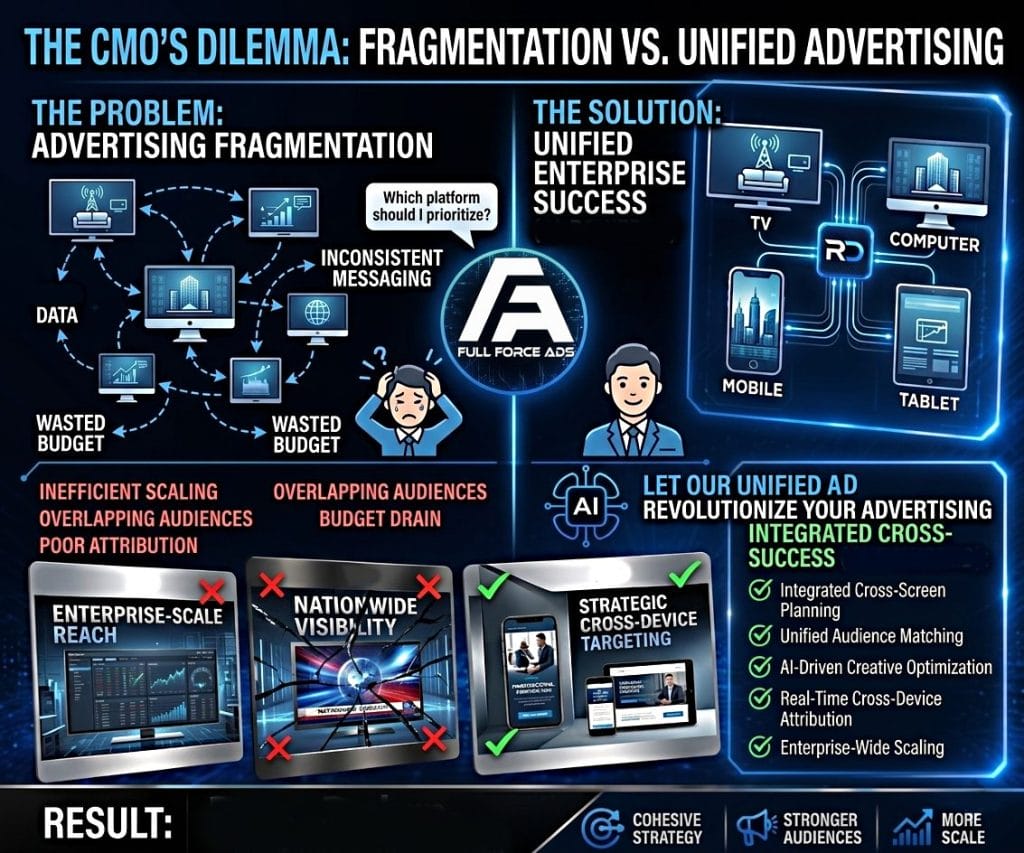
Marketing leaders waste time managing a mess of disconnected platforms. On any given day, an executive is juggling separate dashboards for programmatic display, connected TV, geofencing, and household targeting.
That split creates real problems. Fractured budgets and mismatched reporting hide the actual customer journey. Multiple vendor markups, long contracts, and opaque data compound the damage.
The businesses gaining ground are the ones running everything from one platform with unified data.
Full Force Ads, based in Sandy, Utah, builds programmatic frameworks for mid-market brands and growing businesses. The platform replaces scattered vendors by uniting streaming TV, geofencing, site retargeting, and first-party data into one managed system.
Connected TV and Over-The-Top media are replacing cable. Running non-skippable video ads on Roku, Fire TV, Hulu, and Peacock gives you the impact of television with the precision of digital targeting. Instead of buying broadcast slots and hoping the right people see them, you target specific households using behavioral data.
Consumers spend hours watching video across websites and mobile apps. Programmatic pre-roll, mid-roll, and outstream video capture attention while users read news, sports, or industry content. Outstream video integrates within articles as users scroll and delivers strong completion rates without disrupting the reading experience.
Audio spots on Spotify, Pandora, SoundCloud, and podcast networks deliver messages in an uncluttered environment when the audience is actually listening. Commuters and exercisers hear the ad with no screen competing for their attention, which drives strong recall.
Smartphones stay within arm's reach. Programmatic mobile advertising engages users inside apps and web platforms. Paired with location data, mobile campaigns drive physical foot traffic by reaching buyers near your store or a competitor's location.
Banner ads across brand-safe websites provide cost-effective reach and frequency. While click-through rates are lower than search, display builds the retargeting pools and cross-channel awareness that make every other touchpoint more effective.
Native placements match the visual style and typography of surrounding editorial content, which prevents the banner blindness that kills standard ad blocks. Because they blend into content feeds, native ads drive higher engagement for thought leadership and lead-generation campaigns.
The right channel mix doesn't matter if it reaches the wrong people. Here's how advanced targeting routes budget toward high-intent prospects:
| Business objective | Targeting mix |
| Local store foot traffic | Geofencing, display, mobile |
| Winning competitor market share | Geofencing, addressable |
| Rapid brand building | Streaming TV, video, audio |
| High-volume web traffic | Display, native, search retargeting |
| Recovering abandoned leads | Site retargeting, display, video |
| Activating CRM lists | Addressable, CTV, display |
Standard geofencing uses loose cell-tower radii that accidentally capture nearby gas stations and highways. Precision geofencing traces the exact footprint of a specific structure — a competitor's showroom, convention center, or neighborhood block. The system logs mobile devices that enter that space and serves ads to them across all screens for up to 30 days after they leave.
Addressable targeting connects offline databases, voter files, or mailing lists to digital campaigns. Upload street addresses, and the platform maps them to IP addresses and connected devices in those households. Display, video, and streaming TV ads then reach those exact residents without wasted impressions.
Paid search only captures users on the results page. Search retargeting extends that intent to the open web. When someone searches for a relevant phrase, the intent is logged. As they move on to news sites or apps, the platform serves display or native ads based on those recent keywords.
Contextual targeting places ads next to relevant content. B2B software ads appear on enterprise tech blogs; medical equipment ads run next to healthcare journals. Behavioral targeting adds depth by analyzing purchase history and lifestyle interests to match the consumer's actual profile.
Most first-time visitors leave without converting. Site retargeting tracks behavior across web properties and re-engages those visitors with ads matched to the specific pages they viewed.
Tightening privacy regulations and the phase-out of third-party cookies make rented audience data a growing liability. Sustainable advertising needs a foundation of owned, first-party data.
Internal CRM databases, subscriber lists, and purchase histories are assets most companies underuse. Bringing that offline data into a programmatic platform opens two capabilities: omnichannel remarketing that matches email and phone lists to digital device profiles for retention offers across streaming TV, display, and mobile — without cookies — and lookalike modeling that analyzes traits of current customers to find new prospects with similar behavior.
Traditional programmatic vendors often restrict mid-market businesses with high spend minimums, opaque metrics, and rigid six-month commitments. Full Force Ads removes that overhead — no long-term contracts required, and budgets can shift as market conditions change.
Many agencies bundle ad spend and management fees into a single line item. Full Force Ads provides granular campaign data showing exactly where every ad ran, which websites served impressions, video completion rates, and what actions viewers took.
Scattered platforms lead to inefficient spend and missed opportunities. Competitive advantage belongs to brands that centralize media, use data-driven targeting, and demand clear reporting.
Stop chasing vanity metrics across disconnected vendors. Visit the Full Force Ads platform to schedule a demo and start your discovery call.