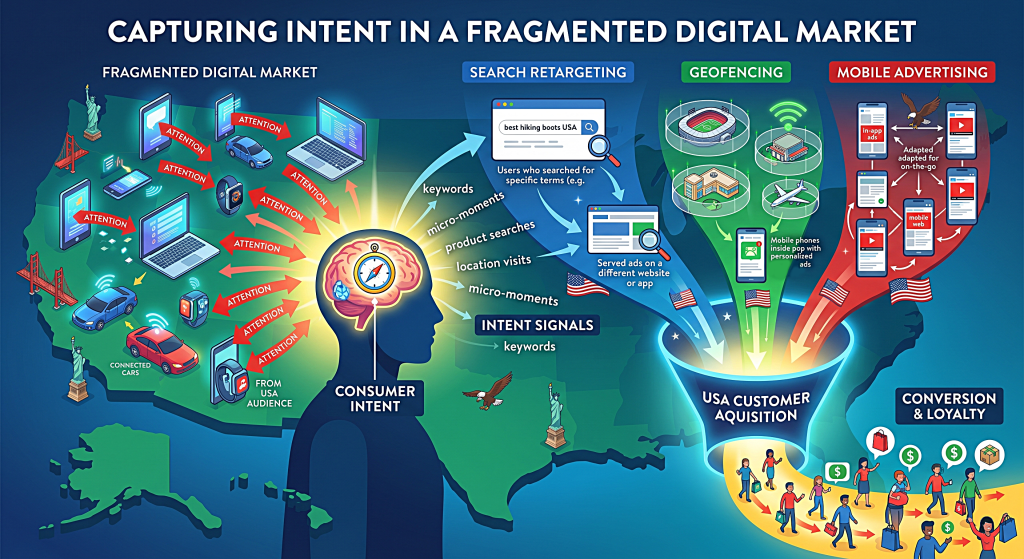
American consumers encounter thousands of digital touchpoints daily, moving from smartphones and podcasts to desktop screens and streaming TV. For business owners and marketing executives, this fragmentation splits consumer attention, making sustained engagement difficult. Treating digital advertising as disconnected tasks (running isolated search campaigns, occasional social boosts, and ignoring programmatic media) loses market share to competitors with unified strategies.
To scale, move beyond single-channel tactics. Growth requires an omnipresent approach that reaches consumers across every screen.
Modern display advertising is a data-driven discipline that places targeted, visual creatives across millions of premium websites, mobile applications, and global networks. It builds brand equity and fuels advanced retargeting.
Using display media correctly keeps your brand visible to active buyers. When a prospect faces a problem your business solves, your company becomes the default choice. This approach secures millions of impressions and establishes market presence cost-effectively. Layered with precise data, display ads become direct entry points into your sales funnel.
Relying on one advertising channel increases financial risk. Because consumers move fluidly between devices and media formats, your advertising infrastructure has to keep up. Unified platforms let businesses deploy a coordinated strategy across five primary channels from one hub.
Streaming TV (Connected TV). Traditional linear cable television is losing viewers. Audiences now stream content via Roku, Fire TV, Apple TV, and Hulu. Streaming TV advertising combines the visual impact of traditional television commercials with digital data tracking. These premium ads are unskippable. Placing your brand on the main household screen builds immediate authority.
Video Advertising. Online video captures attention faster than text. Deploying pre-roll, mid-roll, and outstream video pieces across news portals and mobile apps tells your brand story dynamically. A fifteen-second video addresses customer pain points and delivers a clear call to action during active media consumption.
Audio Advertising. Drivers, runners, and remote workers represent a previously unreachable audience for digital display. Programmatic audio advertising places your message directly into podcasts, Spotify, Pandora, and digital radio. These spots face minimal clutter, securing undivided attention during screen-free activities.
Mobile and Native Ads. Mobile advertising targets users inside applications, gaming environments, and browsers. Paired with location metrics, it drives immediate foot traffic. Native advertising adjusts to the design and editorial style of the host website. Because these ads mirror organic content, they achieve high click-through rates and build deeper reader trust.
Impressions and clicks don't generate revenue. Conversions do. To turn a viewer into a buyer, your digital strategy must align with three behavioral principles.
Familiarity. The Mere-Exposure Effect shows that people prefer familiar options. Seeing your television commercial, hearing your audio spot, and viewing your display banner builds trust. Prospects naturally choose the familiar name over unknown competitors.
Low Cognitive Load. Buyers avoid complex purchasing processes. Your messaging must state what you offer, how it improves the customer's life, and how to buy it. Multi-channel campaigns feed digestible information incrementally, reducing purchase resistance.
Relevance. When an ad matches a user's current context, past behavior, or location, resistance drops. The message functions as a timely solution rather than an interruption.
The best creative asset fails if shown to the wrong audience. Advanced digital advertising uses hyper-targeting to place messages exclusively in front of qualified buyers.
| Targeting Solution | Core Mechanism | Primary Goal |
|---|---|---|
| Geofencing | Draws virtual perimeters around physical locations to capture mobile IDs | Diverts competitor foot traffic |
| Addressable | Maps physical mail addresses to exact digital device graphs | Matches CRM data for Account-Based Marketing |
| Site Retargeting | Serves ads to users who previously visited your website | Recovers abandoned carts and shortens sales cycles |
| Search Retargeting | Targets individuals based on recent search engine keywords | Captures high-intent users affordably |
| Contextual | Matches ad creative to the specific topic of a webpage | Places ads within trusted editorial content |
Geofencing bridges physical and digital spaces. Drawing a virtual boundary around a competitor's storefront, trade show, or neighborhood isolates the unique mobile device IDs of visitors. You can then serve targeted display, video, or streaming ads to those individuals for weeks, service superior alternatives right after they leave a competitor.
Addressable and Search Targeting. Addressable targeting matches physical mailing lists or cold CRM leads to digital devices, delivering streaming and display ads directly to specific households or offices to eliminate budget waste. Search retargeting offers a budget-conscious alternative to expensive search engine bidding. Instead of paying high cost-per-click rates on Google, you target users across the web who recently searched for your industry keywords, capturing active intent at lower costs.
| Corporate Growth Goal | Channel Mix | Tactical Strategy |
|---|---|---|
| Local Foot Traffic | Geofencing, Display, Mobile | Draw perimeters around local competitors; deploy location-specific mobile promotions |
| Competitor Conquest | Geofencing, Addressable, Native | Target competitor offices; upload client registries to serve ads highlighting your advantages |
| Brand Building | Streaming TV, Video, Audio | Run short video commercials during primetime; match with audio ads on top podcasts |
| Lead Acquisition | Display, Native, Search Retargeting | Identify buyer search terms; target those users across the web and direct them to custom landing pages |
Traditional agencies often require multiple platform logins, fragmented communication, and rigid, long-term contracts. A unified programmatic platform removes this friction.
Managing your entire digital footprint from one hub provides a single point of contact and a synchronized brand message. Layered precision targeting ensures your budget reaches buyers, not vanity metrics.
Weekly reports show exactly where your budget goes, including specific websites and streaming networks. Flexible budget structures let you test performance and scale based on clear returns, with campaigns moving from creative approval to live deployment within seven business days.
Ready to build a data-driven advertising strategy? Visit Full Force Ads to review our capabilities, check out targeting options, and schedule a live custom demo.