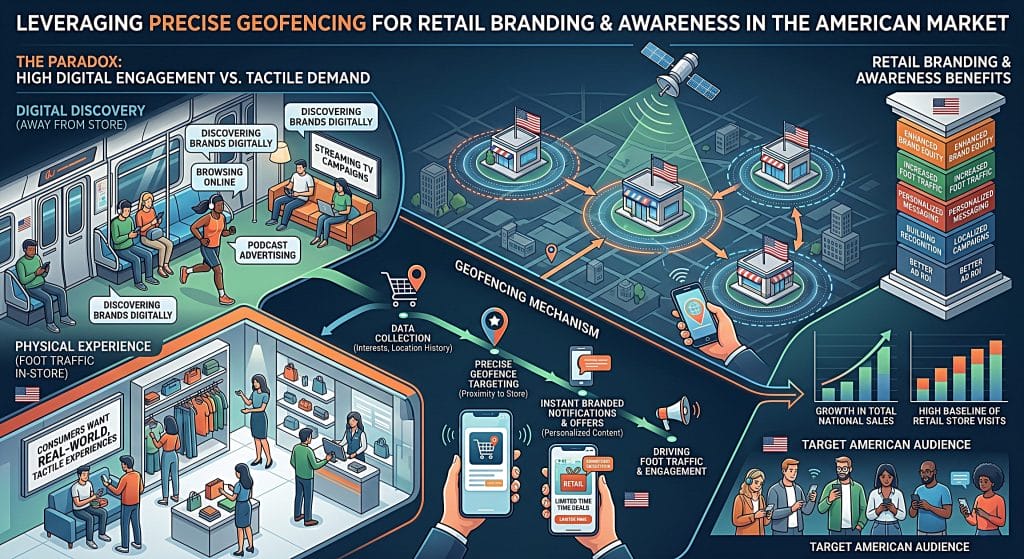
Modern retail runs on a paradox. Digital commerce drives a high baseline of total national sales, but physical storefronts are still filling with foot traffic. Consumers want real-world, tactile experiences, but they find brands digitally. They browse smartphones during commutes, listen to podcasts while running, and stream television after dinner.
For retail businesses growing their footprint, that fragmented journey takes immediate action. Passive billboards and broad television buys waste capital. Consumers want relevance across every screen.
To win, brands have to use location-intelligent advertising. High-impact awareness campaigns, backed by geofencing, drive that growth.
Business growth takes psychological alignment, not just impressions. When consumers walk into a store, they invest their time. To change their physical path, you have to use three levers:
Consumers choose convenience. By identifying exactly where a shopper is standing (in a competitor’s showroom, at a local event, or in a specific neighborhood), you can deliver relevant messaging that cuts the friction between awareness and action.
One ad rarely changes behavior. A unified approach works better. A consumer hears a targeted audio ad during a morning stream, sees a native display ad on a local news site that afternoon, and watches a video ad on Connected TV (CTV) that evening. That multi-channel frequency builds authority without repetitive bombardment.
Your target market is already spending money with your direct competitors. Catching those shoppers during the decision-making process lets you put a better alternative in front of them right at the moment of evaluation.
Full Force Ads gives you a centralized programmatic platform to manage these channels (streaming TV, video, audio, mobile, display, and native) using precise local targeting.
Channels decide where a message shows up. Targeting decides who sees it. Geofencing isolates prospects based on verified, real-world behavior instead of wide zip codes.
[1. Virtual Boundary] -> Draw perimeters around competitor stores or districts.
          │
          ▼
[2. Audience Capture] -> Log mobile device IDs instantly as prospects enter.
          │
          ▼
[3. Omnichannel Delivery] -> Serve ads via CTV, mobile, or audio for up to 30 days.
          │
          ▼
[4. Foot Traffic Tracking] -> Measure exact offline conversions at your store.
The moment a consumer steps inside a custom digital boundary, the platform captures their anonymized mobile advertising ID. You can then serve targeted programmatic ads to that person across multiple touchpoints for up to 30 days:
Regional economics, population shifts, and commercial real estate dynamics drive geofencing returns. Five states show immediate potential for these campaigns:
Tens of thousands of affluent residents move to North Carolina every year. Retail vacancy rates stay low in Charlotte and Raleigh-Durham, pushing asking rents up. Because housing growth outpaces commercial construction, retailers have to build immediate awareness. Geofencing new housing developments and luxury apartment complexes lets incoming brands reach residents before they form habits with older competitors.
Population growth in Greenville-Spartanburg and Charleston has dropped retail vacancies to historic lows. Institutional capital is funding new mixed-use lifestyle centers. Retailers can draw digital boundaries around tourist corridors, coastal resorts, and highway entry points to capture out-of-state spending, or geofence competing shopping centers to pull local traffic.
Corporate relocations and demographic expansion dominate the Dallas-Fort Worth, Houston, Austin, and San Antonio triangles. The physical scale of Texas makes broad-market advertising inefficient. Geofencing isolates local campaigns. By layering addressable targeting, a retail enterprise can upload CRM or direct-mail lists, match them to Texas households, and deploy localized geofences around competitor strongholds.
Zero state income tax, population growth, and year-round tourism drive consumer spending in luxury goods, apparel, and dining. Retailers can use geofencing to target major events, country clubs, or premium outlets, then serve CTV commercials to those people when they get back to their residences or hotels.
The expansion along the Wasatch Front, from Ogden down through Salt Lake City to Provo, has created a young, tech-literate consumer base with high disposable income. These consumers stream media and use mobile apps heavily. Retailers can deploy geofencing around tech campuses, sporting events, and outdoor lifestyle centers, combining physical tracking with search retargeting.
Running a geofencing campaign takes a structured timeline to maximize return on ad spend:
| Strategic Goal | Recommended Channel Architecture | Persuasion & Deployment Rationale |
| Local Awareness & Traffic | Geofencing + Display + Mobile | Draw perimeters around high-traffic shopping districts near your store. Serve proximity-based mobile offers. |
| Competitor Conquesting | Geofencing + Addressable Targeting | Geofence specific competitor storefronts. Win over high-intent shoppers by presenting your value proposition on their devices. |
| Premium Brand Building | Streaming TV + Video + Audio | Target households inside high-income areas to build authority on large screens and audio channels. |
| Digital to Physical Traffic | Display + Native + Search Retargeting | Catch people researching related products online. Use native content and banners to guide them to your store. |
| Re-engaging Lapsed Visitors | Site Retargeting + Display + Video | Remind consumers who visited your website or app to finish their purchase as they browse other web properties. |
| Activating Historical Data | Addressable + Streaming TV + Display | Map your existing CRM database or loyalty lists to digital devices. Re-engage past buyers on their Connected TVs. |
Fragmented marketing creates disjointed messaging and budget waste. Juggling separate vendors for social media, search, Connected TV, and geofencing causes attribution errors.
Full Force Ads pulls your multi-channel footprint into a single platform:
Every day, high-intent consumers walk through your market, visit competitors, and search for products online. Legacy marketing tactics subsidize non-converting impressions. To capture market share, take an agile, location-intelligent posture.
[Schedule a Demo with Full Force Ads Today] to build your retail growth guide.