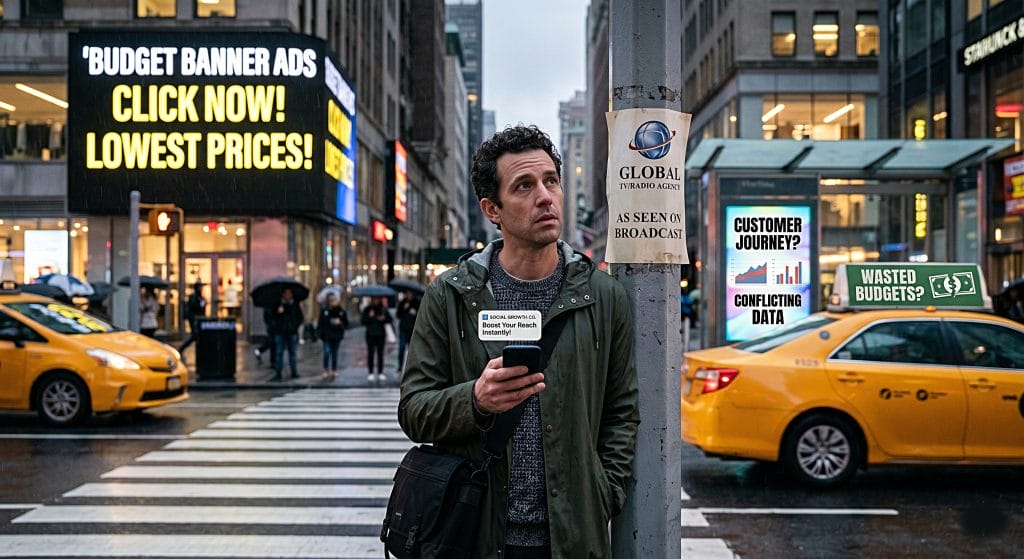
In the competitive American market, traditional methods for getting new customers fail. Businesses have long split their marketing, hiring separate agencies for social media, banner ads, and television or radio commercials. That fragmentation causes disjointed customer journeys, conflicting data, and wasted budgets.
Modern consumers move constantly between platforms. They stream television shows on Roku or Hulu, listen to podcasts on Spotify during commutes, read industry native platforms, and check mobile apps inside retail stores. Winning customers takes unified omnichannel strategies that deliver messages across every screen and channel.
Running streaming TV, video, audio, mobile, display, and native advertising inside a single ecosystem turns arbitrary ad spend into a predictable operation for revenue growth.
The window to capture prospect interest is shrinking. Lead acquisition takes precision and localized relevance because crowded digital channels push costs up and pull lower-quality leads in.
When consumers get ready to buy, they choose based on proximity, relevance, and convenience. If a brand is missing at the moment of demand, a competitor wins.
In competitive sectors like roofing, HVAC, and plumbing, broad demographic targeting fails. Showing banner ads to an entire metropolitan area wastes money on renters, people with new systems, or homes outside the service territory. Success takes reaching a household during acute need or when they engage with a competitor.
That pressure intensifies in major economic hubs:
To capture qualified leads, organizations use geofencing technology. By drawing virtual boundaries around competitor showrooms, trade shows, or commercial zones, businesses serve relevant ads directly to mobile devices, streaming apps, and desktops.
Real market saturation takes a strategic mix of media channels to handle different stages of the consumer journey.
                       [ Unified Omnichannel System ]
                                     |
    +----------------+---------------+---------------+----------------+
    |                |               |               |                |
[Streaming TV]    [Video]         [Audio]        [Mobile]     [Display/Native]
Programmatic streaming TV lets small and mid-sized businesses place ads on screens like Roku, Fire TV, Hulu, Peacock, and YouTube TV. Instead of buying expensive local broadcast spots, businesses stream ads only to households that match specific income brackets, behaviors, or purchase intent.
Digital video ads place pre-roll, mid-roll, and outstream video across premium websites and mobile apps. Those placements build brand authority while prospects watch news clips or industry tutorials.
People listen to Spotify, Pandora, and podcasts while driving, exercising, or working. Audio ads reach audiences during those screen-free moments, driving message recall without depending on visual attention.
Smartphones bridge digital messages and physical reality. Mobile advertising uses in-app placements, web banners, and location triggers to reach prospects based on real-time geographic position.
Banner ads across websites give you cost-effective frequency and retargeting. Pairing standard layouts with native advertising (which matches the visual look and context of the surrounding editorial content) helps you get past ad blindness and lift click-through rates.
Channels decide where ads show up. Targeting decides who sees them. Layering targeting strategies moves marketing from guesswork to precision.
| Targeting Solution | Core Functionality | Strategic Business Value |
| Geofencing | Traces boundaries around physical locations to capture mobile IDs. | Reaches competitor locations and industry events to drive foot traffic. |
| Addressable | Maps physical mailing lists to digital devices. | Reaches physical households with digital ads across all screens. |
| Site Retargeting | Tracks website visitors and serves them ads across the web. | Re-engages web traffic that left without converting. |
| Search Retargeting | Targets individuals based on search engine keywords. | Catches prospects early in the buying journey. |
| Contextual Targeting | Matches ad placements to the specific text and themes of a web page. | Places brands alongside relevant industry content. |
Modern geofencing runs on building-level precision instead of broad radius circles that accidentally sweep up highway traffic. A commercial roofing company, for example, can draw a boundary around a convention center hosting a property management expo.
[ Competitor Store / Trade Show Expo ]  --> ( User enters with smartphone )
                |
     ( Exact Building Footprint )
                |
     [ Anonymized Mobile ID Captured ]
                |
                v
[ Cross-Device Ad Delivery System ] --> ( Served on Roku, Mobile Apps, & Web )
When a prospect walks inside that boundary, the system captures their anonymized mobile advertising ID. The prospect then sees the brand’s streaming TV, video, and native ads across their devices.
Traditional direct mail is slow, expensive, and often goes straight to the trash. Addressable targeting takes a physical database of street addresses and cross-references it against a device graph. That identifies the smart TVs, laptops, smartphones, and tablets running inside those specific buildings, letting companies stream video ads and display native banners directly to targeted households.
Traditional advertising agencies often lock clients into rigid contracts, hide data in vague reports, and demand high budget minimums. Based in Sandy, Utah, Full Force Ads runs a unified programmatic platform that strips out middlemen, letting brands launch and optimize campaigns across all digital channels from a single location.
Media mixes have to line up with specific business goals. The plans below show optimal configurations for distinct corporate objectives.
Campaign deployment follows a four-step process to move from concept to active optimization.
+---------------------+      +-----------------------------+
| Step 1: Discovery   | ---> | Step 2: Custom Plan         |
| (Goals & Audience)  |      | (Channel Mix & Target Map)  |
+---------------------+      +-----------------------------+
                                            |
                                            v
+---------------------+      +-----------------------------+
| Step 4: Optimize    | <--- | Step 3: Full Launch         |
| (Weekly Clean Data) |      | (Live in 5-7 Business Days) |
+---------------------+      +-----------------------------+
Relying on fragmented channels, opaque reports, and untargeted ad spend wastes capital. To win in fast-paced markets, businesses need a cohesive, omnichannel approach that puts messages exactly where audiences spend time.
Whether you’re geofencing competitors in Dallas, running streaming TV campaigns in Miami, or capturing urgent home service leads in Phoenix, you need an agile execution partner focused entirely on measurable business outcomes.
Simplify your digital ad spend, get visibility into performance, and put your brand on the screens that matter. Visit the Full Force Ads Advertising Solutions Portal to review our capabilities, look at targeting options, and book a strategy demo.