Digital marketing is running into a structural wall. For over ten years, mid-sized companies, growing brands, and regional businesses operated on a single assumption: that relying on big social networks and dominant search engines was enough to build a solid brand.
Every marketing leader and business owner feels the strain of that model now. Customer acquisition costs jump every quarter. People tune out ad creative within days. Customer attention is scattered across smart TVs, phone apps, regional news sites, streaming radio, and physical stores. Yet most marketing operations stay locked inside single-channel siloes. They buy disconnected impressions from three or four different vendors, sort through conflicting analytics dashboards, and burn cash on broad demographic targeting that rarely translates into revenue.
Real growth requires breaking away from platform reliance. Winning market share today means showing up consistently across devices. That means targeting people based on real-world movement and clear search intent, then running strong creative across every screen where your audience actually spends time.
This guide outlines how regional and national brands use programmatic systems, multi-screen deployment, building-level location targeting, and unified attribution to strip waste out of their ad budgets.
1. The death of the single-channel silo and the case for full-funnel omnipresence
Consumers do not live inside one app feed, nor do they make major buying decisions off a single search query. A typical buyer wakes up, turns on a Spotify podcast, skims local news on a tablet over coffee, checks phone apps at lunch, streams TV on Hulu or Roku in the evening, and browses web articles on a laptop before bed.
When a business limits its budget to standard search ads or social feeds, it forfeits access to over 70% of a consumer's daily digital attention. Relying on disconnected point solutions also creates immediate operational problems.
To fix this, growing advertisers connect directly with unified programmatic infrastructure providers like Full Force Ads. Based in Sandy, Utah, Full Force Ads operates an end-to-end programmatic marketing platform designed for multi-screen scale.
Instead of navigating legacy ad systems or buying through resellers, Full Force Ads provides direct access to global ad exchanges, premium inventory sources, and unstructured data streams under a single management system.
2. Multi-screen activation: Consolidating your channel execution
An effective campaign meets buyers across their daily routine. By coordinating execution across major digital media from one platform, brands build steady touchpoints that turn into top-of-mind recall.
Living room screens carry a level of prestige that smaller mobile devices do not match. Programmatic Streaming TV lets brands run unskippable 15- and 30-second video spots on services like Roku, Fire TV, Hulu, Peacock, Paramount+, and YouTube TV without traditional cable commitments. Unlike legacy broadcast TV, programmatic CTV lets you target specific households based on location, demographics, or real-world habits.
Sight, sound, and motion capture attention faster than static graphics. Digital video campaigns run across pre-roll, mid-roll, and outstream placements on major publisher sites and mobile apps, building brand interest before pushing viewers down the conversion funnel.
Audio reaches people during screen-free routines like driving, working out, or running errands. Targeted audio ads on Spotify, Pandora, iHeartRadio, and podcast networks give brands a direct line to listeners while they move through their day.
Because smartphones act as the central digital hub for most buyers, mobile ads deliver local messages straight to their hands. Using real-time location data and in-app targeting, brands engage users as they navigate their surroundings.
Display banners across major websites and apps form the baseline layer for sustained market reach and retargeting. Persistent display placements keep your visual branding visible as potential customers browse their usual daily sites.
Native ads mirror the visual layout, typography, and editorial style of surrounding web content. By removing aggressive promotional cues, native placements draw natural clicks and build trust with readers focused on the article itself.
3. High-precision targeting: Turning impressions into revenue
Broad demographic targeting, like selecting males aged 25 to 54, burns ad budgets fast. Media channels determine where your message appears, but targeting rules dictate who sees it and why.
Standard radius targeting, such as drawing a 1-mile circle around an address, spends money on drivers passing by on highways or nearby residential side streets. Building-level geofencing uses custom polygon borders mapped around exact physical structures. You can outline competitor stores, trade show convention floors, or auto lots to target active buyers while they are physically on-site. The system also tracks when a mobile user exposed to your geofenced ad walks through your physical store doors.
Physical direct mail is slow, expensive, and difficult to measure. Addressable targeting updates mail lists by matching physical street addresses against household IP networks, mobile devices, and location markers. You can upload customer databases or targeted address files, then serve Streaming TV, display, and video ads straight to those specific households.
Search intent remains one of the clearest signals of buying interest. Search retargeting captures users based on the specific terms they query across web properties. That lets brands show display, video, or native ads to active searchers across the open web at a fraction of search engine pay-per-click rates.
Fewer than 3% of website visitors buy on their initial visit. Site retargeting captures the remaining 97% of bounced traffic, maintaining visual touchpoints across display, video, and streaming networks as those potential buyers browse elsewhere.
Contextual targeting analyzes page text in real time, placing your ads alongside relevant news stories and articles. This maintains relevance without relying on third-party cookie tracking.
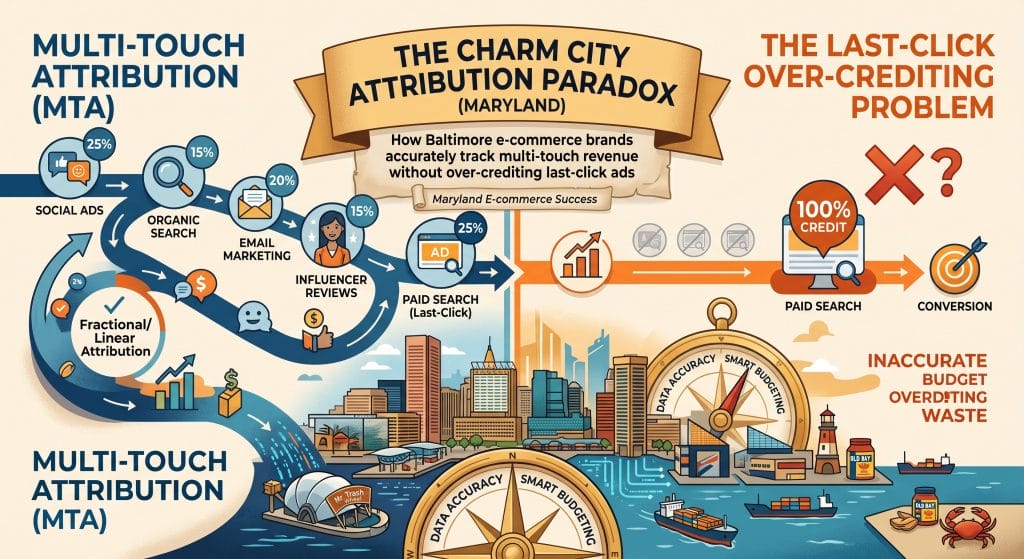
4. Case study analysis: Solving "The Charm City Attribution Paradox" (Baltimore, MD)
Look at a regional brand example to see how multi-screen programmatic strategy plays out in practice. "The Charm City Attribution Paradox" illustrates a common operational pattern among growing retail and e-commerce companies in the Baltimore, Maryland metro area.
The challenge
A growing Baltimore home goods brand was spending heavily across digital media, but their internal reporting showed a clear contradiction:
Standard last-click reporting missed early multi-screen exposures, over-crediting search channels while starving top-of-funnel ads that created customer demand in the first place.
The solution strategy
The brand shifted its strategy to Full Force Ads, running a multi-screen campaign across Maryland and target mid-Atlantic markets.
The results
By dropping isolated platform buying and tracking unified attribution, the brand saw clear operational gains within 90 days:
5. Strategic campaign architectures by business goal
Every business operates with distinct targets. Below are channel combinations designed to solve specific growth goals:
6. Full Force Ads vs. traditional agency models
Your execution partner shapes how quickly and efficiently your campaigns run. Traditional agencies often carry heavy management overhead, outsource media buying, require six-week launch windows, and ask for long contracts.
Full Force Ads uses a modern infrastructure model designed to give advertisers direct targeting tools, clear reporting, and fast setup.
Direct managed services or self-serve platform operations
Growing teams need setup choices. Full Force Ads supports both managed campaign services and direct platform management:
7. The 4-step onboarding framework: Launching your campaign in days
Running programmatic media does not require weeks of setup or complicated technical integrations. Full Force Ads uses a simple four-step process to get campaigns running in 5 to 7 business days.
First, during discovery, we assess baseline metrics and map out goals. We review your sales funnel, audience profiles, competitor landscape, and growth targets. There are no heavy sales pitches, just a practical assessment of which channels suit your budget.
Second, we build a customized channel plan for your market. Rather than offering packaged templates, our team designs a strategy around your audience's habits. We set up location geofences, addressable household matches, keyword targets, and CTV channel allocations.
Third, we handle creative setup and launch across ad exchanges. Your assets are reviewed, formatted, and pushed live across selected channels through our programmatic backend. Most campaigns go live within 5 to 7 business days.
Fourth, we handle ongoing optimization and tracking to refine performance weekly. Media buying needs active management. Our system tracks bid prices, placement quality, creative engagement, and location conversion rates. You get clear weekly reports showing where your ads ran, who saw them, and how they drove web traffic and physical store visits.
Take the lead: Modernize your media setup
Scale alone does not guarantee performance anymore. The brands that stand out over the coming years will be the ones that master multi-screen reach, meeting buyers across Streaming TV, video, audio, mobile, display, and native channels with accurate location and search targeting.
Stop splitting your budget across separate platforms or paying for broad, unmeasurable ad reach. Work with a team that provides programmatic infrastructure, exact geofencing, and clear reporting.
Visit Full Force Ads Advertising Solutions today to see how unified programmatic media can help scale your business.