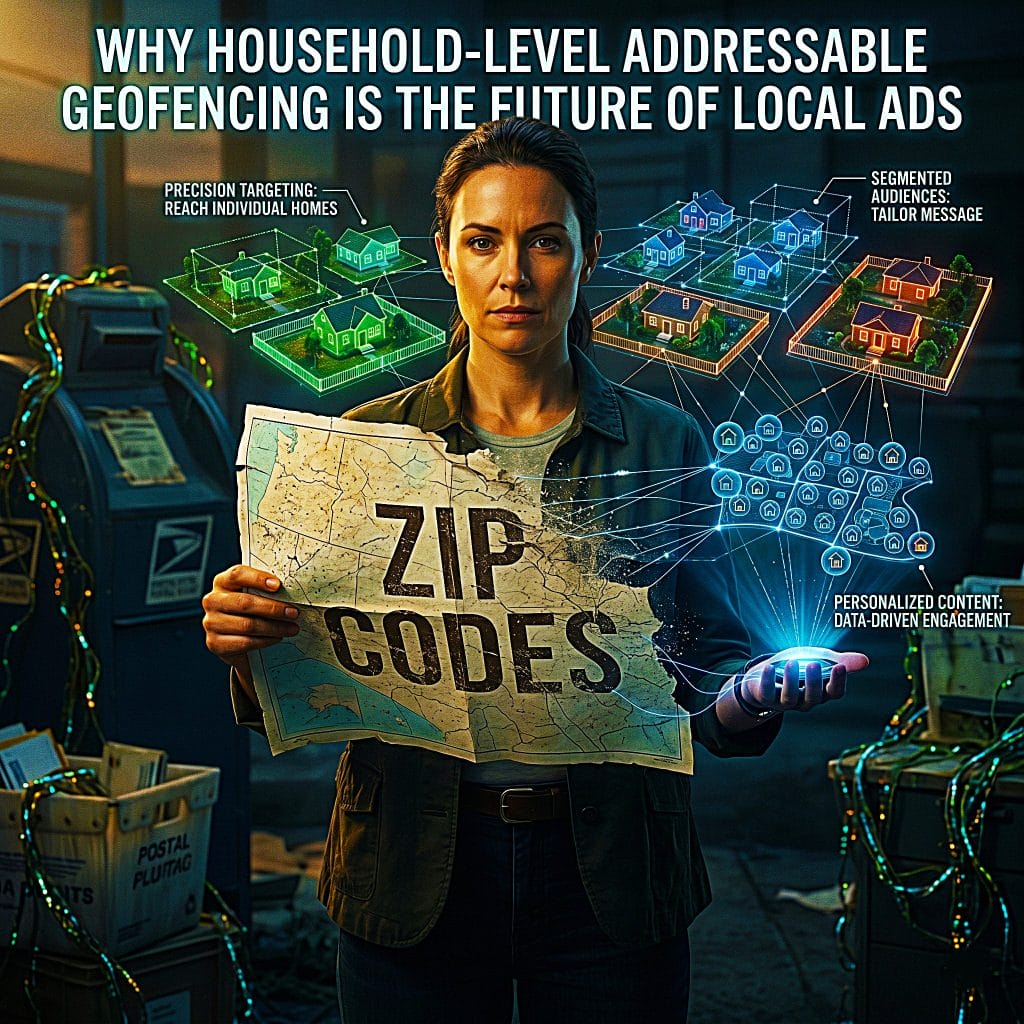
You launch a local ad campaign, pick target zip codes, and wait. Zip codes do not buy products. People do. Targeting an entire neighborhood casts an expensive net. You pay to show ads to college students, retirees, and families alike because they share a mail route.
Addressable geofencing targets individual households instead.
Traditional geofencing draws a boundary around a public location like a competitor’s store and serves ads to anyone inside. Addressable geofencing targets specific residential addresses, building a virtual boundary around those properties.
You can reach specific households using two methods:
Zip code targeting wastes budget on irrelevant impressions and runs on generalized geographic data. Household targeting uses precise CRM data, cuts ad waste, and delivers tailored messages to specific properties.
| Feature | Zip Code Targeting | Addressable Geofencing |
| Precision | Broad and generalized | Individual property |
| Budget Efficiency | High ad waste | Maximum efficiency |
| Data Quality | Outdated geographic data | Active demographics and CRM |
If a household doesn’t match your buyer profile, they don’t see the ad.
Traditional local advertising makes tracking results hard. Addressable geofencing tracks online and offline conversions directly.
That tracking measures your exact return on ad spend.
Stop funding broad neighborhood campaigns. You can control your local reach, cut ad waste, and identify the exact households driving your business.
Contact us to map your next campaign.