Chief Marketing Officers, business owners, and growth directors face the same quiet problem: diminishing returns on ad spend. The digital environments where American consumers spend their time have fractured. The era of predictably scaling revenue by throwing a budget into a single search engine or social media platform is gone.
Today’s consumer path to purchase is non-linear and insulated. People skip ads, switch devices mid-thought, stream audio while commuting, and watch television networks on connected home screens. Growth strategies relying on traditional, siloed digital ad placement drop market share and subsidize agile competitors.
To break through, enterprises must adopt an omnichannel media approach that balances targeting precision with scale.
Headquartered in Sandy, Utah, Full Force Ads has spent more than a decade designing media operations that give small, mid-market, and enterprise organizations access to advanced programmatic technology without corporate red tape, inflated minimum budgets, or rigid multi-month agreements.
Whether you are a CMO looking to deploy campaigns through an external media arm, or a digital marketing agency requiring a white-label programmatic execution layer, you must understand how to harness these multi-screen channels.
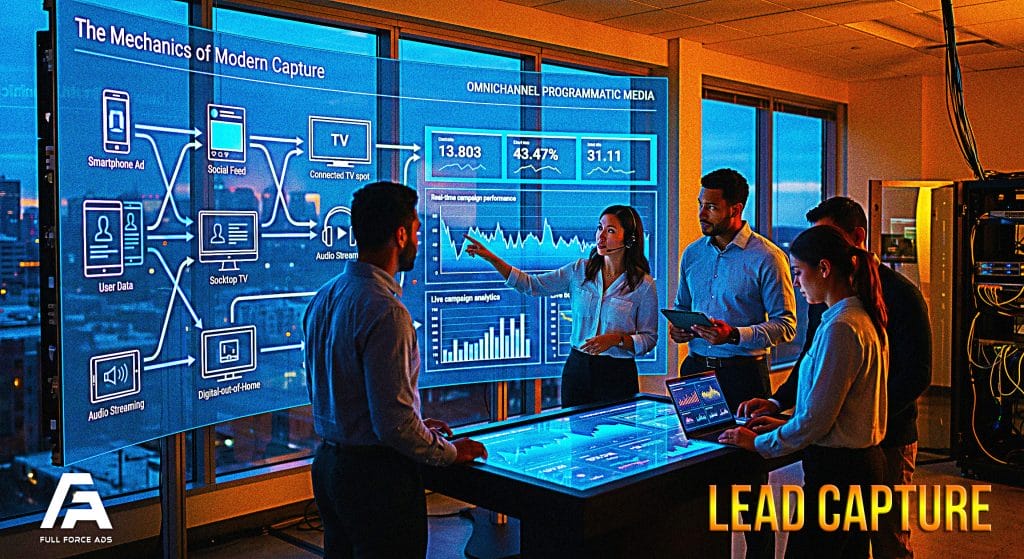
Multi-screen programmatic advertising establishes a brand presence across the screens your target demographic uses throughout the day.
By unifying your media buying within a centralized programmatic architecture, your business eliminates fragmented data, removes conflicting cross-vendor attribution metrics, and creates a story that follows the user from morning podcasts to evening television viewing.
Television builds psychological authority and brand equity. However, buying local cable packages based on broad age demographics is obsolete.
Through programmatic Streaming TV, brands place high-impact, premium video ads directly inside the living room across applications like Roku, Fire TV, Hulu, Peacock, and YouTube TV.
When a consumer views your message on a high-definition home display, your company sits alongside national brands. Full Force Ads targets individual households matching your specific behavioral criteria, purchase intent, or physical location history rather than airing commercials to an entire metropolitan broadcast region.
While Connected TV claims the living room, multi-device digital video captures mid-day attention. Placing pre-roll and mid-roll clips into publisher sites and mobile applications hits consumers during high cognitive engagement.
Outstream video placements appear within editorial text as a user reads, providing a native alternative that reaches users consuming long-form educational, financial, or industry-specific articles.
Consumers listen to curated audio streams while working out, driving, commuting, buying groceries, or managing tasks.
Programmatic audio placements across networks like Spotify, Pandora, digital AM/FM streams, and podcast aggregators slip into these audio environments. Because audio advertising encounters little competing visual stimuli, brand recall rates frequently outperform visual banners.
The average American checks their smartphone dozens of times every day. Mobile programmatic advertising meets prospects where they are, using clean in-app or mobile web placements.
When executed through a Demand-Side Platform (DSP), mobile ad delivery can target the physical building a device occupies in real time, transforming awareness campaigns into immediate calls to action.
Display banners serve as the foundation for multi-device retargeting and cost-efficient visual frequency. To maximize middle-of-the-funnel engagement, smart brands pair standard display creative with native advertising units.
Native ads inherit the typographic layouts, look, feel, and visual styling of the publishing environment where they live. Because they read like editorial pieces rather than intrusive promotions, they bypass subconscious ad-blindness barriers, driving higher click-through performance from analytical B2B and B2C buyers.
Channels define where your advertisements show up. The data framework transforms media spend into a client acquisition system.
Spraying creative across channels without granular behavioral filter layers wastes budget. To generate measurable business outcomes, campaigns must utilize data strategies that filter out wasted impressions and zero in on individuals displaying conversion intent.
Traditional geo-targeting relies on wide, imprecise radius bubbles. Drawing a half-mile or one-mile circle around a target location using social media or search platforms wastes ad dollars on passing highway traffic, residential homes, and irrelevant nearby businesses.
Full Force Ads bypasses this approach by deploying structural, building-level geofencing.
Our platform tracks and builds exact polygon boundaries along the architectural lines of specific buildings. This allows you to geofence your competitors' physical storefronts, industry trade shows, corporate office parks, or retail corridors.
When a buyer steps inside that bounded space, their unique mobile device ID enters an exclusive programmatic audience pool. You can serve tailored messaging to that prospect on their mobile devices instantly, or across their home Streaming TV sets later that evening.
If your enterprise possesses an internal CRM list, a list of lapsed clients, or a dataset of direct-mail leads, Addressable Programmatic bridges the gap between physical mail and digital multi-device saturation.
Instead of cross-referencing emails on limited social media databases, our platform maps physical street addresses directly to the exact internet router and connected hardware profiles tied to that household.
This enables you to deliver precise cross-device campaigns—spanning Connected TV, audio, and display banners—straight to the physical residences or corporate headquarters you care about most, maintaining top-of-mind dominance.
The modern conversion funnel requires an omni-directional approach to intent tracking. By blending search, site, and contextual signals into a single data strategy, your brand maintains a market presence:
Different business outcomes demand unique structural combinations of channels and target filters. No single platform or channel carries the weight of a multi-stage sales process.
To help optimize your internal media architecture, the table below outlines the channel-and-targeting blueprints Full Force Ads uses to solve growth challenges:
| Operational Goal | Primary Recommended Channels | Embedded Targeting Solutions | Core Strategic Outcome |
| Local/Regional Market Awareness | Geofencing + Display + Mobile | Hyper-Local Polygons + Demographics | Saturate immediate territories; drive trackable retail foot traffic. |
| Direct Competitor Conquesting | Geofencing + Addressable | Competitor Storefronts + Trade Show Venues | Intercept and capture buyers directly from rival brick-and-mortar or corporate locations. |
| Enterprise Brand Building | Streaming TV + Video + Audio | First-Party CRM Mapping + In-Market Intent | Cultivate institutional authority and brand recall on home and mobile screens. |
| Inbound Web Traffic Scale | Display + Native + Search Retargeting | Search Intent Keywords + Contextual Relevance | Drive high-intent, lower-cost prospective buyers directly to landing pages. |
| Leads & Pipeline Retargeting | Site Retargeting + Display + Video | Recency-Based Pixel Filters + Frequency Caps | Re-engage warm, non-converting site visitors and move them down the sales funnel. |
| High-Value Account Penetration | Addressable + Streaming TV + Display | B2B Account/Street Address Database Lists | Deliver zero-waste, multi-screen account-based marketing campaigns to corporate targets. |
For Chief Marketing Officers and internal corporate growth directors, the programmatic media landscape contains operational hazards. Most enterprise-level Demand-Side Platforms demand steep monthly spend commitments, long-term contractual lock-ins, and complex software suites that require dedicated media buyers to operate.
This operational overhead causes marketing departments to get caught up in platform administration instead of focusing on creative strategy and brand positioning.
| Typical Programmatic Trap | The Full Force Ads Advantage |
| $10K+ Fixed Monthly Minimums | Flexible Scaling Budgets |
| Rigid 6-Month Contracts | Month-to-Month Performance |
| Siloed, Delayed PDF Data | Weekly Fully Transparent Data |
The Full Force Ads programmatic model removes these internal corporate bottlenecks. We operate as an extension of your existing team, bringing enterprise-grade cross-channel capabilities with zero operational friction:
If you operate a creative studio, public relations company, or boutique web agency, clients ask you for multi-screen digital media solutions.
Building an internal programmatic media buying division from scratch is an expensive uphill battle. It requires capital-intensive exchange access contracts, specialized tech integrations, and the overhead of hiring dedicated ad ops professionals.
Through the Full Force Ads White-Label Partnership, agencies offer elite programmatic capabilities under their own corporate brand.
[Your Client] ───► [Your Agency Brand] ───► [Full Force Ads Ops Layer]
 (Sees premium      (Maintains client        (Executes, optimizes, and
  reporting)         relationship)            delivers backend technology)
We handle the backend infrastructure, real-time optimization, and data execution while remaining invisible to your end clients. Your agency receives comprehensive weekly performance reports customized with your own corporate logo, typography, and brand identity.
This enables your team to win larger client contracts, expand average retainer sizes, and protect client retention rates by delivering geofencing, Connected TV campaigns, and advanced cross-device retargeting—all without adding significant operational overhead.
A successful digital media strategy is not a set-it-and-forget-it asset. It requires structured, ongoing optimization to stay ahead of shifting audience behaviors and real-time ad exchange pricing.
The Full Force Ads deployment methodology breaks down into four explicit, data-driven steps designed to maximize your return on investment:
We begin with an operational discussion centered on your business goals, target audience behaviors, and historic cost-per-acquisition performance. We use no generic templates or rigid industry packages; we focus entirely on mapping out your unique competitive landscape.
Next, our media team builds a custom omni-channel blueprint and precise targeting matrix tailored to your budget constraints. We outline the optimal channel balances—such as blending Connected TV with contextual native ads and precise location geofencing—to ensure your message lands where it makes the greatest economic impact.
Once you approve the media blueprint and target criteria, our campaign ops layer sets up your assets across the necessary ad exchanges. Most custom campaigns go live across selected apps, websites, and TV networks within five to seven business days, bypassing traditional onboarding delays.
Once live, our team reviews and fine-tunes your campaigns, adjusting bidding strategies, shifting budget weights toward top-performing networks, and sharpening your location geofences.
Every single week, you receive clear, transparent performance reports. We break down exactly where your budget went, which screens drove the highest engagement, and the real-world foot traffic actions taken by ad-exposed devices—eliminating dark data or mysterious black-box performance summaries.
Relying on outdated, single-channel marketing playbooks leads to stagnation. The brands that win meet their buyers everywhere they look, listen, and research—combining the authority of television with the surgical precision of real-world location tracking.
Stop letting complex technology platforms, restrictive long-term vendor contracts, or fragmented reporting slow down your corporate growth.
Visit Full Force Ads Advertising Solutions today to explore our full enterprise suite, review detailed case studies, and schedule a live strategy presentation with our media team. Whether you are a brand leader looking to dominate your regional market or an agency director ready to scale your services, it’s time to deploy your marketing campaigns with full force.