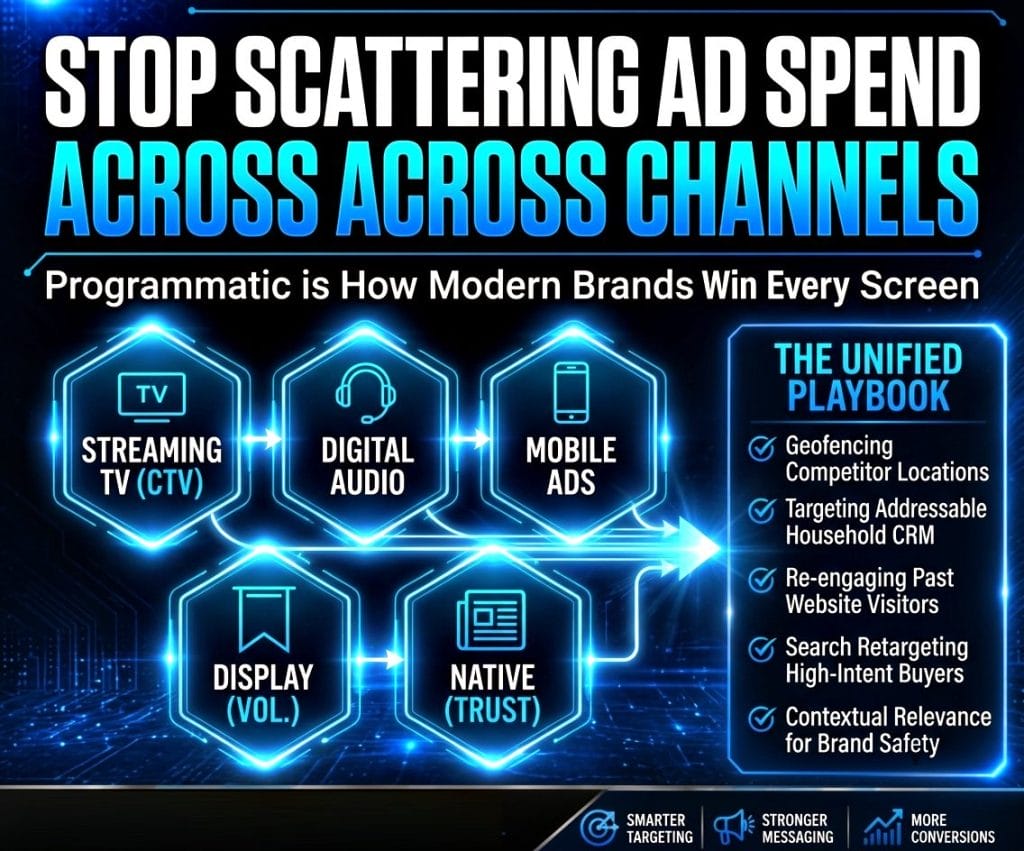
People don't meet your brand in one place anymore. A single homebuyer might read market trends on a laptop over coffee, listen to a podcast on the drive to work, check local news on their phone at lunch, and watch Hulu that night. That's one person across four screens in a single day.
For a growing business, whether you're a real estate brokerage, a regional service provider, or an e-commerce brand, reaching that person everywhere they go is hard to do well. The usual fix is to buy one channel at a time or hire a different vendor for each platform. That tends to leave you with inconsistent messaging, a budget spread too thin, and reporting so unclear you can't tell where the money actually went.
Growing your share in a competitive market takes the opposite approach: one coordinated strategy that follows your audience across every screen instead of betting on a single channel.
For years the digital playbook was simple: Google Search for high intent, Meta for discovery, and banner ads to fill the gaps. Those platforms still matter. Leaning on them alone is where things get risky.
Ad costs on any one platform swing with competition and algorithm changes, so putting your whole budget inside one or two walled gardens puts your cost per customer at their mercy. People also see thousands of ads a day, and a banner stuck in a sidebar gets ignored unless the targeting and format give someone a reason to look. On top of that, buyers rarely act on the first touch. Someone might scroll past your display ad on a design blog in the afternoon and only call after your video shows up on their TV that night.
The alternative is an omnichannel approach: one consistent message that reaches people across every screen they use.
A good campaign puts the right channel in front of people at the right moment, and runs all of those formats under one plan so they reinforce each other instead of competing. You can see how these fit together through Full Force Ads Advertising Solutions.
Put your brand on the biggest screen in the house. Connected TV gives you the look of a traditional TV spot with the targeting and measurement of digital. Your 15- or 30-second ads run on Roku, Fire TV, Hulu, and Paramount+, they can't be skipped, and they build the kind of recognition that makes your retargeting work harder on other devices later.
Audio reaches people during screen-free moments: driving, working out, cooking, commuting. Ads and sponsorships on Spotify, Pandora, podcasts, and digital radio tend to stick, because someone is usually listening one-on-one with headphones in.
Reach people on the device they carry everywhere. In-app placements, mobile web ads, and location-triggered messages catch attention in the moment, often based on where someone is right now.
Pre-roll, mid-roll, and outstream video runs across news, entertainment, and niche industry sites. It holds attention longer than a static image and gives you room to tell an actual story.
Display and native are the steady workhorses. Native placements blend into the article someone is already reading, while banners run across thousands of sites to keep your brand in view. It's cost-effective volume that reinforces the message and keeps your retargeting efficient.
Picking channels is only part of the job. What decides whether the budget works is targeting: making sure your spend goes to people who are actually in the market, not a broad demographic guess. You can target by exact location, by online behavior, or by your own customer lists.
Geofencing draws a virtual boundary around a real-world location and serves ads to people who enter it. You can put a fence around a competitor's showroom to reach shoppers who are already buying, target a trade show or a game to hit a concentrated crowd during the event, or focus on a specific commercial strip or high-value neighborhood.
Addressable targeting is direct mail with digital reach. Upload a list of verified street addresses from your CRM, a past-customer list, or a demographic list, and your ads run across the devices connected to those exact households.
Site retargeting brings back people who visited your website and left without converting. Search retargeting reaches people based on what they've recently searched, so you can get in front of in-market buyers before a competitor does.
Contextual targeting places your ad next to related content, matching your message to the articles, topics, and videos someone is already choosing to read or watch.
Real estate is one of the most competitive spaces in digital advertising, which makes it a good place to see how channels and targeting come together.
Brokerages, developers, and agents have long leaned on billboards, print mailers, and boosted social posts to market listings. But a high-value sale needs more than reach. It needs trust, built over repeated, well-targeted contact. Here's what display looks like when you pair it with location data:
| Objective | Channel mix | Targeting | Result |
|---|---|---|---|
| New luxury development launch | Streaming TV + high-impact video + display | Addressable household targeting in high-net-worth ZIP codes | Reaches qualified buyers on their TVs and phones at once and sets a premium tone from day one |
| Open house and competitor conquesting | Geofencing + mobile display | Geofence nearby open houses and competing brokerages | Reaches active buyers while they're out shopping for homes |
| Converting home-valuation leads | Site retargeting + native + search retargeting | Search terms like "sell my home fast" and "home values in [city]" | Stays in front of likely sellers as they research their options |
Most campaigns miss for one of three reasons.
The first is loose geography. Standard platforms push broad radius targeting that burns budget on renters and out-of-market users. Use address-level mapping and tight polygon geofences to stay on the neighborhoods and household lists that matter.
The second is static creative. Running the same listing photo over and over wears people out. Rotate it instead: open with streaming TV or video to introduce a community, follow with native display on specific features, and close with a retargeting banner and a clear call to action like "schedule a private tour."
The third is siloed reporting. If you look at display metrics apart from website traffic, you can't judge ROI. Track attribution across channels so you can see how impressions turn into site visits, phone calls, and form fills.
You don't need to build an in-house media team or juggle half a dozen agencies to run all of this. Full Force Ads is based in Utah and works with businesses nationwide, and we run your entire media mix from one place.
That means every channel from one partner, from streaming TV and audio to geofencing and display, planned and optimized together. Targeting like geofencing, addressable mapping, search retargeting, and contextual filters is built into every campaign, so the budget goes to verified prospects instead of wasted impressions. Reporting stays plain: every week you see where your ads ran, who engaged, and how each channel performed, with no hidden markup. Budgets flex to fit you, with no heavy minimums or long lock-in contracts, so you can start small and scale as the numbers prove out. And campaigns launch in days, not weeks, so you can move when the market gives you an opening.
Not sure which mix fits your goal? A few starting points:
If your spend is scattered across channels that don't talk to each other, a coordinated multi-screen plan will do more with the same budget. Visit Full Force Ads Advertising Solutions to book a demo and see what a custom media mix could do for your business.