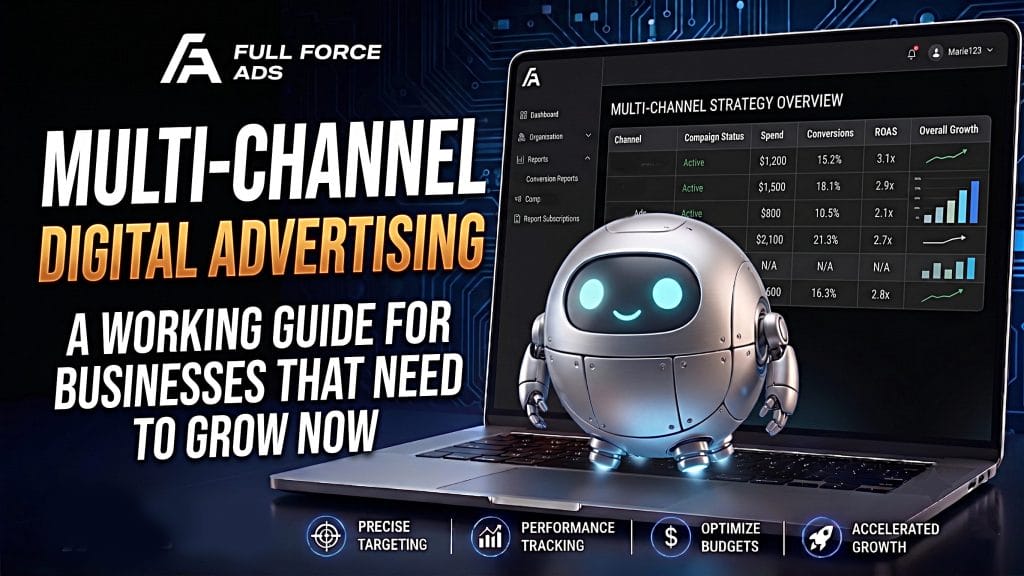
A prospect checks their phone before they get out of bed, streams the news over breakfast, listens to a podcast on the drive in, reads a trade site at their desk, and finishes the day on Hulu. If your advertising lives on one of those five surfaces, you reach that person once and hope it sticks.
That is the problem with running only paid search, or only a local print buy, or only one boosted social account. Each of them works. None of them covers the day. The gaps show up later as a customer acquisition funnel that leaks in places nobody can point to.
What follows is how multi-channel programmatic advertising actually works, what each channel and targeting method is good for, the specific market problems businesses run into across five US states, and how Full Force Ads, a programmatic agency based in Sandy, Utah, puts the pieces together.
Repetition on a single channel stops paying off fast. A banner on the same site is mostly invisible by the third impression, and buying more of it mostly buys more waste.
Spread those same three impressions across different media and they land differently. A 15-second spot on a smart TV, an audio read inside a Spotify session, and a native unit inside an industry article do not feel like three ads from the same campaign. They feel like a company that is everywhere, which is what people mean when they call a brand established.
+-----------------------------------------------------------------------+
|                       THE SYNCHRONIZED AD FUNNEL                      |
+-----------------------------------------------------------------------+
|  AWARENESS     |  Streaming TV (CTV/OTT) + Audio (Spotify/Podcasts)   |
|  ENGAGEMENT    |  Pre-roll video + contextual and native web ads      |
|  RETARGETING   |  Building-level geofencing + mobile + display        |
|  CONVERSION    |  Site and search retargeting + addressable household |
+-----------------------------------------------------------------------+
Programmatic buying is what makes that coordination affordable. Instead of negotiating placements with a handful of brokers, the platform bids on individual impressions in real time using data signals about who is on the other end. The unit you buy is the impression, not the page. Done properly, that removes most of the spend that used to go to people who were never going to buy anything.
Full Force Ads started in 2015 in Sandy, Utah, to solve a pricing problem. The targeting technology that makes programmatic worth doing was locked behind six-figure monthly minimums, so regional chains, mid-sized B2B suppliers, and growing consumer brands got the leftovers: a boosted post here, an untargeted local buy there.
The company buys on the same global real-time bidding exchanges and runs the same data infrastructure the large agencies use, then delivers it as a managed service to businesses that could never have written the minimum check.
FULL FORCE ADS AT A GLANCE

Headquarters      | Sandy, Utah. Clients nationwide.
Model             | Fully managed multi-channel programmatic
Media channels    | Streaming TV, video, audio, mobile, display, native
Targeting         | Building-level geofencing, addressable, site and
                  | search retargeting, contextual behavioral
Terms             | No long-term contracts, no inflated minimums,
| live in 5 to 7 days, transparent reportingBroadcast television sells you a demographic across a metro area and asks you to trust the estimate. Streaming sells you households. A 15 or 30 second spot runs unskippable on Hulu, Roku, Fire TV, Peacock, or Paramount+, inside specific homes you picked, and you get a delivery report at the end of it. You keep the weight that TV advertising carries and lose the guessing.
Video beats static creative on recall and on conversion, which is also why it costs more. Pre-roll runs before content, mid-roll interrupts it, and outstream video plays inside an article as the reader scrolls. Use it when the thing you sell needs showing: a product demo, a customer talking on camera, an offer that takes more than a headline to explain.
A good share of the day happens with no screen involved. Audio ads reach people on Spotify, Pandora, iHeartRadio, and podcast networks while they drive, train, or work, delivered through headphones or a car stereo. Recall runs high, and so does the number of people who search the brand name shortly afterward.
The phone is the most personal screen anyone owns, and it knows where it is. Mobile placements run inside premium apps and mobile web, and the location signal makes them useful for anything with a physical destination: store visits, click-to-call leads, app installs.
Banners are not glamorous and they are not going anywhere. Display across premium publishers is still the cheapest way to hold broad reach and run retargeting at volume, in leaderboard, skyscraper, and rectangle sizes. It does the unglamorous job of keeping a brand present between the moments that matter.
People have trained themselves not to see banners. Native units get around that by matching the fonts, layout, and editorial style of the site they run on, so they read as recommended content. Click-through rates are consistently higher. The tradeoff is that the creative has to earn the click by itself, because nothing about the placement is shouting.
Channels decide where the message appears. Targeting decides who it reaches, and that is where most of the money is won or lost.
TARGETING METHODS

Geofencing        | Traces exact building footprints to capture real
                  | foot traffic and competitor locations
Addressable       | Maps CRM addresses to cross-device household IP
                  | profiles
Site retargeting  | Recaptures the 97% or so of visitors who leave
                  | without converting
Search retargeting| Serves ads based on active keyword searches
Contextual        | Places ads inside articles relevant to your category
Geofencing at building level. Radius targeting draws a circle and pays for everything inside it, including the highway and the apartment blocks. Building-level polygon fencing traces the actual footprint: a competitor's storefront, a convention hall, a trade show floor, one corporate headquarters. Devices that enter get captured, and you can serve them ads for up to 30 days after they leave.
Addressable household targeting. If you have a list of customer or prospect addresses, addressable matches them to household IP networks and serves Streaming TV, video, and display to the connected devices inside those homes. It is the closest digital equivalent to direct mail, except you can see what happened.
Site retargeting. Most first-time visitors leave without doing anything, usually more than 97% of them. A lightweight pixel lets you follow those visitors around the web and put a more specific message in front of them later.
Search retargeting. This serves display and video based on what someone typed into a search engine, so you can reach an active shopper who has not found your site yet. It is a cheaper way to buy intent than bidding on the keyword itself.
Contextual behavioral targeting. Ads run alongside relevant editorial. A financial advisory firm shows up next to articles on tax strategy, wealth management, and retirement planning. Weaker signal than search intent, considerably cheaper, and it scales.
Silicon Slopes keeps pulling in companies and people, which means every established brand in the state is defending its base against a national competitor that showed up last quarter. Churn rises. Acquisition costs rise with it, particularly in tech and home services.
The usual counter is addressable targeting paired with Streaming TV to hold the existing customer base at home, plus building-level fences around the tech corridors in Lehi, Salt Lake City, and Ogden for firms selling to the people who work in them.
The Dallas-Fort Worth metroplex is roughly 70 miles across. A media buy at that scale spends most of its budget on people who will never drive to you, and Houston and Austin have the same shape of problem. Add dozens of regional competitors bidding for the same attention and the numbers get worse.
Multi-location retailers and commercial service providers do better fencing competitor locations and layering search retargeting on top, so spend lands in Plano, Frisco, or The Woodlands instead of everywhere at once.
Snowbirds arrive in November and are gone by April. Tourism runs its own cycle on top of that, and permanent migration keeps rewriting the resident base. Anything tied to a fixed geography struggles.
Healthcare providers, luxury realtors, and hospitality groups get around it with mobile geofencing and site retargeting. Capture the device while it is in Florida, then keep serving audio and display after it goes home to Michigan or Ontario, which is where the decision about next winter actually gets made.
The industrial, manufacturing, and healthcare base around Columbus, Cleveland, and Cincinnati is being handed to a younger set of procurement managers who research online before they take a meeting. That is a bigger threat to long-standing accounts than any out-of-state price undercut.
Native advertising and contextual targeting fit that behavior. Put the case study inside the trade journal, run video against industry and financial coverage, and be the supplier who shows up during the research phase rather than after it.
Seattle and Bellevue give you an educated, high-income, digital-native audience, and an ad auction priced accordingly. Cost per click on standard search platforms is punishing for any company not sitting on venture money.
The workaround is to stop competing in that auction. Search retargeting and pre-roll video buy the same intent signal on programmatic inventory at CPM rates, which is a different price tier for reaching the same person.
THE DIFFERENCE

All channels, one partner | CTV, video, display, and mobile on a single
                          | media plan instead of five vendors
Precise targeting         | Geofencing and addressable CRM matching
                          | included on every campaign
Transparent reporting     | Weekly breakdowns of exact placements, foot
                          | traffic, and conversions
Flexible terms            | No multi-year traps. Start where you are
                          | comfortable and scale with results
Fast launch               | Live in 5 to 7 business days
One partner across channels. Running CTV through one vendor, display through another, and audio through a third produces three reports that do not reconcile and nobody accountable for the whole. Full Force Ads plans and runs all of it together.
Targeting on every campaign. Geofencing, addressable matching, high-intent audience data, and behavioral retargeting are part of the standard build, not an upgrade tier.
Reporting you can actually read. Weekly reports list the domains the ads ran on, impression counts, device interactions, and real-world foot traffic attribution through Conversion Zones. No blended numbers, no hidden fees.
No contract. Budgets flex and there is no multi-year commitment, which means the account has to be re-earned every month. That is roughly the correct amount of pressure to put on an agency.
Live in 5 to 7 days. Most agencies quote four to six weeks to onboard a campaign. Creative review, pixel and Conversion Zone deployment, and launch across the exchanges take about a week here.
Full Force Ads has engineered a frictionless four-step process designed to take campaigns from concept to live execution without agency stress:
Everything begins with a consultative, low-pressure conversation. The team takes the time to audit your core business goals, target customer profiles, market environment, and competitive challenges.
Off-the-shelf advertising packages fail to deliver. Full Force Ads builds a bespoke multi-channel mix and data targeting strategy engineered specifically for your budget, timeline, and growth objectives.
Once your creative assets and campaign strategies are approved, tracking pixels, conversion zones, and real-time bidding parameters go live across global ad networks within 5 to 7 business days.
Launch is only the starting line. Ad operations experts continuously analyze performance metrics, shifting budget toward top-performing media channels, refining geofences, and delivering transparent weekly reports to keep you fully informed.
| Objective | Channel stack | What it does |
|---|---|---|
| Local foot traffic and awareness | Geofencing + display + mobile | Capture competitor foot traffic, fence the surrounding neighborhoods, run tap-to-map mobile banners |
| Conquesting a direct competitor | Geofencing + addressable | Fence their locations, then reach their known customer households with a switch offer |
| Regional brand presence | Streaming TV + video + audio | Unskippable spots on Hulu and Roku alongside Spotify audio for frequency |
| High-intent lead generation | Search retargeting + display + native | Intercept people already searching your category, then convert with editorial-style native |
| Recapturing lost web visitors | Site retargeting + video + display | Sequential video and banner offers aimed at the visitors who bounced |
| Getting more out of your CRM | Addressable + Streaming TV + display | Upload past buyer addresses and upsell them on the living room screen |
Attention is split across more screens than any one channel can cover, and buying harder on a single channel does not fix that. Whether the problem is churn in Utah, scale in Texas, seasonality in Florida, generational turnover in Ohio, or auction prices in Washington, the work is the same: reach the specific people who matter, on the surfaces they use, and measure what comes back.
Book a discovery call at fullforceads.com. We will map a channel mix to your situation before anyone talks about budget.