The American business field tests your endurance. If you operate an enterprise out of Utah or manage a national footprint from a remote headquarters, you face the same challenge: you must capture, hold, and convert human attention.
The mechanisms for achieving this have broken apart. Consumers do not reside in a single digital ecosystem. They migrate across an intricate network of connected devices. They wake up to a podcast on Spotify, check morning headlines on a news app, stream television on Hulu during lunch, navigate commutes via mobile apps, and research purchases through search queries.
For businesses trapped in legacy advertising paradigms, this fragmentation threatens their existence. Traditional media like linear television, print billboards, and radio waste budget on unquantifiable audiences. Conversely, platforms like Facebook and Google offer specific targeting but confine your brand to their crowded real estate, driving up bidding costs through artificial competition.
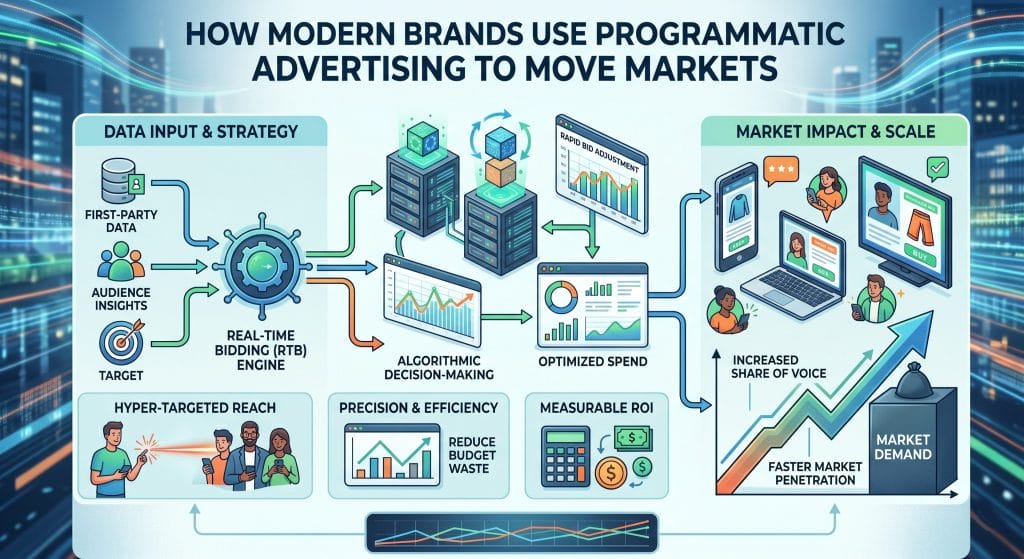
To dominate a market, you must transcend these limitations. Multichannel programmatic orchestration allows you to deliver a targeted message where your audience spends time, managed through a single point of operational control.
This operational philosophy powers Full Force Ads Advertising Solutions. By consolidating media buying across digital screens and channels, brands stop buying fragmented impressions and start engineering predictable consumer behaviors.
To persuade a B2B buyer or a consumer, an advertising campaign must achieve relevance across multiple physical and psychological environments. Programmatic execution deploys specialized media channels that align with the consumer's current cognitive state.
For decades, television belonged to massive conglomerates with seven-figure media budgets. Linear television required upfront commitments, lacked audience targeting, and provided vague, panel-based viewership metrics.
Connected TV (CTV) changed this framework. By deploying programmatic video assets on platforms like Roku, Fire TV, and Hulu, businesses place their brand on the largest screen in the household.
The primary persuasive mechanism of CTV relies on its high-impact environment combined with unskippable formats. Unlike web video, which users easily scroll past or minimize, Streaming TV commands visual real estate. When layered with precise audience data, an enterprise ensures that their commercial only reaches households meeting exact demographic, financial, or behavioral criteria. It provides the prestige of national television with the precision of digital data.
While CTV anchors the household, digital video captures consumers on the move. By utilizing pre-roll, mid-roll, and outstream video formats across millions of websites and mobile applications, brands tell stories that disrupt passive browsing habits.
Video triggers emotional responses through sight, sound, and motion. In a fast-paced digital environment, an optimized programmatic video campaign serves as a hook, introducing value propositions within the first three seconds and driving click-through actions that linear formats cannot replicate.
A critical marketing error assumes that consumers look at a screen. Some of the highest-intent moments of a consumer’s day occur when their eyes are completely disengaged.
Programmatic audio reaches consumers while they drive, exercise, cook, or work, streaming content via Spotify, Pandora, podcasts, and digital radio. Because audio consumption is intimate, often delivered directly into headphones, the cognitive load remains low, and ad recall stays high. By slipping your brand message into these screen-free sanctuaries, you bypass visual clutter and build a relationship with the listener.
       [ SCREEN-ENGAGED MOMENTS ]                [ SCREEN-FREE MOMENTS ]
   +---------------------------------+      +-------------------------------+
   | CTV / Video / Display / Native  |      |      Programmatic Audio       |
   |  Visual Immersion & Direct Click|      | High Recall & Intimate Spaces |
   +---------------------------------+      +-------------------------------+
                    \                                /
                     \                              /
                      v                            v
               +------------------------------------------+
               |   UNIFIED CONSUMER ATTENTION MATRIX      |
               +------------------------------------------+
If CTV and Audio are the heavy artillery of a campaign, Mobile, Display, and Native advertising are the continuous infantry.
Deploying your message across premium media channels is only half the battle. Modern programmatic advertising decouples the ad placement from the publication. In the legacy world, if you wanted to reach corporate executives, you bought an ad in The Wall Street Journal. In the programmatic world, you find the executive where they happen to be online, buying the audience instead of the real estate.
To achieve efficiency and prevent budget dilution, sophisticated enterprises layer targeting strategies onto their multichannel campaigns.
Physical movement indicates consumer intent. Social media profiles can be falsified, and search histories can be anomalous, but the physical locations an individual visits reveal their lifestyle, preferences, and operational needs.
Geofencing allows businesses to draw virtual boundaries around specific locations, such as competitor storefronts, industry conventions, corporate parks, or affluent neighborhoods. When a prospect enters this zone with their mobile device, the platform captures their anonymous device ID. This allows you to serve targeted ads to them in real time, or retroactively serve ads to them across their devices, including their home CTV, for weeks after they leave the location.
For businesses possessing curated first-party data, such as CRM lists, past customer databases, or B2B account targets, traditional outreach methods are slow. Direct mail is expensive and often thrown away unread. Email lists suffer from degrading open rates and aggressive spam filters.
Addressable programmatic targeting bridges the gap between offline identity and online precision. By uploading a list of physical street addresses, the programmatic platform cross-references public data registries, IP routing tables, and device graphs to map those specific households or corporate offices.
Once mapped, you can serve customized digital ads to every connected device associated with that address. Your target account sees your message on their smart TV, their tablet, and their mobile device, creating omnipresence before your sales team ever places a cold call.
The data of digital commerce reveals a harsh pattern: most initial website traffic leaves without converting. Site Retargeting captures these warm prospects, keeping your brand top-of-mind by serving tailored ads as they browse other areas of the open web.
However, relying solely on site retargeting means waiting for a prospect to find you first. Search Retargeting changes this dynamic. This strategy targets users based on the exact keywords they enter into major search engines, even if they have never heard of your business. If a user searches for a high-intent industry phrase, the system tags them as an in-market buyer, enabling you to display visual media, like video, display, or native ads, to them across the web within minutes of their search. This intercepts the buyer at the peak of their intent cycle, stealing market share directly from your competitors.
+---------------------------------------------------------------------------------+
|                          THE HIGH-INTENT TARGETING FUNNEL                       |
+---------------------------------------------------------------------------------+
|                                                                                 |
|  [Search Retargeting] -> User types critical industry keywords into search engine |
|         |                                                                       |
|         v                                                                       |
|  [Native/Display Ad]  -> Captures attention on premium editorial sites          |
|         |                                                                       |
|         v                                                                       |
|  [Website Visit]      -> Prospect evaluates your primary value proposition       |
|         |                                                                       |
|         v                                                                       |
|  [Site Retargeting]   -> Follows unconverted users across CTV, Audio, & Mobile  |
|                                                                                 |
+---------------------------------------------------------------------------------+
As cookie deprecation and privacy regulations reshape the digital ecosystem, relying on user identity data creates a risky long-term strategy. Contextual targeting solves this by analyzing the actual semantic content of the webpage or video a user interacts with in real time.
If your business sells enterprise-grade financial software, contextual targeting ensures your ad appears directly alongside an analytical article discussing corporate tax compliance or treasury management. The persuasion mechanism here is cognitive: your ad acts as a natural extension of the thoughts the reader is already processing, eliminating ad fatigue and building implicit authority.
To understand the conversion power of these unified frameworks, examine the hardest environment for digital tracking: the brick-and-mortar hospitality and restaurant industry.
Restaurants, retail storefronts, and local services live and die by physical foot traffic. While digital e-commerce brands track a consumer from an ad click to a shopping cart conversion pixel, physical businesses historically operated without clear data.
               +---------------------------------------+
               |   THE TRADITIONAL CONUNDRUM           |
               | "I know half my advertising budget    |
               |  is wasted; I just don't know which   |
               |  half." - John Wanamaker              |
               +---------------------------------------+
                                   |
                Legacy Tracking    |    Programmatic Tracking
                 Gap Continues     |     Bridges the Divide
                                   v
               +---------------------------------------+
               |       THE PROGRAMMATIC SOLUTION       |
               | Ad Impression -> Mobile Location GPS  |
               | -> Confirmed Physical Foot Traffic   |
               +---------------------------------------+
Many restaurant operators and retail executives dump their marketing budgets into social media or basic search engine marketing. While these channels have utility, they present severe strategic bottlenecks:
Programmatic multichannel execution solves this classic business dilemma by connecting digital impressions to physical coordinates. This strategy bridges the gap between awareness and verified visitation.
Imagine a premium local dining establishment looking to capture the competitive corporate lunch and upscale weekend dinner crowd. Instead of casting a wide, wasteful net, a sophisticated programmatic campaign uses a localized strategy managed through Full Force Ads.
This creates a definitive metric: Cost Per Verified Visit. The business owner no longer guesses if their advertising works. They see exactly how many people saw an ad on their living room television or mobile screen and subsequently walked into the establishment to purchase a meal. This replaces speculative marketing with data-driven business scaling.
When enterprises realize the necessity of running multichannel campaigns, they frequently fall into the trap of vendor fragmentation. They hire one boutique agency to manage social media, contract with a separate vendor for their Connected TV buy, employ a third platform for mobile geofencing, and try to manage basic display retargeting internally.
This multi-vendor fragmentation introduces severe operational inefficiencies:
| The Pitfall | The Operational Reality | The Programmatic Single-Platform Cure |
| Data Silos & Blind Spots | Each vendor utilizes their own proprietary tracking methodology, leading to mismatched metrics and finger-pointing when performance drops. | A single tracking pixel across all channels ensures uniform, clean, and uncorrupted attribution data. |
| Ad Blasting & Audience Fatigue | Without a centralized platform, you cannot cap ad frequencies. A single prospect might be served your ad 15 times in one day across different platforms, causing brand annoyance. | Centralized frequency capping ensures a prospect sees your brand at an optimized, persuasive cadence across all screens combined. |
| Wasted & Inflexible Budgets | If your CTV campaign performs well but your mobile display ads underperform, you cannot easily shift funds if they are tied up with different vendors. | Fluid budget allocation allows real-time shifts to the highest-performing channels instantaneously. |
This operational headache explains why sophisticated organizations partner with comprehensive solutions providers. The infrastructure at Full Force Ads Advertising Solutions eliminates multi-vendor chaos by consolidating planning, execution, and optimization into a single programmatic interface.
Selecting the right partner to execute a programmatic roadmap requires auditing their operational capabilities against the standard pitfalls of the digital advertising industry. Full Force Ads engineered its service delivery model to directly address the primary pain points felt by modern business leaders.
       [ CONVENTIONAL PROGRAMMATIC ]             [ THE FULL FORCE ADS STANDARD ]
   +------------------------------------+     +-----------------------------------+
   |  • Opaque "Black Box" Reporting    |     |  • 100% Transparent Weekly Audits |
   |  • High Minimum Spend Contracts    |     |  • Flexible, Scale-as-You-Grow    |
   |  • 4 to 6 Week Onboarding Lags     |     |  • Fast Launch (5-7 Business Days)|
   +------------------------------------+     +-----------------------------------+
Instead of juggling disparate dashboards and invoices, your entire digital footprint—Streaming TV, Video, Audio, Mobile, Display, and Native—is managed under a single strategic plan. Your messaging updates synchronize across the entire internet simultaneously, ensuring absolute brand consistency.
Full Force Ads moves past basic impression metrics. By embedding advanced geofencing, addressable mapping, search retargeting, and deep behavioral filters into the DNA of every campaign, the focus shifts entirely from acquiring cheap clicks to capturing high-value human intent. You stop paying for empty eyeballs and start buying access to verified buyers.
The digital advertising industry frequently relies on opaque reporting where agencies hide margins, obscure real placement data, and present complex metrics to mask mediocre results. Full Force Ads operates on absolute clarity, delivering weekly reports that detail precisely where your ads ran, exactly who saw them, and the concrete actions they took. You retain total visibility into every single ad dollar deployed.
Many enterprise programmatic platforms demand massive financial minimums and lock businesses into rigid, long-term contracts that penalize agility. Full Force Ads provides flexible, scalable frameworks. This allows brands to deploy initial campaigns at comfortable investment tiers, gather real-world market intelligence, and scale allocation only after verifying positive ROI.
In modern commerce, speed is a decisive competitive advantage. A brilliant marketing strategy loses its power if it takes six weeks to clear an agency’s bureaucratic onboarding pipeline. Full Force Ads moves at the speed of contemporary business, taking complex multichannel campaigns from initial concept to live market execution within 5 to 7 business days.
Transitioning your business from fragmented, legacy marketing to a high-yielding programmatic operation does not require a disruptive internal overhaul. The path to modernization is structured into four managed, collaborative steps designed to maximize output while minimizing internal corporate friction.
+-----------------------------------------------------------------------------------+
|                        THE FULL FORCE ADS EXECUTION PIPELINE                      |
+-----------------------------------------------------------------------------------+
|                                                                                   |
|  [STAGE 1: Discovery]     --> Deep dive into unit economics, goals, & targets.     |
|          |                                                                        |
|          v                                                                        |
|  [STAGE 2: Architecture]  --> Customized multi-channel programmatic blueprint.     |
|          |                                                                        |
|          v                                                                        |
|  [STAGE 3: Deployment]    --> Multi-screen campaign launch within 5-7 days.        |
|          |                                                                        |
|          v                                                                        |
|  [STAGE 4: Optimization]  --> Weekly audited reports & dynamic budget shifting.    |
|                                                                                   |
+-----------------------------------------------------------------------------------+
The process begins with a structured strategic conversation. Rather than pitch generic, off-the-shelf packages, our programmatic architects embed themselves into the realities of your business. We analyze your precise customer personas, historical acquisition costs, geographical market opportunities, and primary commercial objectives.
Armed with data from the discovery phase, we build a tailored channel mix and targeting blueprint designed specifically for your corporate budget. We map your goals to proven channel combinations.
If your goal is immediate local awareness, we construct a tactical framework combining Geofencing, Display, and Mobile ads. If your objective is a campaign to capture a competitor’s market share, we deploy a blend of Geofencing and Addressable household targeting. If you need to build premium brand equity, we anchor the strategy in Streaming TV, Video, and Programmatic Audio.
Once the strategic architecture is approved and creative assets are aligned, our technical team handles the configuration. We configure the tracking parameters, build virtual geofences, map the address databases, and push the campaign live across selected global networks. Most accounts transition from final sign-off to active live placements within 5 to 7 business days.
Programmatic advertising is a dynamic ecosystem that generates continuous streams of real-time market data.
Through our weekly reporting rhythm, our optimization teams analyze asset performance, placement efficiencies, and audience engagement levels. If a specific native ad variant outperforms standard display banners among your target demographic, our team reallocates budget to maximize that advantage. We trim waste and expand winning vectors, ensuring your customer acquisition costs trend downward over time.
Every business leader eventually faces a critical crossroad: continue pouring resources into legacy, fragmented marketing channels while hoping for the best, or step into a modern framework where every ad impression is backed by data, precision targeting, and undeniable accountability.
The open web holds opportunities for your brand, provided you possess the tools to navigate it. By unifying your media buying, leveraging location and addressable data, and demanding absolute transparency from your partners, you transform advertising from an unpredictable corporate expense into a reliable, scalable engine of economic growth.
Do not let your competitors claim the premium digital real estate where your customers spend their lives. Take command of your market, gain clarity over your media spend, and position your brand on every relevant screen.
Your transition to data-driven, multichannel programmatic advertising begins with a single conversation. Schedule a discovery call with our enterprise media architects today to review your current marketing bottlenecks, map your growth opportunities, and receive a customized, high-yield programmatic recommendations blueprint built entirely around your business goals.
Explore our comprehensive platforms and claim your strategic edge by visiting Full Force Ads Advertising Solutions.