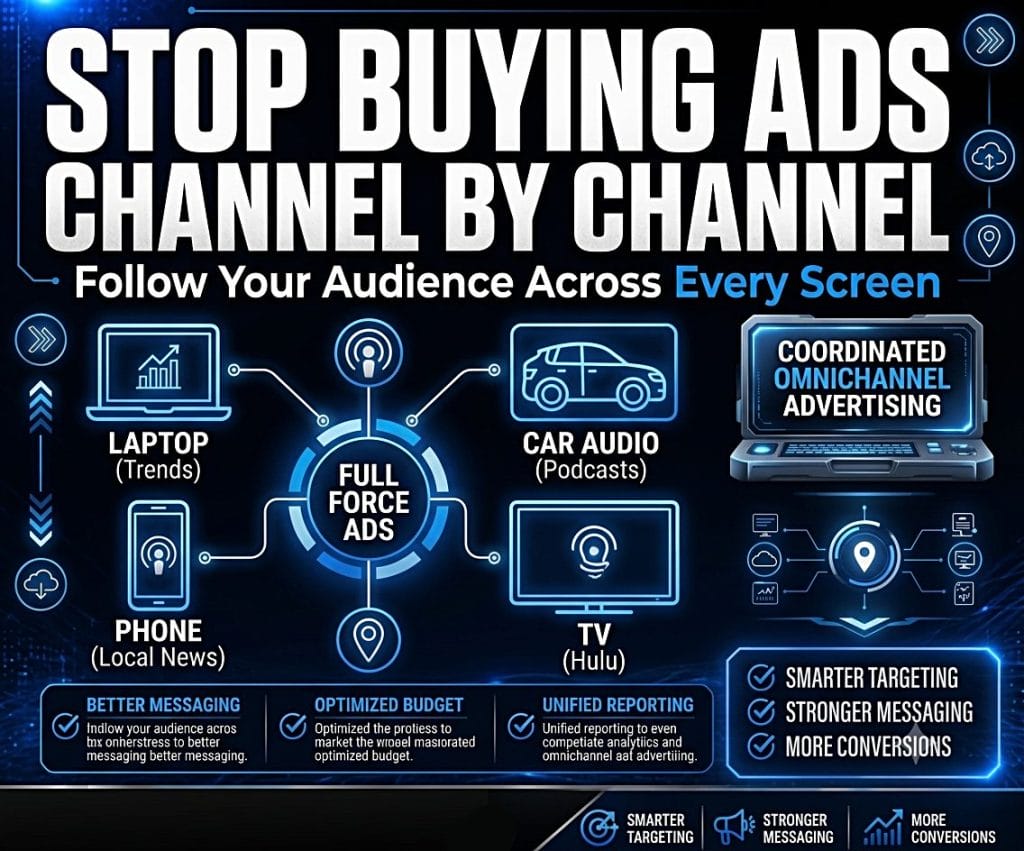
Every year, a lot of marketing budget disappears into campaigns that produce good-looking metrics and not much else. The click-through rate holds up on the slide. Impressions land in the high seven figures. And the meeting still ends with the same question nobody wants to ask out loud: where's the actual revenue?
The problem usually isn't a shortage of places to run ads. It's that the ads run in pieces. Your buyer doesn't experience your brand in one clean channel. They listen to a podcast on the drive in, scroll a news feed at lunch, watch ad-supported streaming TV after dinner, and search for a solution on a laptop before bed. One person, one day, five or six screens.
When one vendor runs your display, another runs your programmatic video, and a third handles social, the message stops adding up. The prospect sees three unrelated versions of you. Meanwhile budget leaks out through duplicate impressions and gaps in attribution that nobody owns.
Fixing that isn't a matter of buying more ads. It's a matter of running them as one system, pointed at real people and real behavior, so each impression builds on the one before it instead of competing with it.
Here's how growth leaders are using programmatic media, physical-world targeting, and a single campaign structure to show up everywhere their buyer goes, and turn that presence into pipeline.
A typical buyer touches around seven media touchpoints before a serious purchase. If reaching all seven means managing three to five agency relationships and as many dashboards, you're not just working harder than you need to. You're bleeding efficiency your competitors aren't.
Real omnichannel is more than one graphic pushed across three social networks. It means the message is coordinated across channels so the story actually progresses. Run it through a single partner and you get three things you can't get from a stack of separate vendors.
You can cap frequency across everything at once, so one prospect doesn't get hammered with twenty display impressions in an afternoon while never once seeing your video. You can move budget toward whatever's working while the campaign is live, instead of finding out at month-end reconciliation. And you can actually sequence the creative: open with a streaming TV spot, follow with a mobile unit while they're out, then close with a display offer when they sit down at a computer.
Run streaming TV, video, audio, mobile, display, and native under one plan and you go from being visible to being hard to ignore.
Every medium in the mix does a specific job. Picking channels well means knowing which job you're hiring each one to do.
| Funnel stage | Channels |
|---|---|
| Upper funnel (awareness and reach) | Streaming TV (CTV/OTT); digital audio and podcasts |
| Mid funnel (consideration and intent) | Online video (pre-roll and mid-roll); native content |
| Lower funnel (conversion and retargeting) | Mobile in-app and hyper-local; targeted display |
Linear cable is fading, but the big screen in the living room still carries more brand weight than anything else in the house. Streaming TV puts television-quality storytelling in front of people with the targeting that broadcast never had.
You deliver a high-definition 15 or 30-second spot, unskippable, straight into streaming environments like Roku, Amazon Fire TV, Hulu, and the major network apps. The difference from broadcast is who sees it. Broadcast charges you for a broad regional demographic. Connected TV lets you buy at the household level, so you pay to reach qualified decision-makers instead of an entire market you'll never sell to.
Video is still the strongest storytelling format online, and it lives well beyond CTV. People run into it while reading the news, working through an industry report, or watching something in a niche they care about.
You run pre-roll, mid-roll, and outstream formats across premium publisher sites and mobile apps. Because these units sit inside content people chose to consume, they hold attention better than a static banner ever will.
Most advertising needs eyeballs. Audio doesn't. It reaches your buyer during the parts of the day when no screen is in front of them: the workout, the commute, the two hours of focused work, the dishes.
You place programmatic spots across Spotify, Pandora, digital radio, and targeted podcast networks. Podcasts and personal playlists are intimate spaces, and listeners tend to trust them. That makes audio unusually good at building recall and affinity.
The phone isn't a second screen anymore. For most people it's the control panel for the day. Reaching them in-app, on mobile web, and through location-aware placements keeps you in contact through the whole decision cycle.
You run mobile banners, rich interactive units, and location-triggered placements built for the handset. The upside beyond reach is data: mobile lets you target based on where someone actually is and how they actually behave in the physical world.
Display gets treated as basic plumbing, and that undersells it. It's still the backbone of broad web presence and the engine behind ongoing retargeting.
You place banner units across millions of brand-safe sites and apps. Display is cheap enough to keep you top of mind at scale, and it's the safety net that keeps catching interested people and pulling them back into the funnel after they first saw you on video or heard you on audio.
Banner blindness is real. On content-heavy sites, people learn to skip the ad slots without thinking. Native gets around that by matching the look, tone, and layout of the page it sits in.
You run content-style placements inside the feeds of premium news, business, and trade sites. Because they read like the editorial around them, native units earn much higher click-through and deeper engagement, which is exactly what B2B, financial, and premium consumer offers, with their longer buying cycles, need.
Choosing channels only answers where your ad shows up. Targeting decides who's on the other end, and that's where the money is won or lost.
A perfect video ad served to the wrong person is just expensive noise. Real returns come from dropping broad demographic buckets and buying against behavior, location, and intent instead.
                    [ AUDIENCE SELECTION ]
                            |
      +---------------------+---------------------+
      v                     v                     v
[ REAL-WORLD          [ HOUSEHOLD           [ INTENT &
  LOCATION ]            DATA ]                BEHAVIOR ]
  Geofencing           Addressable lists     Search intent
  Event capture        Verified CRM matches  Site retargeting
      |                     |                     |
      +---------------------+---------------------+
                            v
                  [ HIGH-INTENT AUDIENCE ]
Geofencing connects a physical action to a digital ad. You draw a precise virtual boundary, tight enough to trace the footprint of a single building, around a real-world location, and collect the anonymous mobile device IDs of the people who visit it.
Two ways that pays off. You can draw the perimeter around a competitor's storefront, office, or dealership and serve their active customers a better offer or a direct comparison. Or you can map a trade zone, an industrial park, an affluent neighborhood, or a specific commercial district where the clients you want actually work.
Addressable ties your offline CRM to programmatic delivery. You upload a list of physical home or business addresses, the system maps those exact structures at street level, and your ads run across every connected device in those households: TVs, phones, laptops, tablets.
The win is that the waste is gone. Instead of buying a whole ZIP code, you reach the 1,500 qualified addresses that are already sitting in your sales system.
Almost nobody buys on the first touch. Retargeting keeps you in front of people who've already shown intent.
Site retargeting re-engages anyone who visited your site, looked at a service page, or bailed on a form, staying visible as they browse elsewhere until they come back to finish. Search retargeting reaches people based on the intent-heavy terms they've recently searched, so you catch them while they're comparing options, well before they ever find your site. Contextual targeting places you next to relevant content, so a B2B software brand shows up inside articles about the exact problems it solves.
Of all the location-based tactics, this is the one that builds a high-intent audience out of nothing but real-world behavior.
Event targeting uses geofencing to capture the anonymous mobile device IDs of people while they're at a specific, time-bound event. You draw a boundary around the venue, keep it live only for the hours the event runs, and then serve ads to those verified attendees across their screens for up to 30 days afterward. The audience isn't a demographic guess or an inferred interest group. It's the set of people who were physically in the room.
1. DEFINE VENUE & TIME    2. CAPTURE ATTENDEES     3. RETARGET (30 DAYS)
+---------------------+   +--------------------+   +--------------------+
| Convention center   |   | Mobile device IDs  |   | Ads across CTV,    |
| Perimeter live only |-->| captured during    |-->| mobile, and web    |
| during event hours  |   | event hours        |   | for up to 30 days  |
+---------------------+   +--------------------+   +--------------------+
Here's why it rewrites the trade-show math. A booth at a major show runs tens of thousands of dollars before you count travel, freight, and staff. Event targeting lets you reach the same room without renting the floor. Put a perimeter over the venue during show hours and you've built an audience made only of the executives and buyers who showed up.
It also fixes the part everyone complains about after the show. Attendees are overwhelmed on the floor, and a fishbowl of business cards rarely turns into deals. With event targeting, you stay on their streaming TV at home, their tablet in the hotel, and their phone apps for the next month, right when they finally have time to compare vendors. The same logic works for consumer brands at stadiums, festivals, and expos, where the budget only reaches people who actually care enough to be there.
There's no single right campaign structure. The channel and targeting mix should follow the business objective.
| Business objective | Recommended mix |
|---|---|
| Local and regional dominance | Geofencing + mobile + targeted display, to capture foot traffic in the areas that matter |
| Conquesting direct competitors | Competitor geofencing + addressable, to put your offer in front of their customer base |
| Enterprise brand building | Streaming TV + online video + digital audio, for maximum sight, sound, and story |
| Website lead generation | Display + native + search retargeting, to catch active searchers |
| Re-engaging warm traffic | Site retargeting + display + video, to convert mid-funnel visitors |
| Getting value from your CRM | Addressable household + streaming TV, to surround your best accounts on every screen |
Running programmatic exchanges, location-data providers, geofencing tools, and attribution analytics in-house takes real capital and a specialized team. Most growth-focused companies that try end up with fragmented execution, higher costs, and no clean line of accountability.
That's the gap Full Force Ads, based in Utah, is built to close. We run the whole thing as one revenue engine instead of a pile of vendors.
        [ YOUR OBJECTIVES ]
                |
                v
    [ FULL FORCE ADS SETUP ]
    - One platform, one team
    - Layered targeting: geofence, addressable, retargeting
    - Transparent weekly performance data
    - Live in 5 to 7 days
                |
                v
      [ MEASURABLE RESULTS ]
Five things drive how we work. We plan, run, and optimize every channel (streaming TV, video, audio, mobile, display, native) under one roof, so you're not stitching agencies together. We build targeting around ROI, not impressions, using geofencing, addressable matching, search retargeting, and behavioral layers so the spend lands on verified, high-value prospects. We report in plain weekly decks that show where your ads ran, who engaged, and what those touchpoints turned into, with none of the black-box mystery. We keep the money flexible, so you can start at a spend level you're comfortable with, test the response, and scale once the numbers prove out, instead of signing a multi-year minimum. And we move fast: campaigns go live in 5 to 7 business days, not the weeks or months a traditional agency cycle eats up.
Modernizing your media doesn't require a painful multi-month transition. The path from idea to live campaign is short.
  STEP 1            STEP 2              STEP 3            STEP 4
+------------+    +---------------+   +------------+    +------------+
| Discovery  |    | Custom        |   | Launch     |    | Optimize   |
| call       |--> | plan          |-->| (5-7 days) |--> | & scale    |
| Goals &    |    | Channels &    |   | Creative   |    | Weekly     |
| audience   |    | targeting     |   | goes live  |    | refinement |
+------------+    +---------------+   +------------+    +------------+
It starts with a conversation. We work through your objectives, your sales cycle, who you're trying to reach, your trade zones, and the metrics that matter to you. From there we build the channel matrix and targeting plan, with budget mapped across each stream, whether that's local conquesting through geofencing or national reach through Connected TV. Once the creative is finalized, deployment starts right away, and within 5 to 7 business days your message is live across streaming platforms, premium sites, audio networks, and apps. After that it's ongoing work: we watch performance, shift budget toward what's converting, test new creative, and tighten the geographic borders to lift return on ad spend.
Running isolated budgets across disconnected channels isn't a growth strategy anymore. Buyers expect one coherent experience across every screen, and the brands winning right now are the ones delivering it through unified, tightly targeted media.
Whether you want to take share from local competitors, build a national brand, or reach the buyers who just walked a trade-show floor, the point is the same: cut the waste, see exactly what your media is doing, and hold attention on every screen your audience uses.
If that's where you want to be, the next step is a straightforward conversation. Book a no-pressure strategy call with Full Force Ads and we'll map what a campaign built around your goals actually looks like.