For decades, local home services businesses (plumbers, HVAC technicians, electricians, roofers, and landscapers) ran reactive marketing. They bought Yellow Pages space, sent local direct mail, and eventually bid on high-intent Search Engine Optimization (SEO) and Pay-Per-Click (PPC) search ads. When a pipe burst or an air conditioner failed in July, consumers searched for a provider. The fastest responder won the job.
The modern consumer journey has changed. The industry is under intense pressure to respond immediately. About 78% of consumers buy from the service provider that replies first (Rathore, 2025). Relying only on reactive search marketing no longer sustains growth. High competition has driven search engine PPC costs to historic highs, and consumers research, validate, and choose brands long before an emergency hits.
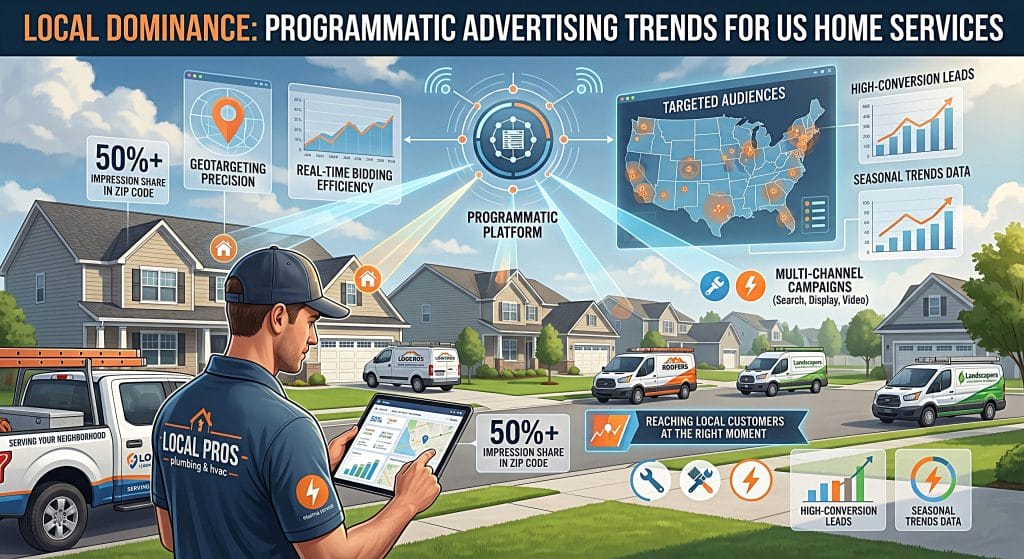
Programmatic advertising changes that dynamic. By combining automated real-time bidding, machine learning, and behavioral data, programmatic advertising lets home service companies move from reactive marketing to predictive, targeted multi-channel campaigns. Instead of waiting for a homeowner to search for an emergency fix, contractors can stay top-of-mind throughout the homeownership lifecycle.
This breakdown covers how programmatic advertising works for the US home services sector, the macroeconomic and behavioral trends shaping the industry, and a strategy for local contractors to run high-ROI campaigns.
Programmatic advertising is the automated buying and selling of digital ad space in real time using algorithmic bidding software (Ciuchita, 2023). Instead of negotiating ad placements with specific publishers, advertisers use a Demand-Side Platform (DSP) to buy impressions across millions of websites, mobile apps, connected television (CTV) channels, and digital audio streams.
When a user loads a webpage or opens an app, an automated auction runs through a Supply-Side Platform (SSP) and an Ad Exchange in milliseconds. The DSP analyzes the user’s demographic profile, geographic location, browsing history, and real-time intent. If the user matches the target parameters, the DSP submits a bid, wins the placement, and displays the ad before the page finishes rendering.
[Consumer Loads Webpage/App]
           │
           ▼
[SSP / Ad Exchange Triggers Auction]
           │
           ▼
[DSP Analyzes Audience Data & Intent] ◄─── (Matches Homeowner Persona)
           │
           ▼
[Automated Real-Time Bid is Won]
           │
           ▼
[Hyper-Localized Ad Displays to User] (Less than 100ms)
For a home services business, shifting from buying ad space to buying specific audiences changes marketing efficiency. Instead of paying for a banner ad on a local news website hoping a homeowner sees it, a roofing company can buy impressions served only to people inside a 15-mile radius who are flagged as new homeowners or likely to renovate.
The programmatic ecosystem spans several channels:
Running programmatic advertising takes an understanding of the economic and technological shifts across the United States. Local service providers have to line their messaging up with macroeconomic realities and consumer psychology.
The physical condition of American real estate drives home service demand. The median age of owner-occupied homes in the United States is over 40 years. Millions of structures need structural, electrical, and HVAC remediation (Martín, 2024). At the same time, high mortgage interest rates have created a lock-in effect. Homeowners who locked in low fixed mortgage rates refuse to sell and move.
Instead of upgrading to new properties, Americans are investing in repairing, retrofitting, and remodeling their existing homes. Programmatic campaigns work with this trend by targeting older suburban neighborhoods with ads built around system replacements, like main sewer lines or electrical panel upgrades.
Residential energy consumption and extreme weather events shift consumer priorities toward asset protection and cost mitigation. Homeowners prioritize resource conservation and building durability (Livingston, 2012).
Driven by weather risks like intense freeze-thaw cycles or heatwaves, and financial incentives from federal legislation like the Inflation Reduction Act (IRA), consumers want energy-efficient heat pumps, smart thermostats, high-performance insulation, and fortified roofing. Programmatic platforms let companies trigger ad creative based on environmental changes, like pushing HVAC maintenance ads ahead of a predicted heatwave.
Machine learning algorithms automate data analytics, sharpen behavioral predictions, and personalize messaging (Baek, 2025). At the same time, consumers expect fast, frictionless service. On the operational backend, businesses use customer relationship management (CRM) systems, chatbots, and automated scheduling tools to capture leads (Rathore, 2025). On the advertising frontend, programmatic ads have to match that efficiency. Ads should point to landing pages featuring live calendars, transparent pricing estimates, and automated booking options.
By stacking data layers, a home services business cuts ad waste and delivers impressions to verified prospects.
For service contractors, geography drives profitability. Driving a service van two hours across a metro area kills margins. Programmatic DSPs allow for precise geographical boundaries:
Programmatic ad networks aggregate anonymized consumer data, letting advertisers target users based on verified life events and digital behaviors.
| Target Audience Segment | Underlying Data Points Used | Ideal Home Service Vertical |
| Recent Home Buyers | Real estate deed filings, mortgage pre-approvals, recent shifts in utility accounts. | Locksmiths, junk removal, painting, general handymen. |
| Likely Renovators | Frequent browsing of home design sites, search history for DIY tools, hardware store visits. | Remodeling contractors, kitchen/bath designers, landscaping. |
| Aging-in-Place Households | Demographics indicating adults aged 60+, searches for accessibility modifications. | Specialized plumbing (walk-in tubs), electrical (lowered switches, smart lighting). |
| High Utility Bill Sufferers | Contextual consumption data, geographical mapping of older energy-inefficient grids. | HVAC (Heat pump upgrades), insulation companies, solar installers. |
Dynamic creative optimization (DCO) ties campaigns to real-time data feeds. Advertisers set automated rules that turn campaigns on or off, or change the ad copy based on environmental triggers.
Example: An HVAC company configures a programmatic CTV and display campaign with an automated weather trigger. When local temperatures go above 90°F or drop below 20°F, the system raises bidding multipliers by 40% and switches the ad creative from "Proactive Maintenance Inspections" to "Emergency 24/7 Same-Day Repair Services."
Similarly, roofing and exterior restoration companies can use National Weather Service (NWS) radar data. After a severe hailstorm, addressable geofencing pushes targeted video and display ads highlighting storm-damage inspection services to the exact neighborhoods inside the hail footprint.
Working through digital ad buying takes attention to brand safety, data privacy, and attribution modeling.
As automated systems get baked into digital advertising, consumers worry about data transparency, privacy, and how ad algorithms process personal information (How, 2026). Poorly executed, aggressive retargeting ads turn prospects off and create a sense of unwanted surveillance.
To counter that skepticism, home service brands have to put transparency and human credibility front and center in their ad creative (How, 2026). Ads should feature photos of badged technicians, uniform service vehicles, and explicit guarantees of safety, licensing, and background checks. Programmatic ads perform best when they build a reliable local brand, not when they act as an anonymous lead-generation trap.
Because programmatic advertising processes massive impression volumes across open ad exchanges, it’s open to ad fraud (like bot traffic) and low-quality ad placements on Made-for-Advertising (MFA) websites. Without active monitoring, a plumbing company’s budget can get wasted on impressions served to mobile apps designed for children or hidden in non-viewable positions on low-tier blogs.
To cut waste, contractors should use strict inclusion lists so ads run only on verified, high-quality media properties. They should also use verification tools like DoubleVerify or Core Ad Science (IAS) inside their DSP to make sure all won impressions are viewable and human-generated.
The digital advertising industry is moving away from traditional tracking methods because of privacy laws like CCPA/CPRA and browser changes around third-party cookies. To work in that privacy-first environment, home service companies have to use their own first-party data.
Your CRM platform is your most useful marketing asset (Livingston, 2012). Uploading secure, hashed lists of past clients, expired maintenance agreement members, or lost estimates into a DSP opens up sophisticated programmatic campaigns.
[CRM Platform Data] ──► [Securely Hashed & Uploaded to DSP]
                                │
       ┌────────────────────────┴────────────────────────┐
       ▼                                                 ▼
[Exact Match Retargeting]                      [Lookalike Modeling]
- Cross-sell HVAC to plumbing clients.         - Analyze traits of top 20% clients.
- Remind past clients of annual flushing.      - Find matching high-value prospects.
Moving a traditional home services marketing budget from simple search ads to an advanced, multi-channel programmatic strategy takes a structured approach.
Measuring programmatic performance using search marketing metrics is a common mistake. In search marketing, a consumer clicks an ad and books a job. The direct Click-Through Rate (CTR) and Cost Per Lead (CPL) are the main indicators of success.
Programmatic advertising, especially upper-funnel channels like CTV and audio, works differently. Consumers rarely click on a television screen or a billboard. Programmatic works as an amplifier for your entire marketing operation.
To measure the real return on investment of a programmatic campaign, look at downstream metrics:
The US home services market is local, competitive, and sensitive to shifts in consumer behavior and technology. As the cost of traditional search advertising climbs, relying only on reactive, last-minute marketing leaves contractors open to losing market share.
By using algorithmic bidding, hyper-local geofencing, environmental triggers, and first-party CRM data integration, programmatic advertising lets local home service providers build a resilient digital presence. It makes sure that when a home system fails, a renovation project gets planned, or a seasonal maintenance need shows up, your brand is already the trusted authority in the mind of the consumer. In a market where speed, precision, and trust drive survival, programmatic advertising gives you the framework for local market dominance.