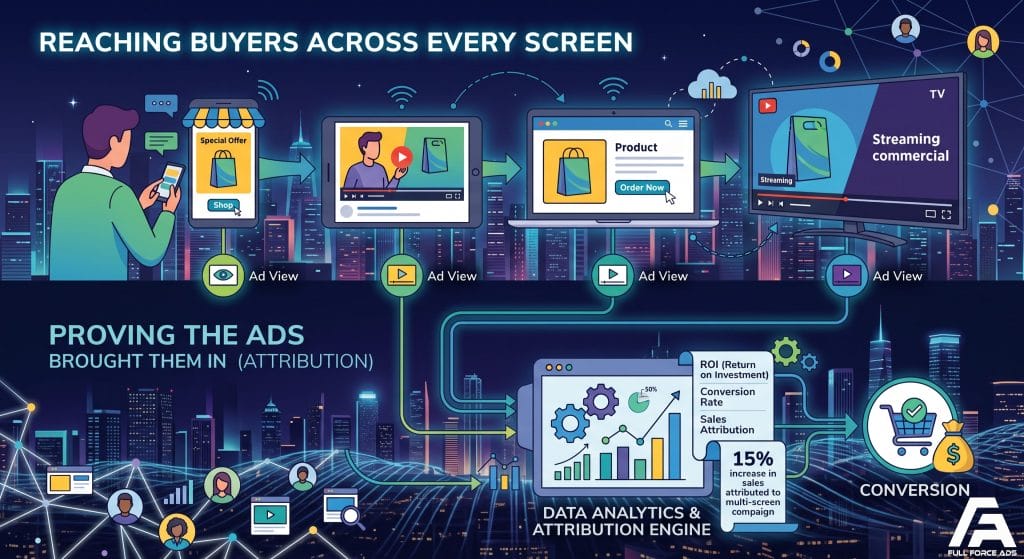
Your next customer starts the morning with a podcast on the commute. She checks industry news on her phone over lunch. That evening she watches an episode on Hulu through the Roku box in her living room. Before bed she reads a couple of design blogs on a tablet.
Four devices. Four completely different contexts. One buyer.
If you run marketing for a business, that pattern is the whole problem. You cannot buy her attention in one place anymore, because she is not in one place. And whatever you do buy, you still have to answer the question your CFO is going to ask: did any of it bring someone through the door?
For years the answer was to hire specialists. One vendor for connected TV. A second for mobile geofencing. A third for display retargeting. A fourth for addressable, which is really just direct mail wearing a digital jacket. You pay four sets of fees, read four reports that never quite agree, and sign four spend minimums. Meanwhile nobody can tell you whether the CTV spot and the mobile ad hit the same household twice or missed it entirely.
Full Force Ads is a programmatic advertising agency in Sandy, Utah. We started in 2015 on a fairly simple bet: the targeting technology that big national brands use is not actually expensive to operate, it is just expensive to buy, because it comes wrapped in $10,000 monthly minimums and twelve-month contracts. Strip those away and a regional retailer can run the same campaign a national chain runs.
What follows is how the channels fit together, how targeting decides who actually sees your ad, and a worked example of building-level geofencing in Manhattan.
People move between screens all day without thinking about it. Your media plan has to do the same thing, or you end up with a funnel full of gaps.
Running these six channels through a single platform is what makes that possible:
| Channel | Where your ad shows up |
|---|---|
| Streaming TV (CTV) | Roku, Hulu, Peacock, Amazon Fire TV, YouTube TV, Paramount+ |
| Video | Pre-roll, mid-roll, and outstream placements across the open web and apps |
| Audio | Spotify, Pandora, iHeartRadio, podcasts |
| Mobile | In-app, mobile web, location-aware placements |
| Display | Banner inventory across millions of sites and apps |
| Native | In-feed units built to match the article around them |
Cable is losing households every quarter and streaming is picking them up. Streaming TV gets you the big screen in the living room, with the production value of a television commercial, but you choose the households instead of buying a time slot and hoping. The ads are unskippable, viewers are actually watching, and you are not paying for impressions delivered to people who will never buy from you.
Video is where you get to tell an actual story. Pre-roll runs before the content, mid-roll runs inside it, and outstream sits within an article, playing as the reader scrolls past. Nothing else demonstrates a product as well. If your pitch takes thirty seconds to explain, this is the channel that gives you thirty seconds.
Some of the best moments to reach someone are the moments they are not looking at anything. Driving. At the gym. Cooking. Heads-down at a desk with headphones on. Audio ads on Spotify, Pandora, iHeartRadio, and podcasts land in those gaps, and recall on audio tends to be strong because there is no competing visual clutter.
The phone goes everywhere, which is the entire point. Mobile placements reach people inside apps, on mobile sites, and in specific physical locations. Pair mobile with real-world location data and it stops being an awareness channel and starts driving people to walk in.
Display is the cheap, flexible workhorse. It keeps your name in front of people, it reinforces whatever your video and audio are saying, and it is the engine behind every retargeting campaign you run. Unglamorous, but nothing else covers as much ground per dollar.
Ad blindness is real. Native units take the look and typography of the publication they sit in, so they read as part of the feed instead of an interruption. Engagement and click-through are usually well above standard banners, especially with readers who have trained themselves to skip anything that looks like an ad.
One thing worth flagging before you go build this: running these six channels through six vendors costs you more than the extra fees. Your frequency caps stop working, so the same person gets hit eleven times in a week while somebody else gets hit once. Your budgets overlap without anyone noticing. And attribution splinters into six reports that each claim credit. Consolidating the buy fixes all three problems at once.
Channels are where the ad runs. Targeting is who it runs to, and that is where most budgets get wasted. The problem is almost never bad creative. It is good creative shown to people who are never going to buy.
Broad demographics and three-mile radius circles are still the default at most agencies. Here is what we use instead.
| Targeting method | What it does |
|---|---|
| Building-level geofencing | Traces the actual outline of a competitor's building or a venue |
| Addressable | Matches street addresses to the devices in that household |
| Site retargeting | Brings back people who visited your site and left |
| Search retargeting | Reaches people by what they typed into a search engine |
| Contextual | Places ads next to content on a matching topic |
Radius targeting draws a circle. A three-mile circle around a store in most cities contains highways, apartment blocks, a river, a hospital, and forty businesses that have nothing to do with you. You pay for all of it.
Polygon geofencing traces the building instead. The exact footprint of a competitor's showroom, a convention hall, an event space. When a phone crosses into that shape, its anonymized device ID gets captured. You can serve ads to that person while they are standing in the building, and keep reaching them for up to 30 days after they leave.
Addressable is direct mail with the waste taken out. You upload a list of physical addresses, which can be your CRM export, your past customer file, or a purchased prospect list. The technology matches those addresses to the IP addresses and connected devices inside those homes. Then you run streaming TV, video, and display straight into that household, across every screen in it.
Over 95% of first-time visitors leave your site without calling, filling anything out, or buying. A tracking pixel lets you keep reaching those people after they go. They see your display, native, and video ads while reading news, browsing apps, and scrolling other sites, which pulls a decent share of them back before they forget you existed.
Someone searches for what you sell, then clicks through to a competitor. Search retargeting lets you reach that person based on the terms they typed, and serve them display and native ads across the open web. You get in front of active demand instead of waiting for it to find you.
Contextual reads the actual text, topics, and metadata on a page in real time and places your ad next to relevant content. A kitchen remodeler ends up on articles about renovation costs and cabinet trends rather than wherever the algorithm felt like putting them.
Manhattan retail is about as hard as local advertising gets, which makes it a useful place to show how the pieces fit.
Aurelia & Co. is a stand-in name. The campaign structure below is how we build luxury retail conquest programs.
The brand: a luxury outerwear boutique with a flagship on Prince Street in SoHo.
The problem: SoHo has enormous foot traffic and Aurelia was invisible in it. Flagship retailers on Broadway and Fifth Avenue own the visual real estate, and venture-backed pop-ups kept appearing for six weeks at a time with budgets nobody could match. Google and Meta had gotten expensive in the New York DMA. Radius-based mobile ads were burning money on people riding the subway underneath the store and sitting in traffic on the Manhattan Bridge.
The goal: reach high-net-worth shoppers while they are already out browsing luxury boutiques, get them to walk the three blocks to Prince Street, and count the visits.
Rather than dropping a circle over lower Manhattan, we drew polygons around specific buildings:
[ Fifth Ave department store ]
              |
              v
   Building polygon geofence
              |
              v
    Device ID captured
              |
              v
   Mobile display / native ad:
   "Handcrafted Italian silk outerwear.
Our SoHo boutique is three blocks away."Devices captured inside those polygons got two waves of messaging.
While shoppers were inside or near a competitor's store, they saw mobile web and in-app display with location-aware copy: "Shopping in SoHo today? Bespoke Italian outerwear, three blocks away on Prince St. Show this ad for a complimentary champagne fitting."
Devices picked up at hotels and trade events went into a 30-day retargeting window across mobile, native feeds, and video apps, so Aurelia stayed in front of them for the rest of their trip.
Attribution is the part physical retail has always struggled with. You can prove someone saw the ad. Proving they walked in is harder.
We solved it with a Conversion Zone, which is a second polygon drawn around the store's own footprint on Prince Street.
A. Device enters competitor geofence   -> ID captured
B. Device sees the mobile or native ad -> impression and click logged
C. Device enters the Conversion Zone   -> store visit attributed
When a phone that had already been served an Aurelia ad crossed into that zone, the platform logged a verified foot-traffic conversion. Not an estimate, not a modeled lift. That specific device saw the ad and then entered the store.
| Metric | Radius and social ads | Geofencing campaign |
|---|---|---|
| Geofence precision | 1-mile radius, spending on subway riders and traffic | Custom polygon, building-level |
| Cost per verified foot visit | $42.50 (estimated) | $11.80 (Conversion Zone verified) |
| Competitor conquest | 1.2% click-through rate | 3.8% store visit lift from conquest fences |
| Attribution | Impressions and clicks only | Actual store visits |
Wasted impressions dropped by more than 60%. More useful than the cost per visit, though, was that Aurelia ended up with a system they could rerun. Fashion Week comes back every season, the competitor fences stay mapped, and the Conversion Zone keeps counting.
The right mix depends entirely on what you are trying to do. A regional chain building awareness and an agency running white-label campaigns for clients need very different builds.
| Your goal | Channels | Targeting | Why it works |
|---|---|---|---|
| Local retail awareness | Display, mobile, native | Building geofencing, contextual | Concentrates spend on phones already moving through your trade area |
| Take competitors' customers | Mobile, video, display | Competitor location geofencing | Catches buyers while they are physically inside a competing business |
| Brand building | Streaming TV, video, audio | Behavioral, demographic, contextual | Big screens and audio drive recall in a way banners never will |
| Website traffic and leads | Display, search retargeting, native | Search intent keywords, contextual | Reaches people already searching for what you sell |
| Win back site visitors | Site retargeting, display, video | Tracking pixel | Recovers the 95% who left without converting |
| Activate a CRM or B2B list | Addressable display, streaming TV | Addressable household IP matching | Delivers your customer file to every screen in those homes |
Most programmatic shops sell you a version of the same package: a $10,000 monthly minimum, a six to twelve month contract, a monthly PDF full of impressions and clicks, and a self-serve platform complicated enough that you need to hire someone to run it.
| Traditional vendor | Full Force Ads | |
|---|---|---|
| Monthly minimum | $10K and up | Flexible |
| Contract | 6 to 12 months locked | Month to month |
| Geofence precision | Zip code or radius | Building-level polygons |
| Attribution | Impressions and clicks | Conversion Zone store visits |
| Channel management | Multiple vendors | One platform, one team |
| Time to launch | 4 to 6 weeks | 5 to 7 business days |
What that means in practice:
One partner for everything. CTV, audio, mobile, display, native, and geofencing all get planned, bought, and optimized together, so frequency and budget stay under control.
Fences drawn to the building. Our mapping tools trace the actual contours of a competitor's store, a dealership lot, or an event venue.
Store visits, not vanity metrics. Conversion Zone tracking tells you how many people walked in after seeing your ads.
Weekly reporting you can read. You get where the ads ran, which channels performed, and what we changed. Every week, not every quarter.
No contract. We would rather earn the renewal every month. Start at a budget you are comfortable with, watch the numbers, and scale when you believe them.
Live in a week. Legacy agencies take a month and a half to onboard. We get campaigns running across the major exchanges in 5 to 7 business days.
We handle the media buying, audience building, geofence mapping, and daily optimization. You do not need a trading desk or an in-house media buyer.
1. Discovery call -> 2. Custom plan -> 3. Launch -> 4. Optimize and reportDiscovery call. A conversation about your business, your customers, who you compete with, the geography you care about, and what a good quarter looks like. No pitch deck.
Custom recommendation. Our strategists put together a plan: which channels, which targeting layers, what the budget does in each, built for your market rather than pulled off a shelf.
Launch. Once creative is finalized, whether you supply it or we help build it, our trading desk configures the campaign, maps the geofences, and pushes everything live across the major exchanges within 5 to 7 business days.
Optimization and reporting. We watch performance daily, move budget toward whatever is working, tighten the targeting, and swap creative. Every week you get impressions, engagement, clicks, video completion rates, and Conversion Zone store visits.
If you are trying to pull foot traffic away from a competitor, stretch a budget across CTV and mobile without losing track of it, or find a white-label programmatic partner for your agency clients, we should talk.
Book a strategy call with Full Force Ads.