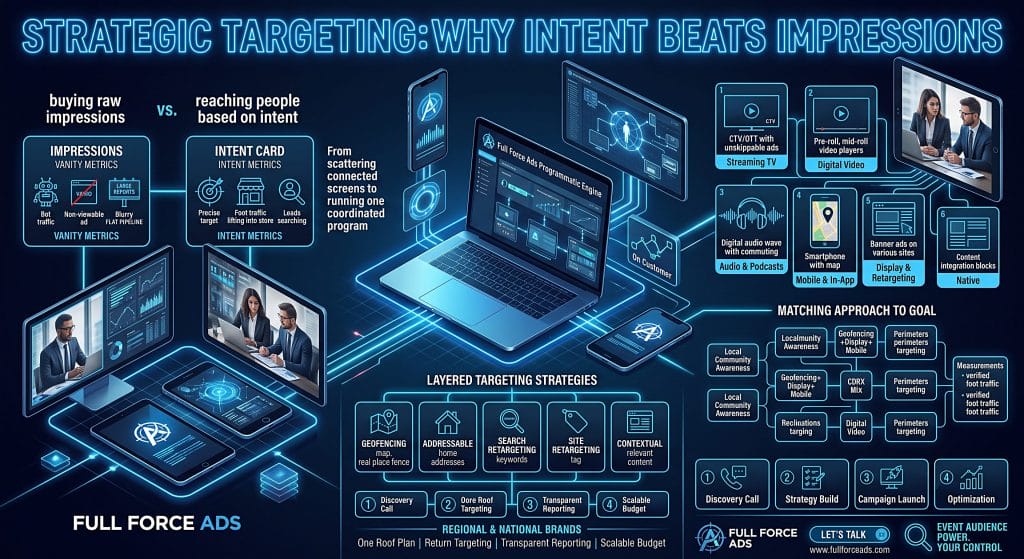
Plenty of businesses spend real money on digital advertising and get back a nice-looking report full of impressions and views. The numbers are big. The pipeline is flat. Nothing in the bank account has moved.
For years, media buyers treated impressions as the goal. Show your brand to a million people and, by the math, some fraction would convert. That logic held up better when there was one screen to buy. Now a single person streams on a TV, listens to podcasts on the drive to work, scrolls three or four apps, and tunes out banner ads without noticing them. Raw impressions aren't an edge anymore. Most of the time they're just expensive noise.
What actually builds market share now is reaching people based on what they do: where they physically go, what they search for, which household they belong to. That means dropping the scattershot approach of six disconnected vendors and running one coordinated program across channels.
Full Force Ads is a programmatic advertising agency in Utah. We build campaigns that follow customers across the screens where they pay attention, the living room TV, the podcast in their earbuds, the phone in their hand, and we tie that spend back to revenue you can actually verify.
Look at how ad inventory gets sold. Display networks make money by serving as many ad units as possible, which pushes CPM rates down. Cheap impressions sound good until you see what makes them cheap: bot traffic, ads that never actually appear on a screen, and placements shown to people nowhere near your service area.
Buy impressions without tight targeting and you're paying to reach people who will never become customers. A polished streaming TV spot shown to a household three states outside your service area is wasted budget, however good the creative is.
The better question isn't how many people saw the ad. It's what happened next. A few things worth tracking:
Winning share comes from pairing the right channel with targeting tight enough that the ad reaches the people those metrics care about.
Your customers aren't sitting on one website waiting for your ad. On a normal Tuesday, someone you'd love to reach might listen to a podcast on Spotify over coffee, check the news on their phone at lunch, put on a show on Hulu after dinner, and read reviews on a tablet before bed.
Treat those as separate, disconnected buys and the message falls apart. You hammer the same person with the same banner ten times while missing the chance to reach them on a streaming spot or an audio ad that would have landed better.
We run all of it through one system. It starts with intent signals (geofencing data, your CRM address lists, search behavior, and the content people are reading), routes them through a single planning hub, and pushes your message out across the screens that matter: the big screen, personal devices, and screen-free audio. Then it measures what came back, in one weekly report that covers both store visits and online conversions.
That message follows the consumer across six channels.
The TV in the living room is still the screen with the most pull. Connected TV and OTT let you run the kind of full-sound, full-screen spot people associate with television, but pointed at specific households instead of a whole broadcast market. Your 15 or 30 second ad runs unskippable on platforms like Roku, Amazon Fire TV, and Hulu, and only in homes that match the customer you're after. Traditional broadcast spreads your budget across millions of viewers you'll never sell to. This doesn't.
Video holds attention better than a static image or a block of text. Running pre-roll (before the content), mid-roll (during it), and outstream video (dropped inside articles) across quality publishers and apps gives you room to actually tell a story. Motion and sound build familiarity with your brand before someone ever lands on your site.
A lot of buying attention has moved to audio, where there's no screen involved at all. People spend hours every week on Spotify, Pandora, digital radio, and podcasts, often while their hands are busy and their focus isn't: commutes, workouts, yard work, heads-down work at a desk. A host-read spot or a targeted audio ad reaches them in those moments without adding to the pile of things competing for their eyes.
People pick up their phones dozens of times a day, so that's where a lot of the reach is. Mobile campaigns run across both mobile web and in-app inventory. Just as important, the phone is what makes location targeting work: it's how ad views get connected to real trips and real store visits.
Banner ads across a wide range of sites and apps are still a cheap way to stay visible and keep retargeting running. On their own they rarely drive the first conversion. Their job is support: keeping your brand in view after someone has seen your streaming spot or visited your page and left.
People have learned to skip banners without looking. Native ads get around that by matching the look and layout of the content around them, whether that's a news site, a lifestyle blog, or a trade publication. They work well when you're selling something that needs a little explaining: a considered purchase, an educational piece, an offer that won't fit in a banner.
Channels decide where your ad shows up. Targeting decides who sees it, and that's the part that protects your budget. A great streaming spot shown to someone who will never buy is still wasted money. The point of layering targeting across the mix is to make sure the spend lands on people who are actually in the market.
| Strategy | What it focuses on |
|---|---|
| Geofencing | Real-world locations and events |
| Addressable household | Physical addresses from your CRM |
| Search retargeting | Active buying keywords |
| Site retargeting | Warm traffic and bounced visitors |
| Contextual targeting | Topic-relevant editorial content |
Geofencing draws a virtual boundary around a real place, tight enough to trace a single building's property line. When someone carrying a phone crosses into that boundary, their device gets added to an audience you can advertise to, either while they're there or for up to 30 days after they leave.
A few ways to use it:
If you already have a customer list, a prospect list, or a set of mailing addresses, addressable targeting turns that list into a digital campaign. You upload the street addresses, the system matches them to the households behind them, and within a few days the connected devices in those homes start seeing your ads: the smart TV, the laptop, the phones, the tablets. Nothing runs outside your list, so there's no spend leaking to households you didn't choose.
Bidding on competitive keywords through search engines can run anywhere from a few dollars to well over a hundred per click. Search retargeting is the cheaper route. Instead of paying that per-click premium, you reach people who recently searched your keywords and show them display, native, video, or audio ads as they move around the rest of the web. Same buying intent, without the auction prices.
Most first-time visitors, north of 95%, leave without calling, buying, or filling anything out. Those are warm leads walking out the door. Site retargeting puts a privacy-compliant tag on your site so that after someone leaves, your ads keep finding them on other sites, streaming apps, and phones, with a sequence built to answer their hesitation and pull them back to finish.
With privacy rules tightening and third-party cookies going away, contextual targeting is a practical way to stay relevant. It reads the actual content of a page and places your ad next to articles on related topics. An outdoor gear brand ends up on hiking blogs, trail reviews, and camping guides, not because it's following individual users around, but because that's where the relevant readers already are.
No single channel does the whole job by itself. The results come from matching the channel mix and the targeting to what you're actually trying to accomplish. Here are combinations we run often.
| Goal | Channel mix | Targeting | What we measure |
|---|---|---|---|
| Local market awareness | Geofencing + display + mobile | Perimeters around commercial zones and neighborhoods | Verified foot traffic and local impression share |
| Competitor conquesting | Geofencing + addressable | Boundaries around competitor stores plus mailing lists | Store visits and offer claims |
| Brand building | Streaming TV + video + audio | Behavioral and contextual category targeting | Video completion rate and household reach |
| Qualified website traffic | Display + native + search retargeting | Keyword intent and topic context | Cost per click and time on site |
| Converting bounced visitors | Site retargeting + display + video | Web pixel and event triggers | Return-visit conversion rate and CPA |
| Account-based marketing | Addressable + streaming TV + display | Verified corporate address lists | Account-level engagement across touchpoints |
Doing this yourself usually means hiring media buyers, negotiating minimum spends with a long list of publishers, and stitching together analytics from tools that don't talk to each other. We handle all of that as your outside programmatic team, with the media access, the targeting, and the reporting in one place.
Everything runs under one roof. You're not juggling one vendor for TV, another for banners, and a third for audio. We plan, run, and optimize all of it.
The targeting is built for return, not just reach. Every campaign gets layered with location data, address lists, or intent signals so the budget goes toward people who might actually buy.
The reporting is transparent. Each week you see where your ads ran, which platforms did the work, who saw them, and how they converted. No black box.
The budget scales with you. There's no multi-year contract to sign up front. Start smaller, see what works, and put more behind it once the numbers hold.
And it moves fast. Most cross-channel campaigns are live within five to seven business days.
If you're tired of paying for impressions that don't move the pipeline, the fix is straightforward: stop buying reach for its own sake and build a targeted program that reaches your customers on the screens they actually use. If that's the direction you want to go, let's talk.