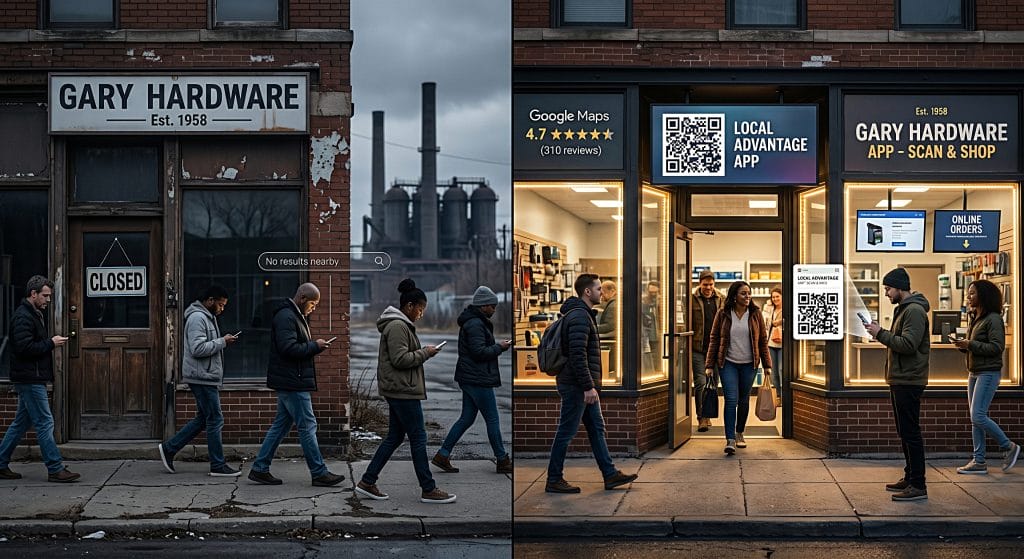
The phrase "build it and they will come" is a recipe for bankruptcy. The defining challenge of business is no longer production, logistics, or inventory management. It is discoverability.
Thousands of capable businesses close because they are invisible to the consumers who need them. This breakdown covers the customer acquisition crisis, lays out the digital advertising solutions to reverse it, and highlights US regions (the Rust Belt, parts of the South, and mid-sized cities like Erie, Gary, and Jackson) where a deficit in digital infrastructure stalls local growth.
Consumers no longer shop in the traditional sense. They query. The modern consumer journey starts behind a screen. Whether through search engines, social media, or algorithmic recommendations, the physical world maps directly to a digital layout.
Traditional: Physical Signage -> Foot Traffic -> Purchase
Modern:      Algorithmic Discovery -> Online Reviews -> Targeted Intent -> Conversion
When a business leans only on physical visibility (storefront foot traffic, word-of-mouth, local print and radio) it cuts itself off from up to 80% of its market. Three shifts drive this invisibility:
When these factors hit at the same time, a business enters a decline, forced to compete on price until margins disappear.
To break that cycle, a business has to build a data-driven customer acquisition system. Digital advertising connects intent capture, awareness, and retention.
When a user searches for a specific service, they show immediate commercial intent. Someone searching for "emergency plumber near me" or "corporate tax attorney in Charlotte" wants to buy now.
While search advertising captures existing demand, social media advertising generates new demand. Using demographic, behavioral, and interest data, businesses can put products in front of buyers who did not know a solution existed.
Most users leave a website without buying. Retargeting places a digital marker on the visitor so the business can serve custom ads to that user across the web.
| Stage of the Funnel | Primary Digital Channel | Core Objective |
| Top (Awareness) | Meta Video Ads, Programmatic Display | Introduce the problem and validate experience. |
| Middle (Consideration) | Search Ads, Targeted Social Carousel | Differentiate from competitors using case studies and reviews. |
| Bottom (Conversion) | Dynamic Retargeting, High-Intent Search | Offer a direct incentive or frictionless checkout. |
Adoption of digital advertising is uneven. Metros like San Francisco, New York, Austin, and Seattle are saturated with digital-first businesses, but a lot of mid-sized cities and industrial regions are short on digital outreach. Local businesses struggle to scale because the local ecosystem is missing digital literacy, agency infrastructure, and programmatic advertising adoption.
Three regions show how a lack of digital advertising limits economic vitality:
Erie is a classic Rust Belt economy moving from heavy manufacturing to service, healthcare, and tourism. The city has local manufacturers and waterfront hospitality venues, but many of those businesses stay invisible online.
A lot of multigenerational businesses rely on legacy signage and local word-of-mouth. As the population shifts and regional tourism draws visitors from Pittsburgh, Cleveland, and Buffalo, traditional methods fail.
A visitor looking for dining or marine repair searches on a smartphone. If local businesses lack optimized Google Business Profiles, localized display ads, or active Meta location targeting, those dollars flow to national chains with automated regional digital spending. Local manufacturing firms often operate without a LinkedIn ad footprint or automated search campaigns, cutting them off from global supply-chain buyers.
Gary sits inside the Chicago metropolitan area but lives in a deep digital shadow. Historically anchored by the steel industry, Gary’s local commercial sectors deal with a customer acquisition deficit.
Gary has a specific structural challenge: regional audience bleed. Because of its proximity to the Chicago media market, traditional media advertising is expensive and inefficient for a local Gary business. Local owners have been slow to adopt the hyper-local digital targeting that solves that problem.
Local businesses rarely use precise digital geofencing to serve ads directly to smartphones inside specific neighborhoods. A consumer in Northwest Indiana who searches for local services often gets ads for businesses in downtown Chicago or southern suburbs like Hammond and Munster because Gary businesses do not bid on local keywords. That digital vacuum forces residents to spend capital outside the community.
As the capital of Mississippi, Jackson is a cultural hub with a large network of small businesses, professional firms, and creative companies. The city faces a severe digital marketing implementation gap driven by an absence of local digital marketing agencies.
Jackson has a vibrant community of artisans, culinary creators, and professional services, but lacks structured, multi-channel social advertising campaigns like localized TikTok or Instagram Reels targeting. Without those visual ad avenues, local businesses fail to reach younger demographics and professionals moving into urban pockets.
Basic search engine marketing is underused. Local legal firms, medical practices, and contracting companies rarely run active Google Search or Local Service Ad campaigns. National aggregate platforms and corporate chains absorb the local search volume, pushing independent providers down the search results pages.
The lack of digital outreach in these cities comes from structural hurdles, not from a choice to avoid growth.
For businesses in regions that lack digital advertising adoption, the current deficit is an arbitrage opportunity. Because local competitors are not running digital ads, the Cost-Per-Click (CPC) and Cost-Per-Thousand-Impressions (CPM) in these territories are low compared to tech hubs.
To take advantage of that, businesses can run a four-phase rollout:
Before spending money on ads, install tracking software. Put Meta Pixels, Google Analytics 4 tags, and Conversion APIs on your website. If you can’t measure where a customer came from, you can’t optimize your budget.
Optimize your Google Business Profile completely. Upload high-resolution photos, systematically request reviews from existing clients, and launch a targeted Google Local Service Ads campaign. Make sure your business shows up in the Local Map Pack for your target keywords.
Run Facebook and Instagram ads restricted to your target zip codes or city radius. Use video content showing your product, your team, or your customer success stories. Use broad targeting parameters inside your local geography so the platform’s system can find buyers.
Set up an ongoing retargeting campaign. Anyone who visits your website, clicks your social ads, or interacts with your profiles should get follow-up ads featuring reviews, testimonials, or an introductory offer for the next 30 days.
When local businesses fail to adopt digital advertising, the municipal economy takes a hit. Wealth leaves the community as consumers redirect spending to digital-first national brands, local tax bases erode, and downtown corridors lose occupancy.
On the other side, embracing digital advertising lets a small business in a struggling city bypass geographic limits. A specialized manufacturer in Erie can find clients across North America through LinkedIn ads. An artisan in Jackson can build a national brand using Instagram shopping ads. A local service provider in Gary can lock down their county with hyper-localized geofencing.
The barrier to acquiring customers is not a lack of local demand. It is a lack of digital visibility. For a business trying to survive, digital advertising is a necessity.