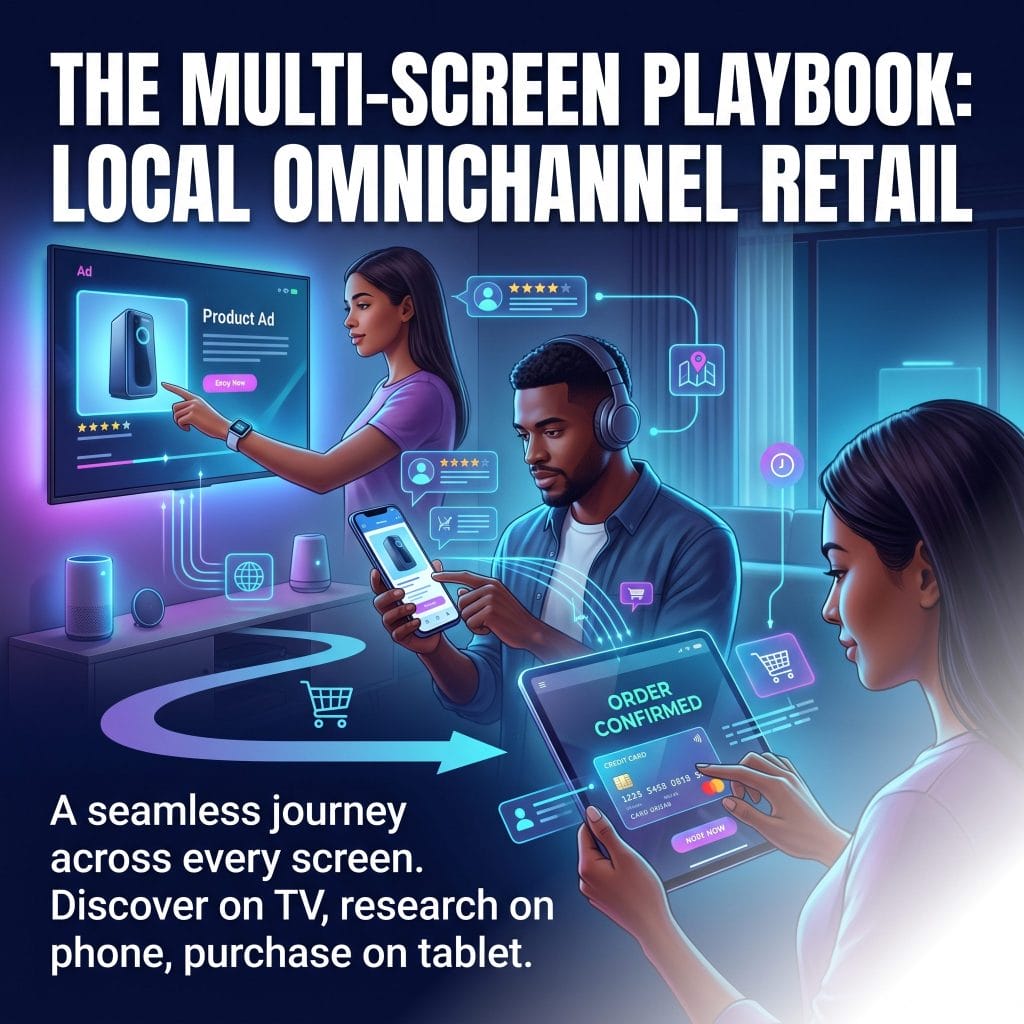
Retail requires more than relying on foot traffic. The consumer journey spans multiple devices and doesn't follow a linear path. A customer might see a product on a television screen at breakfast, research it on a smartphone during lunch, view options at a competitor's storefront in the afternoon, and buy it on a tablet at night.
For retail brands looking to scale, the main challenge is staying relevant across separate digital platforms.
When advertising budgets fund disconnected vendors, messages get diluted and data stays siloed. Retailers lose money on unverified impressions instead of driving business outcomes. Growth requires an omnichannel strategy that combines programmatic execution with precise targeting.
Consumers don't divide their shopping into online and offline categories. They view the entire process simply as shopping.
Consider this typical purchasing cycle: A consumer watches a cooking show on Hulu via a Roku device and sees a 30-second commercial for a premium kitchenware brand. The next day, they use a smartphone to search for stainless steel cookware sets and browse an independent cooking blog where they see display ads matching that brand. On the weekend, they visit a local shopping plaza and check a competitor's cookware aisle to inspect options in person. They leave the competitor empty-handed, return home, visit the original brand's website, and add a 10-piece set to their cart. After leaving the site, a customized display ad offers them free shipping. They click and buy.
Brands relying only on social media grids, local print, or traditional radio miss most of this journey. Capturing market share requires a unified strategy across every screen.
Consolidating programmatic media buying lets you manage campaigns across major digital channels with unified reporting.
Streaming TV (Connected TV / OTT). Linear cable is giving way to streaming ecosystems. Streaming TV places ads on home television screens via platforms like Roku, Fire TV, and Apple TV, or apps like Hulu and Pluto TV. Unlike traditional cable, you serve unskippable ads exclusively to households matching specific profiles, such as defined income tiers or specific lifestyle interests.
Digital Video. Consumers watch video content on laptops, tablets, and smartphones. Pre-roll and mid-roll ads run before or during video content across websites and apps. Outstream video opens within text-based articles as a user scrolls, pausing when out of view.
Digital Audio. Commuting, working out, and cooking offer opportunities for audio advertising. Retailers reach listeners on Spotify, Pandora, iHeartRadio, and podcasts. Because audio is an intimate medium often experienced through headphones, it retains high message retention.
Mobile Advertising. Smartphones accompany users everywhere. Mobile advertising includes in-app placements, optimized web banners, and location-aware creative assets. Retailers use these to deliver immediate calls to action, like driving directions to a local storefront.
Display Advertising. Banner ads provide cost-effective reach and frequency across websites and mobile applications. Display serves as the primary vehicle for visual retargeting, reminding shoppers of products they previously viewed.
Native Advertising. Native advertising delivers ads matching the visual design and layout of the surrounding content. When a consumer reads a lifestyle publication, the native ad appears as recommended content. These placements bypass banner blindness and work well for gift guides, style trends, and product reviews.
Channels dictate where ads appear. Targeting ensures you reach the correct audience.
Geofencing. Geofencing draws a virtual perimeter around real-world locations using GPS coordinates. When a consumer enters that zone with a smartphone, the system logs the device ID. Retailers use geofencing for competitor conquesting (draw geofences around direct competitors' physical stores), event interception (geofence local marathons, stadiums, or fitness conventions), and neighborhood targeting (target commercial districts or nearby shopping centers).
Search Retargeting. Search engine marketing can be expensive for competitive retail keywords. Search retargeting offers an alternative by targeting individuals across the web based on keywords they typed into major search engines. If a consumer searches for an ergonomic office chair, closes the browser, and later reads a news article, search retargeting serves them a visual ad for your furniture brand.
Site Retargeting. Most first-time website visitors leave without purchasing. Site retargeting tracks behavior on your digital storefront, monitoring browsed categories, clicked products, and abandoned carts. As those users travel across the internet, site retargeting serves them ads featuring the exact products they left behind.
| Retail Objective | Channel Mix | Targeting Strategy |
|---|---|---|
| Local Brand Awareness | Geofencing, Display, Mobile | Location Proximity |
| Conquesting Competitors | Geofencing, Addressable | Competitor Foot Traffic |
| Brand Building | Streaming TV, Video, Audio | Behavioral Filtering |
| Driving High-Intent Traffic | Display, Native, Search Retargeting | Keyword Intent |
| Recovering Abandoned Carts | Site Retargeting, Display, Video | Behavioral Tracking |
| Activating Loyalty Lists | Addressable, Streaming TV, Display | CRM Data Upload |
A regional outdoor gear retailer wants to launch a line of hiking boots. Instead of running a generic campaign, they deploy a multi-layered approach.
First, they run Streaming TV commercials targeted at households within a 20-mile radius of their stores where occupants show interest in hiking and national parks. Next, they activate search retargeting for keywords like "waterproof hiking boots." People searching for those terms see native ads featuring expert product reviews. They also draw geographic boundaries around national outdoor competitors in their region. When an outdoor enthusiast walks into a competitor's footwear department, their device is logged, and over the next week they see mobile ads showcasing a 15% discount on the retailer's boots. Finally, for individuals who clicked the ads, visited the site, but closed the tab, site retargeting takes over with dynamic banner ads featuring the exact boot to finalize the order.
Managing these capabilities separately introduces three major structural issues.
The Reporting Problem. Using separate vendors creates isolated reports with conflicting attribution metrics. One vendor claims credit for a view-through conversion, another claims a click-through, and internal analytics show a third number. This makes it impossible to track your exact return on investment.
Disconnected Audience Journeys. Without cross-channel communication, frequency capping fails. A consumer might see your ad dozens of times in one day, causing ad fatigue. Or retargeting ads pursue users for weeks after they've already made their purchase.
Wasted Budget. Every isolated vendor requires its own margin and minimum spend. This traps capital in rigid buckets, preventing you from shifting budget in real time from underperforming banners to successful search retargeting.
Full Force Ads consolidates your entire media footprint into a single platform. From localized geofencing to nationwide Streaming TV deployments, we build, manage, and optimize campaigns from one hub.
Our onboarding process is built to get you live fast.
Ready to build a unified advertising strategy for your retail brand? Visit Full Force Ads to schedule your custom campaign demo.