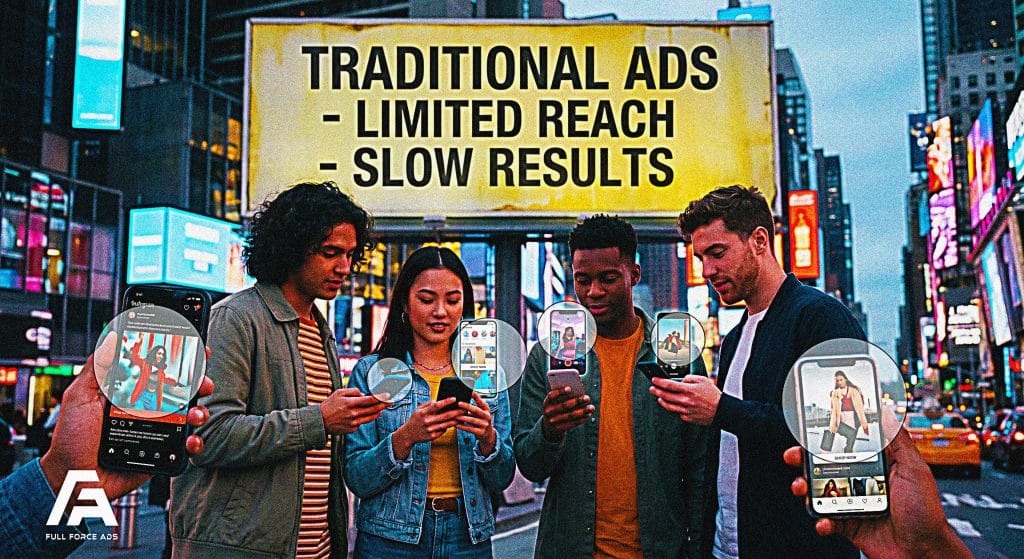
Traditional advertising playbook is broken. For decades, businesses relied on broad, manual negotiations or siloed digital ecosystems that restricted visibility and controlled pricing. Today, forcing a brand into static channels without real-time agility causes operational inefficiency and halts growth.
Winning market share requires a sophisticated technological approach. You must meet audiences where they are, use precise data instead of guesswork, and deploy messaging across every screen.
Traditional advertising—linear broadcast television, terrestrial radio, print, and static billboards—served as the primary vehicle for brand building for generations. These mediums relied on a single framework: mass reach through uniform message distribution.
Consumer media consumption has changed. Households no longer gather around a single linear television broadcast or rely on local radio stations. Attention is split across thousands of niche touchpoints:
Investing in legacy manual advertising means purchasing unrefined impressions. A billboard along a major highway or a spot on a local evening news broadcast charges for the entire audience, regardless of who looks.
| Media Type | Operational Mechanism | Budget Efficiency |
| Legacy Buying | Mass Impressions | High Waste on Irrelevant Audiences |
| Programmatic | Filtered Data Layers | Focused Solely on In-Market Buyers |
Manual ad buys require long negotiation cycles, static insertion orders, and rigid commitments. If a market shifts or a campaign fails within the first week, you cannot easily pivot. Capital stays locked in, creative remains static, and data arrives delayed.
Programmatic infrastructure replaces manual negotiations with automated, real-time bidding protocols. You purchase access to individual consumers based on verified behaviors, not broad demographic averages.
Faced with the decline of traditional media, many brands turned to major search and social platforms. While these closed ecosystems offer powerful data within their networks, relying on them exclusively creates distinct operational challenges.
Closed ad platforms control both ad inventory and performance reporting. This creates a conflict of interest: the platform determines the value of an impression, auctions it off, and validates its own success.
This model leads to cost-per-click inflation. In competitive regional sectors—like home services, legal representation, or specialized healthcare—bidding on high-intent keywords depletes budgets with no guarantee of conversion.
Relying solely on search or social assumes a linear purchase journey. In reality, buyers use multiple devices. A prospective customer searches for a service on a desktop during the workday, listens to a podcast during the evening commute, and streams a television program at night.
Living inside a single social network or search engine misses the wider digital landscape. Programmatic advertising coordinates campaigns across independent websites, apps, streaming networks, and digital audio feeds from a centralized framework.
Effective advertising requires cognitive ease and contextual relevance.
The human brain prefers things it recognizes. Achieving familiarity requires consistent cross-screen frequency. Seeing an ad on a streaming television, hearing a synchronized audio ad on Spotify, and encountering a supporting native ad while reading an article online builds mental availability.
Coordinated repetition creates a compounding effect. You experience a cohesive brand presence that appears established and authoritative without repeating a single banner.
Advertising fails when it disrupts the consumer experience. Modern programmatic strategy places native and display ads within environments that mirror the user's immediate focus. When an ad matches the look, feel, and topical content of the surrounding editorial space, consumer resistance drops.
Programmatic systems focus entirely on audience accuracy rather than total impressions. Advanced targeting strategies ensure budgets go exclusively toward individuals showing commercial intent.
Geofencing uses spatial data to map the exact structural footprint of physical locations.
Addressable programmatic targeting connects physical data—like direct mail lists, past customer databases, or CRM leads—to digital spaces. Uploading physical street addresses into a programmatic system maps those coordinates to the internet-connected devices operating within those households. You deliver tailored digital ads across streaming televisions, laptops, and mobile devices directly to target households, removing printing and postage costs.
Programmatic frameworks track intent data through multiple forms of continuous retargeting:
Site Retargeting: Re-engages individuals who visited your website but left without converting, keeping your brand top-of-mind across the web.
Search Retargeting: Targets users based on specific keywords typed into search engines, capturing active intent outside traditional search result pages.
Full Force Ads provides a managed solution for businesses moving away from inefficient legacy media and multi-vendor tracking. Headquartered in Utah, Full Force Ads consolidates global digital inventory into a single execution layer.
Their suite of advertising solutions deploys coordinated multi-channel campaigns across digital touchpoints:
Managing separate relationships, contracts, and platform dashboards for connected TV, audio, search, and social media introduces operational friction. It complicates reporting, fragments budgets, and obscures attribution.
Full Force Ads removes this fragmentation by planning, executing, and optimizing campaigns across digital media channels simultaneously.
Historically, accessing premium programmatic marketplaces required large monthly minimum spends, complex multi-month contracts, and specialized technical knowledge. The FullForceAds.app self-serve platform removes this technical friction, offering an intuitive workspace to launch premium programmatic campaigns quickly.
       ┌─────────────────────────────────────────────────────────────┐
       │               FULLFORCEADS.APP WORKSPACE                     │
       ├─────────────────────────────────────────────────────────────┤
       │  • Low Entry Threshold: Minimum $500 per campaign           │
       │  • Total Financial Freedom: Zero monthly platform fees      │
       │  • Enterprise Reach: Instant access to premium channels     │
       │  • Simple Setup: Launch high-impact campaigns in minutes    │
       └─────────────────────────────────────────────────────────────┘
The self-serve platform changes the economics of programmatic advertising through two structural updates:
True advertising efficiency requires aligning digital channels with specific business goals.
Legacy media and siloed digital advertising platforms often obscure performance data. Many businesses receive confusing monthly PDF summaries focusing on vanity metrics—like broad impressions or estimated reach—while hiding where ads ran or how much budget went to low-quality inventory.
Full Force Ads provides detailed weekly reporting updates. Dashboards reveal exactly where ads displayed, which screens captured the highest engagement, how different audience targeting layers performed, and what actions consumers took after seeing your message. This visibility removes guesswork from your marketing spend, giving you the data needed to make scaling decisions.
You can partner with Full Force Ads for a managed enterprise strategy, or control your campaigns directly with the self-serve platform at FullForceAds.app.
Visit the Full Force Ads Advertising Solutions portal to explore platform capabilities, or schedule a strategy call to build a programmatic campaign tailored to your business goals. To see a demonstration of how this technology operates, watch the Programmatic Self-Serve Platform Walkthrough video to see how to set up, target, and launch campaigns using the self-serve dashboard.