Every day, people who actually want what you sell show up on your website. They search specific, solution-oriented phrases into Google. They read your case studies. They hover over your pricing page.
Then they leave.
No form fill. No call. No purchase. Just the little "X" at the top of the browser tab, and they're gone.
Industry benchmarks put first-time visitor conversion at under 3%. That means the other 97% of the traffic you paid for through SEO, content, social, and cold outreach walked away and left nothing behind but a bounce in Google Analytics.
The usual response to this is to pour more traffic into the funnel and hope volume fixes the math. It doesn't. What actually moves the needle is a system that catches people at the moment they show intent, then keeps showing up until they convert.
That's what search retargeting and site retargeting do. Used together, and run by a team that knows how to operate them, they turn passive traffic into revenue instead of a line item you write off every quarter.
Before getting into how retargeting works, it's worth being honest about why the usual approach to digital ads doesn't do much for small and mid-sized businesses.
Most independent operators lean on basic Google Search ads or demographic-targeted social boosts. Those channels have their place, but they run into a few structural problems.
Demographics aren't intent. A display ad targeted at "males, 34 to 45, in Salt Lake City, interested in logistics" might land on someone who fits the profile perfectly and has zero need for your service right now. Fitting an ICP and being ready to buy are two different things.
You're bidding against companies with far bigger budgets. On competitive search terms like "enterprise software solutions" or "commercial insurance broker," a mid-market advertiser is bidding directly against companies that can absorb a $40 or $50 cost per click without blinking. You can't win that fight on volume.
One touchpoint isn't enough. People don't see an ad once and buy. Most B2B and higher-consideration B2C purchases take somewhere between 7 and 21 touchpoints before someone feels comfortable enough to act. If your media plan doesn't have a way to stay in front of a prospect across weeks, you're paying to educate someone who ends up buying from whoever shows up next.
The way around this isn't more broad-spectrum advertising. It's shifting toward intent-based, cross-channel targeting that follows a person across the screens they actually use.
Traditional search advertising and search retargeting solve different problems.
With a normal Google Search campaign, you pay to appear at the top of results the moment someone types a query. If they don't click, or click and leave, that's it. You're also limited to the search engine itself.
Search retargeting works differently. It targets people based on keywords they searched recently, but instead of paying for a spot on the results page, you serve them display, video, native, or audio ads as they move on to other sites, apps, and streaming platforms.
Someone searches a keyword, leaves the search engine, and starts browsing the web, an app, or a streaming service. That's when your ad shows up.
When someone searches for something, whether on a search engine, a shopping site, a directory, or a research tool, that action is a strong signal. Through programmatic data partnerships, Full Force Ads picks up that keyword activity in near real time.
Someone typing "best commercial fleet management software" or "affordable corporate tax attorney near me" has already told you they're actively looking for a solution. They're not a demographic guess anymore. They're a buyer with a specific problem.
With search retargeting, you're not fighting for the top spot on the results page. You wait until that person leaves the search engine to read a news article, check the weather, stream a show, or listen to a podcast, and your ad appears in front of them there instead.
A search ad puts people on guard. They know they're being sold to. But when the same person later sees a well-made display or native ad while reading something unrelated, it feels less like a pitch and more like a coincidence, which lowers their resistance.
There's also a cost argument. Premium search clicks can run $20 to $50 each. Programmatic display and video impressions across the open web cost a fraction of that, which means your budget covers more ground while still reaching people who've shown real intent.
If search retargeting brings in new intent, site retargeting is what keeps the people who already visited you from disappearing for good.
Most of the traffic that hits your site leaves without doing anything, and it's rarely because of your product. Someone gets a phone call mid-session. Someone's browsing on their phone during a commute and doesn't have time for a form. Someone's comparing you against three competitors and isn't ready to decide. Or they just got pulled away by something else.
Without retargeting, that's the end of the relationship. They forget your URL and default to whichever brand happens to be in front of them when they're finally ready to buy.
Old-school retargeting relied on browser cookies tied to a single device. If someone browsed your site at work and then looked at it again from an iPad on the couch, the tracking broke.
Modern retargeting uses cross-device identity matching. A pixel on your site drops an anonymous identifier that maps to a household's broader device ecosystem, so the same person can be reached whether they're on a laptop, a phone, or watching Hulu on a Roku.
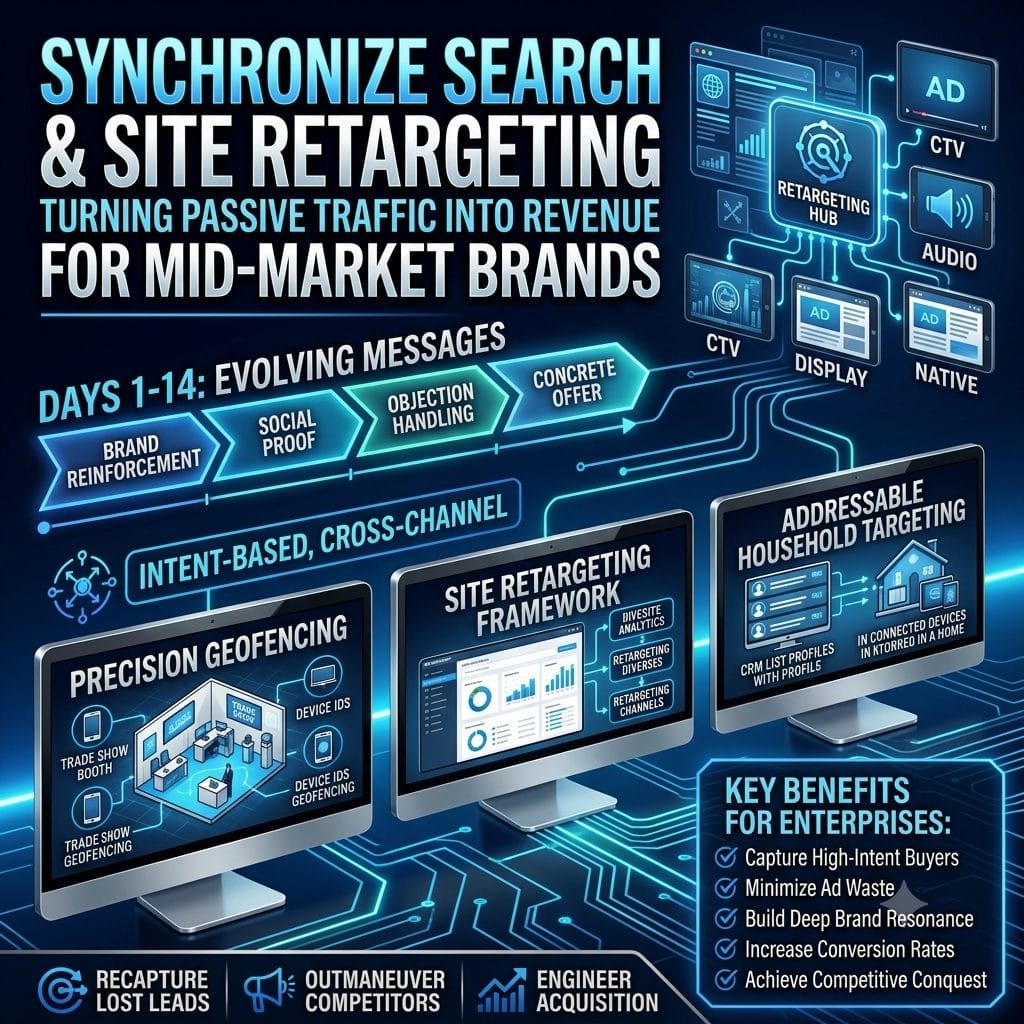
That opens up a few channels worth knowing. Connected TV puts unskippable 15- or 30-second spots on Roku, Fire TV, and Hulu, right on the biggest screen in the house. Outstream and in-app video cover pre-roll and mid-roll placements inside apps and high-traffic web properties. Native ads get styled to match the publication they're sitting in, so they don't read as an obvious ad. Digital audio reaches people through Spotify, Pandora, or podcasts while they're driving, working out, or working. And display rounds it out with standard banner and rich media placements, a low-cost, constant reminder that you exist.
The most common mistake in site retargeting is running the same static banner for 90 days straight. People get tired of it fast, and it starts to work against you.
A better approach is to change the message as time passes:
Days 1 to 3. The visit is fresh in their memory. Reinforce what makes you different. If you run a commercial roofing company, this is craftsmanship and certifications, not a hard sell.
Days 4 to 7. If they haven't come back by day four, they're probably comparing you to someone else. Shift toward proof: testimonials, case studies, review counts. Something like "over 500 Utah businesses trust us" does more here than another product shot.
Days 8 to 14. By now the holdup is usually an unaddressed objection: price, onboarding, contract length. Native ads that answer these directly, like "What does commercial fleet software actually cost?", tend to pull people back in because they offer a straight answer instead of another pitch.
Day 15 and beyond. For the people who still haven't moved, offer something concrete: a discount, a free consultation, a limited-time audit, paired with real urgency, not manufactured scarcity.
Shifting the message this way turns retargeting from a background tracking tool into something closer to a sales rep who's still working after everyone else has gone home.
Once business owners see what synchronized search and site retargeting can do, the instinct is often to hand it to an in-house marketer or try to build it with basic self-serve tools.
That instinct usually costs more than it saves, for a few reasons.
Everything ends up in separate silos. Run search in Google, social in Meta, audio through one network, and CTV through a third-party broker, and none of those platforms know what the others are doing. Google has no idea what Meta just showed the same person. Your CTV buy is blind to what happened on audio that morning. Without a shared view, you can't control total frequency, so someone might get hit 15 times on their phone and never see your brand on their TV.
A single demand-side platform solves this by tracking the whole journey in one place. Whether someone's listening to a podcast on a run, reading a trade publication at their desk, or watching a show that night, the system manages exposure across all of it together.
Self-serve accounts don't get premium inventory. Most major news publishers and streaming networks don't sell ad space to small self-serve accounts. That inventory sits behind programmatic exchanges with capital minimums most mid-market companies can't meet on their own. Run campaigns through basic ad networks instead, and your ads usually end up on lower-quality sites and mobile games with more click fraud and less real engagement. A programmatic partner with existing access can put your ads on the same publications and streaming platforms the biggest companies use.
Standard reporting doesn't tell you much. A lot of platforms hand you a monthly summary of clicks and impressions and call it a day, without showing where the ads actually ran or what was really driving results. Full Force Ads sends weekly reports with the actual URLs, apps, and programs your ads appeared on, along with what happened after someone saw them. No hidden markups, no vague numbers.
Search and site retargeting work well on their own, but they're stronger paired with a few other tactics.
Geofencing. Say a prospect walks into a competitor's booth at a trade show, or spends an hour in a rival's showroom. Geofencing draws a boundary around that location and picks up anonymized device IDs from people who cross it. When they get back to their hotel or office and search anything related to what they just saw, your ads follow them across their phone, laptop, and TV, right when they're weighing the options.
Addressable targeting. If you've got a CRM list of cold leads or a set of high-value account addresses you've tried to reach through direct mail, you can upload those addresses and match them to specific households. From there, you can run streaming TV, audio, and native ads to those exact homes, and when the same decision-makers later search for a solution online, search retargeting picks them up on the back end.
Getting a campaign live doesn't take months. Our process runs in four steps.
1. Discovery call. We talk through your business, your goals, your ideal customers, and where your current funnel loses people. No pitch, just a real conversation about where the opportunities actually are.
2. Custom recommendation. Our media planning team builds a targeting and channel plan around your specific goals and budget. If you're trying to take share from local competitors, that might mean geofencing, addressable, and display. If you're building long-term brand equity, that's more likely streaming TV, video, and audio. Either way, we tell you exactly what's running, who it's reaching, and how we're measuring it.
3. Fast-track launch. Once you approve the plan, we set up tracking, load your creative, and configure the audience targeting. Most agencies take four to six weeks to launch. We usually get campaigns live in 5 to 7 business days.
4. Ongoing optimization and reporting. Once a campaign is live, we watch performance in real time, adjust bids, cut underperforming placements, and shift budget toward what's actually working. You get a transparent report every week.
Every day you don't have a coordinated retargeting strategy in place is a day your competitors, who do, get more visible than you. You're still funding the research phase of a buying journey for someone who might buy from someone else.
If you want to talk through what this could look like for your business, reach out and we'll set up a call.