FulForceAds Growth Playbooks Talk
Alex Vance: Welcome back to the Growth Playbooks series. Today we're on a problem that turns up in almost every mid-market ad audit I sit in on: the whole budget runs through one or two channels. For years that was fine. You fed Facebook or Google Search, customers came back out. Now CPMs keep climbing, privacy changes keep breaking measurement, and every competitor you have is bidding on the same inventory you are.
With me is Marcus Reed, Senior Programmatic Strategist at Full Force Ads, based in Sandy, Utah. His team builds multi channel media plans for brands across North America. Marcus, why is the single channel approach breaking down, and what replaces it?
Marcus Reed: Thanks, Alex. Media habits fragmented and ad budgets mostly didn't follow. A typical adult moves across six or eight screens and formats in a day. Podcast on the commute, desktop browsing at lunch, streaming TV on the couch at night, phone in hand for most of the gaps.
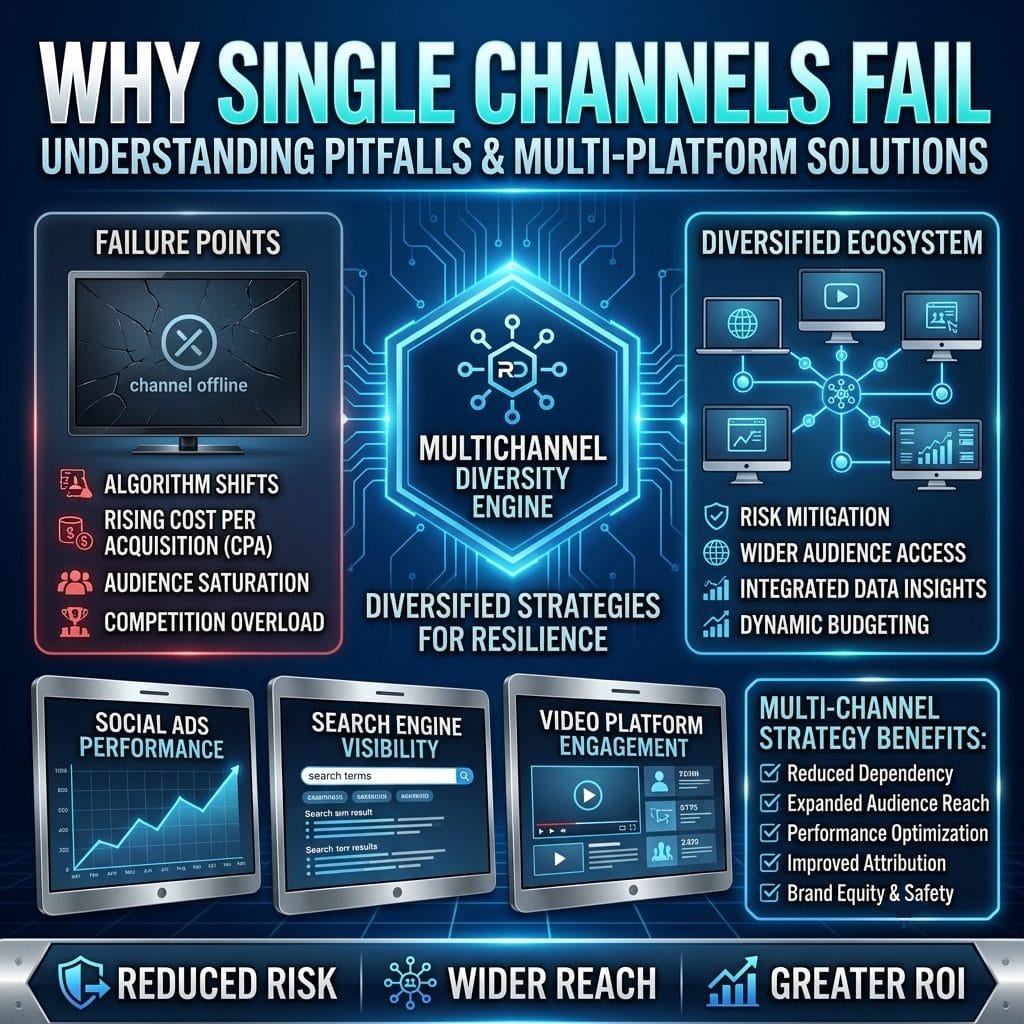
Buy only social feeds and search results and you're absent for most of that. Where you do show up, you're in an auction against everyone who picked the same keyword you did. Prices climb, results flatten, and the usual response is to raise the budget, which makes the auction worse.
The fix is to stop buying platforms and start buying audiences. Same customer, every screen, using targeting data that doesn't live inside Google or Meta. That's what we run at Full Force Ads: streaming TV, audio, mobile, native, video and display on one platform.
Alex Vance: "Omnichannel programmatic" is an easy phrase to say and a hard one to budget for. Take one combination your team deploys often: geofencing, search retargeting, outstream and pre roll video, and display. What is each piece actually doing?
Marcus Reed: Internally we call it the High Intent Velocity Stack, which is a grander name than it deserves. Four pieces, one job each.
Marcus Reed: Radius targeting drops a circle over a zip code. You pay to reach people driving past on the freeway and people three streets over who will never buy from you.
We build fences at the building level instead. Precise polygons around specific structures: a competitor's showroom, a trade show hall, a corporate campus, a dealership row. When a phone enters that shape, its anonymous device ID gets logged. We can serve mobile and display ads while that person is standing there, and keep reaching the same device for up to 30 days after they leave.
Alex Vance: Give me a version of that with a real buyer in it.
Marcus Reed: Commercial HVAC contractor, or a B2B equipment distributor. Their buyers go to two or three industry shows a year. We draw the fence on the hall walls at the convention center in Salt Lake or Las Vegas. Not the hotel across the street, not the parking structure. The floor.
Everyone inside sees video and native ads on their phones that week. When they get back to their offices, the same devices keep seeing your message on laptops and home TVs. You've isolated a few thousand verified in market buyers and spent nothing on the tourists.
The honest caveat: fence quality depends on how clean the location data is for that venue, and some buildings are messier than others. We'll tell you before launch if a fence looks weak.
Alex Vance: Most marketers know Google Search ads. How is programmatic search retargeting different from PPC?
Marcus Reed: PPC only reaches someone while they're sitting on a results page. Close the tab and your touchpoint is gone.
Search retargeting lets you reach people based on the keywords they've searched recently, but the ad shows up somewhere else entirely: a news site, a weather app, a blog they read on lunch break.
Someone searches "commercial roofing repair" or "enterprise cybersecurity software." On Google you're bidding forty to eighty dollars a click for that phrase, and so is every competitor. We pick up the same intent signal and serve display, native or pre roll video to that person across premium publishers at a CPM that costs a fraction of it. You get search level intent at display level efficiency.
It isn't a replacement for PPC. People still convert on the results page. It's a way to keep talking to the same buyer for the other 23 hours of their day.
Alex Vance: Where does video fit? Smaller brands tend to assume production and placement price them out.
Marcus Reed: Video is what makes someone believe you. A static banner can remind, but it can't really argue. Pre roll, mid roll and outstream placements get you a face, a voice and a room, and response rates on a geofenced or search retargeted audience move noticeably once video is layered in.
The budget objection is dated. You don't need a hundred thousand dollar production. A regional HVAC brand or a local law firm can shoot a clean fifteen second spot, put it against sharp targeting on premium mobile and desktop inventory, and beat what they were getting from generic social feeds on view through rate. The targeting does more work than the production value does.
Alex Vance: Display banners get criticized for weak click through rates. Why keep them in the stack?
Marcus Reed: Because click through isn't their job. Display is the cheapest way to be seen repeatedly by someone who already showed intent somewhere else.
Once a geofence or a search signal identifies a buyer, display keeps you in front of them at low cost. They watch your fifteen second spot on a news site, see a native unit on a sports portal, catch a banner while checking the forecast in the morning. None of those individually does much. Together they keep you present until the day the buyer is ready to request a quote.
Alex Vance: Objectives differ. One business needs foot traffic this month, another needs B2B leads, another wants national e commerce revenue. How should the channel mix change?
Marcus Reed: We don't run a template. The mix follows the buying cycle, so here's roughly how we pair channels against goals.
Alex Vance: Say more about addressable. What happens mechanically when a client uploads a CRM list?
Marcus Reed: Addressable connects a physical address list to digital delivery. A business hands us ten thousand customer addresses. A developer hands us a list of target neighborhoods. Either works.
We load that list and map the street addresses to the IP addresses and device IDs inside those specific households. From there we can put a CTV spot on the living room television, run audio on the smart speaker or the Spotify account, and serve banners to the phones and laptops in the house.
It's the same idea as a direct mail drop, minus print and postage, and you find out who engaged. Match rate is the number to watch. It's never a hundred percent, and any vendor who tells you otherwise is selling. Ask what theirs was on the last comparable list.
Alex Vance: Television and radio used to be for companies with real media budgets. What changed?
Marcus Reed: The minimums went away. Buying linear cable or regional radio meant a fifty thousand dollar commitment to broadcast at everyone in the market, relevant or not.
Programmatic streaming works differently. We place non skippable fifteen and thirty second spots across Hulu, Roku, Peacock, YouTube TV, Fire TV and a hundred or so other premium apps. The buy is household by household rather than network by network, and you can filter on income, homeownership, purchase intent or geography. A luxury remodeler in Salt Lake City can run only in homes above a hundred fifty thousand dollars in annual income.
Alex Vance: And digital audio? When is it worth adding Spotify, Pandora or podcasts?
Marcus Reed: Audio owns the moments when nobody is looking at a screen. Driving, at the gym, cooking dinner, heads down at a desk. Nothing else is competing for that attention, so you have the listener to yourself for thirty seconds.
Pair the spot with a companion banner in the app and you get the voice message plus something tappable. Audio rarely carries a campaign on its own. It's very good at cheap incremental reach against an audience you're already targeting elsewhere.
Alex Vance: Native. How is it different from a banner?
Marcus Reed: Native matches the format, typography and context of whatever publication it runs on. It reads like a recommended article or an in feed content card instead of an ad unit, so it slips past the banner blindness people have trained themselves into.
It earns its place when the buyer has to learn something before they'll convert. Complex B2B services, SaaS, high ticket home services, healthcare practices. If your value proposition takes two paragraphs to explain, native gives you the two paragraphs.
Alex Vance: Let's get into execution. A lot of marketing directors have been burned. Six month contracts, ten thousand dollar monthly minimums, reporting that hides the margin, six weeks before anything goes live. How does Full Force Ads handle that?
Marcus Reed: Those complaints are why the company exists. We started in 2015 because enterprise grade programmatic tech was sitting behind giant minimums and long lock ins, and there was no reason a regional business shouldn't be able to buy the same targeting.
Marcus Reed: Most reporting still leads with impressions. Impressions are worth knowing, but nobody makes payroll with them.
Our location attribution, which we call Conversion Zone Tracking, follows the physical visit. We fence a competitor's store or an industry event, a device inside it sees your ad, and then we can tell you whether that same device later walked into your showroom, office or lot. That gives you an offline conversion you can trace back to a specific media dollar.
It isn't a perfect count. Device level location data has gaps, and a visit isn't a sale. But it's a far better signal than a click, and it usually tells you which fence to kill and which one to fund.
Alex Vance: Black box reporting is a standing complaint in ad tech. What do your weekly reports show?
Marcus Reed: Plenty of vendors roll everything into a monthly PDF. You never see which domains ran your ads, which targeting parameters produced the conversions, or how the budget split across channels.
Our reporting is weekly and goes down to the element level: exact domains, apps, formats, zip codes, creative. If a publisher app is burning money, we cut it. If one keyword cluster or one geofence is converting, we move budget there that week instead of at the end of the month.
Alex Vance: What does onboarding actually take?
Marcus Reed: Most campaigns go live in five to seven business days. The standard four to six weeks is mostly account setup and strategy documents, which matters less than being live during the season you're trying to capture. If a competitor closes a location or a storm rolls through your service area, we can build and launch against it that week.
Alex Vance: Say a marketing director reads this and recognizes their setup. What's the process?
Marcus Reed: Four steps, and we try to keep the first one honest rather than promotional.
Step one, discovery. A conversation about current spend, who your best customers are, where they are geographically, and what number you're judged on. Sometimes that call ends with us saying your budget is better spent fixing your landing page first. That's a fine outcome.
Step two, the plan. We pick the mix against the objective and the budget, whether that's geofencing plus video for local conquesting, or addressable CTV plus search retargeting for a regional push. You see the geofence map before anything runs.
Step three, build and launch. Once creative is approved, our ad ops team handles targeting setup, bidding parameters and publisher access. Live across the selected screens inside five to seven business days.
Step four, optimization. We watch campaigns daily and do a deeper pass weekly: bid adjustments, budget shifts toward what's working, geofence refinements, foot traffic and site conversion tracking. Reports are white label, so agencies can hand them straight to their own clients.
Alex Vance: You also work with agencies. How does that arrangement run?
Marcus Reed: A lot of growing agencies want to sell CTV, geofencing, addressable and audio, and building an internal trading desk to do it means platform licenses, minimum spend commitments and at least one specialized ad ops hire. That math rarely works below a certain size.
We run the back end instead. Through our white label services, the agency sells programmatic under their own brand and we handle strategy execution, campaign management, optimization and reporting. They keep the client relationship and the credit. We stay invisible.
Alex Vance: Last piece of advice for teams planning next quarter?
Marcus Reed: Stop betting the whole budget on one platform. Your customers don't spend their day in one app, and there's no reason your media should.
Put your intent signals, the geofences and the search data, underneath your visual channels, the streaming TV and video and audio and display. That combination holds up better than one auction you're stuck bidding in against everyone else in your category.
You don't have to rebuild everything at once. Take one campaign, run it across three screens instead of one for ninety days, and compare the cost per acquisition against what you're doing now. If it doesn't beat it, you've lost a quarter of one line item and learned something.
Ready to look at your mix? Visit Full Force Ads to schedule a demo.
Which channel in your current media mix is producing your cheapest acquisitions, and where are you losing people?