Customer acquisition costs keep climbing, and a lot of executives assume that means people are paying less attention. They're not. They're just harder to find in one place. The same person who used to sit through a 30-second TV spot now splits their day between a Roku remote, a podcast on the drive home, and three open tabs on a work laptop. The audience didn't disappear. It scattered.
So the real question is how you say one coherent thing to a person who's only ever half-present on any given screen.
Connected TV and OTT is still the heaviest hitter for brand storytelling, and it's not close. Roku, Fire TV, and Hulu turned the living room screen into something closer to a lab experiment. Ads on these platforms are largely unskippable, which alone puts them ahead of most desktop video. But the bigger shift is targeting: instead of guessing at a demographic the way network TV always did, CTV can target a household by purchase intent and behavior, not just age and income bracket.
Pre-roll and mid-roll placements on premium sites and apps catch people while they're already reading something they chose to read. That context matters. An ad next to an article someone opened on purpose lands differently than one interrupting a random scroll.
Digital audio, like Spotify, Pandora, and podcasts, works because people choose their audio deliberately in a way they rarely choose a banner ad, and that choice creates a kind of trust display advertising can't fake.
Mobile, display, and native each do their own job. Mobile is personal by nature, so location-based and in-app ads can catch someone at the moment a need actually shows up. Display is the cheapest reach and does the unglamorous work of keeping a brand visible and feeding retargeting pools. Native ads borrow the visual language of the page they sit on, which is why they tend to get clicked more than a banner that screams "advertisement."
None of these channels beats the others. They cover different moments in a buyer's day, and that's the point.
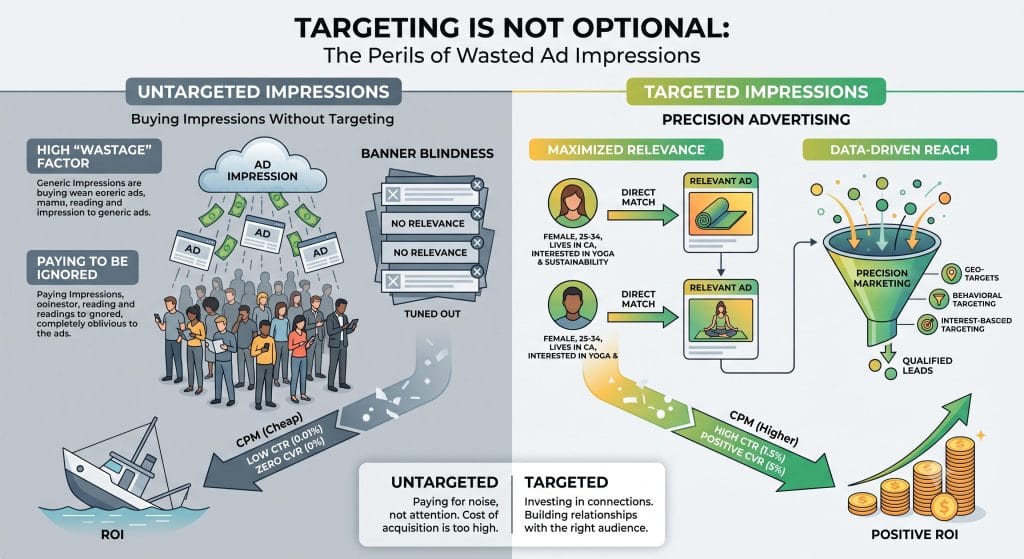
Buying impressions without targeting is just paying to be ignored. Here's the stack, roughly from broadest to most precise. Contextual targeting matches ads to page content. Search retargeting catches people based on what they searched, even if they never visited your site, while site retargeting brings back people who already showed up once and left. Addressable matches a physical mailing list or CRM to household IPs and devices. And geofencing draws a virtual line around a real-world location and serves ads to anyone whose device crosses it.
Geofencing is probably the most interesting one, if only because it does something print advertising never could: it connects a physical footprint to a digital ad. Draw a boundary around a competitor's storefront or a trade show, and when a device enters it, you can follow that person home with a message later. Addressable targeting does something similar for people who already gave you their information the old-fashioned way. If you're sitting on a mailing list or a stack of past customer records, that data can be matched to home IP networks instead of getting mailed out as another flyer that lands in the recycling bin.
Retargeting, meanwhile, is just math. Most first-time visitors to a website leave without buying anything. Site retargeting brings the warm ones back. Search retargeting goes further and reaches people who never visited at all but typed something that signals they're close to a decision.
Split your media buying across separate agencies for search, streaming, geofencing, and display, and you inherit three specific problems. Reporting turns into a fight over credit, because multiple platforms will each claim they drove the same conversion. Frequency spirals out of control, because none of the platforms talk to each other, so the same person can see your ad a dozen times in one day and start tuning it out. And budget shifts take weeks instead of hours, because someone has to get four account managers on the same page first.
Running everything through one programmatic platform simplifies reporting, sure, but the bigger win is speed: you can move money from display to streaming mid-week if the data says that's where it's working, instead of waiting for next month's contract renewal to make the call.
Different business goals call for different combinations, and it's worth being specific about this instead of throwing every channel at every problem:
| Goal | Core channels | Targeting | What you're measuring |
|---|---|---|---|
| Local awareness | Mobile, display, native | Geofencing | Foot traffic, brand lift |
| Competitor conquesting | Geofencing, addressable | Competitor locations, mailing lists | Market share |
| Brand building | Streaming TV, video, audio | Contextual, behavioral | Top-of-mind recall |
| High-intent web traffic | Display, native, search retargeting | Keyword history | Inbound leads |
| Re-engaging visitors | Site retargeting, video, display | Visitor auditing | Lower cart abandonment |
| Activating offline lists | Addressable, streaming TV | CRM address mapping | Cross-device matched accounts |
For brick-and-mortar businesses like dealerships or medical practices, the most useful number isn't a click. It's whether the person who saw the ad actually walked through the door. Pairing geofencing with attribution modeling gets you that answer directly instead of leaving you to guess whether the ad had anything to do with the visit.
A programmatic campaign worth running follows a pretty simple sequence: discovery to understand the business and its goals, a custom channel and targeting strategy built around the budget, creative deployment across networks within about a week, then ongoing weekly adjustments based on what's actually performing.
None of this requires a black box. If a partner can't tell you where your ads ran or why a budget shifted, that's a red flag.
Run five vendors and you get five people defending their own slice of the budget, each one convinced their channel deserves more credit than it's getting. Run one system that can see the whole picture, and you get to shift weight toward whatever's actually working that week.