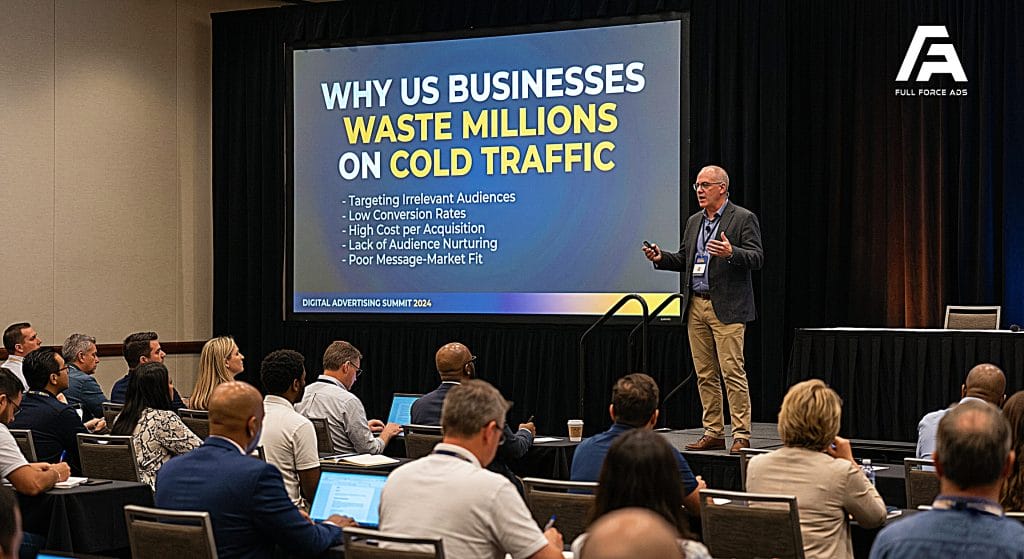
Every day, growing American businesses lose money to a quiet financial drain. It happens openly on analytical dashboards, yet teams consistently misdiagnose it.
A business invests in building a brand. They spend months sharpening a value proposition, perfecting a product line, and financing customer acquisition campaigns to drive fresh traffic to a website. The clicks arrive, traffic spikes, and executives celebrate the initial engagement.
Then the data settles.
Out of every 100 prospects who land on a commercial website, between 96 and 98 leave without converting. They do not buy, fill out a lead form, or call. They click away, vanishing into internet noise.
In traditional growth models, the immediate reaction is an operational error: pour more water into a leaky bucket. Teams increase top-of-funnel ad spend, buy more cold traffic, bid higher on saturated keywords, and burn through capital trying to out-muscle a systemic leak.
High-stakes enterprises do not need more anonymous clicks. They need a systematic, multi-screen capture mechanism that converts existing traffic into revenue.
To fix a leaky bucket, you must understand why consumers leave your digital storefront. It rarely happens because a product is poor or pricing is wrong. It is a symptom of modern human behavior.
The customer journey is no longer a linear pathway. It is fragmented across screens and interrupted by notifications. Consider a typical buyer path:
When an intentional visitor leaves your site, they are not rejecting your offer. They are living their life.
If your marketing strategy stops the moment a user clicks away, you subsidize your competition. You paid the premium to educate the buyer, stir their intent, and validate their need, only to let them buy from a competitor who appears in front of them when they are ready to pull out a credit card.
Sophisticated, omnichannel advertising alters the trajectory of a scaling enterprise.
For many business owners and mid-market executives, the word "retargeting" conjures up a basic display banner that follows users around the web, repeating the same product image until it annoys them. That is a blunt instrument from a bygone decade.
True enterprise audience re-engagement is subtle, omnipresent, and deeply contextual. It treats every past website visitor as a premium asset, building a customized digital wrapper around them across the media landscape.
Instead of limiting reach to standard display networks, top-tier execution meets your audience where their attention shifts, leveraging sight, sound, motion, and context across a unified spectrum of channels.
       [ High-Intent Website Visitor Leaves Without Converting ]
                                  │
         ┌────────────────────────┼────────────────────────┐
         ▼                        ▼                        ▼
  [Streaming TV]               [Audio]                 [Native]
Targeted, unskippable     Premium podcasts &      Contextually blended
  ads on Roku/Hulu         Spotify playlists        editorial layouts
Imagine a prospect explores your B2B enterprise software or luxury home service page during lunch. That evening, they sit down in their living room to watch a movie on Roku, Hulu, or Fire TV. Your brand appears on the biggest screen in their house with a high-definition, unskippable ad.
You do not spend $50,000 to buy a mass-market regional cable slot where most viewers have zero interest in your niche. Instead, you buy a targeted commercial impression delivered to a person who looked at your precise pricing page four hours ago. It commands institutional authority, framing your company as a market leader.
Attention is the primary currency of the digital economy. Pre-roll, mid-roll, and outstream video ad structures place your dynamic video creative inside premium content across millions of consumer apps and websites. By combining visual storytelling with user data, you transition your audience from passive recognizers to active buyers.
The consumer journey does not end when screens are put away. When your prospects drive to work, work out, or cook dinner, they listen to Spotify, Pandora, or professional podcasts. Incorporating targeted audio ads ensures your brand maintains mindshare during screen-free moments.
To round out a retargeting framework, your presence must feel seamless. Native ads adopt the natural design, typography, and visual layout of the editorial platforms or news sites your audience reads. Supported by data-backed display banners across high-traffic web properties, this approach builds a multi-layered safety net around your pipeline.
While channels dictate where your message appears, targeting methodologies dictate how your capital is deployed. Simply knowing that someone visited your website is merely the ground floor of an optimized campaign.
To maximize return on ad spend (ROAS), digital agencies layer precision data directly on top of your media footprint.
| Targeting Solution | Core Strategic Mechanism | Ideal Business Application |
| Site Retargeting | Tracks abandoned visitors and delivers tailored ads based on the specific pages they explored. | Maximizing conversions from organic and paid top-of-funnel traffic. |
| Search Retargeting | Captures individuals based on key phrases they typed into search engines, before they visit your site. | Intercepting high-intent buyers who are comparing solutions. |
| Geofencing | Maps out precise, virtual building-level footprints of competitor spaces to capture active devices. | Conquesting physical competitor locations, trade shows, and industry events. |
| Addressable Targeting | Matches a physical CRM mailing list or home address database to exact digital device profiles inside those homes. | Executing account-based marketing (ABM) or localized community drops. |
| Contextual Targeting | Evaluates page text, metadata, and sentiment of an online article to serve relevant, inline creative. | Aligning complex product solutions with industry news and educational content. |
By fusing these tools, a growing business stops chasing vanity metrics and begins executing calculated strikes on their market.
When a business recognizes the need for a digital advertising blueprint, they arrive at an operational crossroads: Should we build this capability internally, or should we align with an external partner?
On paper, building an internal media buying wing looks enticing. Many executives believe that hiring a generalist internal marketer or tasking an existing coordinator with managing ad platforms grants total control and lowers long-term overhead.
In practice, this path often leads to an operational bottleneck. The digital advertising ecosystem is no longer a simple interface where you toggle a few campaign switches. It is a technical, fragmented environment driven by programmatic algorithms, data compliance laws, and engineering dependencies.
                     [ THE IN-HOUSE PITFALLS ]
                                │
        ┌───────────────────────┼───────────────────────┐
        ▼                       ▼                       ▼
[Siloed Vendors]        [Saturated Skills]      [Enterprise Minimums]
Managing 4+ platforms   Generalists struggle    Locked out of premium
simultaneously.         with deep tech.         ad exchanges.
This is why high-growth enterprises partner with a dedicated programmatic media company like Full Force Ads. Based in Sandy, Utah, Full Force Ads acts as an enterprise-level programmatic media infrastructure designed to eliminate the friction, technical overhead, and heavy capital barriers of modern advertising.
By consolidating every premium digital channel—Streaming TV, digital video, premium audio, targeted mobile web, native networks, and local display—into a single managed ecosystem, Full Force Ads gives scaling brands institutional leverage.
Instead of juggling four or five disconnected accounts, businesses partner with a single ally. This approach reshapes marketing efficiency:
Through a four-step operational cadence—commencing with a Discovery Call, moving into a data-backed Custom Recommendation, followed by a Fast-Track Launch within 5 to 7 business days, and closing with Weekly Optimization—Full Force Ads transforms cold digital properties into high-conversion pipelines.
While many mid-market enterprises require the high-touch support of a fully managed agency relationship, a separate challenge exists for modern professional marketers, internal growth teams, and boutique digital agencies.
Many internal professionals possess excellent strategic visions, but they find themselves bottlenecked by the technical complexity required to operate modern programmatic Demand-Side Platforms (DSPs) or navigate the rigid policy rules of platforms like Google Ads.
The industry has long suffered from a sharp polarization: you either had to stick to standard, heavily restricted walled gardens, or you had to hire an enterprise engineering team to handle complex programmatic buying software.
To bridge this specific industry chasm, Full Force Ads engineered FullForceAds.app—a self-serve advertising engine built for professional marketers who demand enterprise-level targeting capability without the technical barrier to entry.
       [ TRADITIONAL GOOGLE ADS / DSP ]
                     │
       ( Heavy Technical Interface )
       ( Manual Tracking Configurations )
       ( Restrictive Policy Obstacles )
                     ▼
       [ High Resource Strain & Delay ]

                      VS

       [     FULLFORCEADS.APP         ]
                     │
       ( Streamlined Self-Serve UI )
       ( Pre-Built Programmatic Rails )
       ( Instant Cross-Screen Delivery )
                     ▼
       [ Rapid Deployment & Max ROAS  ]
FullForceAds.app strips away the technical drag, serving as a clean, intuitive programmatic launchpad. It allows agile marketing leaders to rapidly build out multi-channel display, native, geofenced, and retargeting campaigns inside a user interface that bypasses complex coding or manual data tracking setups.
It preserves the raw targeting power of a global enterprise DSP, allowing you to scale precise programmatic parameters, while providing a streamlined deployment speed that keeps pace with fast-moving businesses.
For the modern marketing operator, FullForceAds.app offers the ideal balance: total control over campaign variables, instant cross-screen distribution, and complete freedom from the technical clutter that historically crippled self-managed programmatic execution.
In an economy driven entirely by attention, staying static is the financial equivalent of moving backward. Allowing thousands of highly motivated, in-market prospects to browse your digital ecosystem and slip away unrecognized is an operational inefficiency that no scaling business can afford to absorb.
Whether your organization requires a completely managed, high-touch strategic partnership to dominate regional markets, or your internal growth teams need a streamlined, high-powered self-serve infrastructure like FullForceAds.app to deploy campaigns without technical friction, the mandate remains identical: you must close the loops in your marketing funnel.
Stop pouring capital into a leaky bucket. Protect your brand equity, maximize every single visit to your web properties, and command premium authority across every screen your audience views.
To explore a tailored channel mix, isolate your target demographics with surgical accuracy, and receive a customized strategy framework engineered for your specific business objectives, connect directly with our programmatic media specialists and review our complete suite of advanced advertising solutions.