American retail is fragmented. Consumers no longer follow a straight line from discovery to purchase. They bounce between physical storefronts and digital screens, listening to podcasts during commutes, scrolling apps at lunch, and streaming television after dinner.
That behavior creates a problem: how do you capture the attention of a distracted consumer and get them through your front door?
The answer means breaking down the wall between offline behavior and online advertising. To win, retailers have to use programmatic technology that meets consumers where they already are, with messaging tied to what they’re actually doing in the real world.
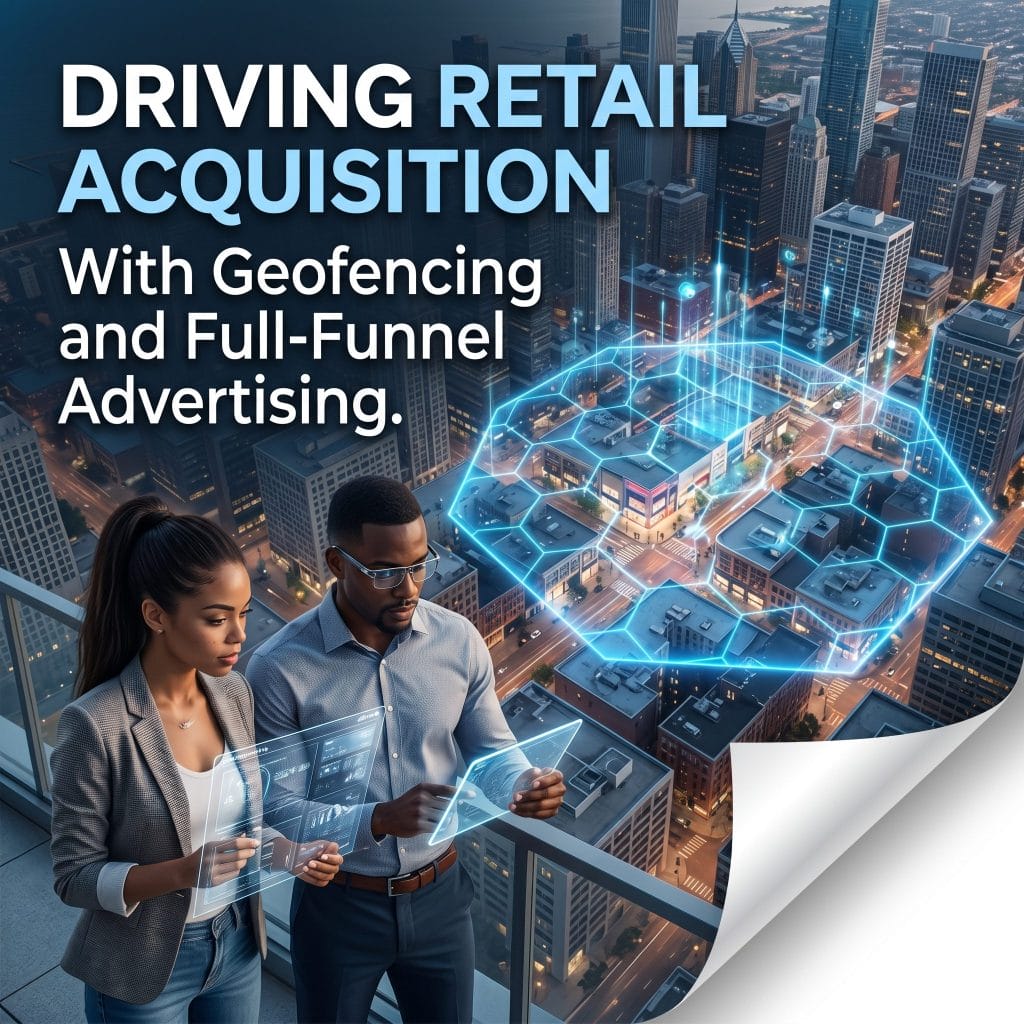
Geofencing advertising, a location-based marketing tool, turns physical foot traffic into targeted digital audiences. When it’s plugged into a multi-channel strategy, geofencing helps brick-and-mortar brands take market share from competitors, reactivate past shoppers, and grow revenue.
Review the Full Force Ads Advertising Solutions page to see how these integrated strategies scale a retail operation.
A lot of traditional retailers still rely on legacy tactics: billboards, print circulars, local radio spots, or basic zip-code social posts. Those methods used to work. Today they suffer from three flaws: waste, no attribution, and no agility. You pay for impressions seen by people who have no interest in your product, you cannot track who walked in because of a billboard, and changing your creative takes weeks.
Digital advertising built on programmatic infrastructure shifts the conversation from passive broadcasting to active persuasion.
Human behavior is habitual. The places people go (the grocery stores they frequent, the coffee shops they stop at, the competitors they walk through) tell you more about buying intent than a demographic profile. A consumer who regularly visits a high-end boutique fitness studio is a high-intent target for a premium activewear retailer. Someone who spends Saturdays walking through auto dealership lots is in the market for vehicle accessories, insurance, or financing.
Geofencing taps into that behavior. By drawing a virtual boundary around specific physical locations, retailers capture the unique device IDs of consumers walking into those spaces. You then deliver an ad that matches their real-world lifestyle and immediate needs.
Marketing is mostly about reducing friction. In retail, the biggest friction point is moving a consumer from online awareness to offline action: getting them into the store. Programmatic advertising solves that by building a continuous loop of multi-screen reminders.
When you combine precise location targeting with timely offers, you cut the cognitive load required for a consumer to choose your business over the next option. You answer their unspoken question: "Where should I go right now to solve this problem?"
To use geofencing for retail conquesting, you need to understand how the technology actually works and how it maps to real business scenarios.
[Target Physical Location: Competitor Store]
│
▼
[Consumer Enters with Mobile Device] ───► [Virtual Geofence Captures Device ID]
│
▼
[Programmatic Ad Delivered Across Screens]
(Streaming TV, Mobile Apps, Audio, Display)
│
▼
[Consumer Visits Your Store = Conversion]
Geofencing uses GPS, cellular data, and Wi-Fi network mapping to build a digital perimeter around a custom polygon: a building lot, a shopping plaza, an exhibition hall, or a competitor’s storefront.
When a consumer steps inside that boundary with a smartphone, their device pings ad-supported mobile applications or location services. The geofencing platform logs the interaction while protecting user privacy through anonymized device identifiers. That triggers a window of opportunity, letting the retailer serve tailored ads to that person for a set period, anywhere from right then while they’re still inside the fence to 30 days after they leave.
The most profitable use of geofencing for retail is competitor conquesting.
Picture this: you run an independent outdoor apparel store in a busy retail corridor. A national big-box sporting goods chain sits three miles away. Trying to compete with their television budget on a broad regional scale is a losing fight.
With geofencing, you do not have to. Instead, you draw a precise digital fence around the footprint of that big-box competitor. When a customer walks down their outerwear aisle, your campaign audience logs their device. Over the next week, as that consumer browses websites, plays mobile games, or listens to music, they see ads showing your local store’s premium selection, your customer service, or a first-time visitor discount.
You intercept a high-intent shopper standing inside a competitor’s building, and you redirect their lifetime value to your brand.
Geofencing works nationwide, but its return on investment climbs in specific regions. The profitability of location-based advertising depends on a few geographic variables: population density, economic growth, commuter habits, and regional retail infrastructure.
These four states gain the most from running advanced geofencing strategies.
Texas has a fast-growing population, fueled by corporate relocations and suburban buildout across Dallas-Fort Worth, Houston, Austin, and San Antonio.
Florida’s economy runs on incoming wealth, a growing population, and seasonal tourism.
Running a retail business in California, especially in Los Angeles, San Diego, and the San Francisco Bay Area, comes with high overhead and high customer acquisition costs.
As the home base for Full Force Ads, Utah is a sweet spot for digital advertising, driven by the tech sector along the "Silicon Slopes" corridor from Salt Lake City to Provo.
Treating geofencing as an isolated tactic is a mistake. Setting up a mobile fence, watching click-through rates on a small banner ad, and judging success on that one metric misses the bigger picture.
Real persuasion happens through omni-channel reinforcement. Geofencing builds your audience. Your media channels capture their attention.
When you partner with a unified digital media team, you take the audience captured via geofencing and run your message across every screen the consumer touches during the day.
Television carries emotional weight, builds brand authority, and commands attention. Historically, television advertising was out of reach for local and regional retailers because of high entry costs and broad, un-targeted broadcasts.
By pairing geofencing data with Streaming TV (running unskippable ads on networks via Roku, Fire TV, Apple TV, and Hulu), you deliver your commercial to households where a family member recently visited a competitor’s location or a specific shopping district.
You get the credibility of a big-screen TV spot, backed by the precision of digital location targeting.
Video captures attention through sight, sound, and motion. By running pre-roll and mid-roll video campaigns across desktop and mobile, you show product demos, store walkthroughs, or customer testimonials to people identified inside your geofenced areas.
During screen-free moments, when consumers drive to work, exercise at the gym, or cook dinner, they’re listening to Spotify, Pandora, iHeartRadio, or podcasts.
Adding digital audio to your programmatic mix keeps your brand present when consumers aren’t looking at a screen. An audio ad about a sale, targeted to a listener who visits neighboring shopping plazas, plants an auditory reminder.
Display banner ads are the foundation of a digital campaign. They keep visual frequency up, reminding consumers of your brand as they read local news sites, check the weather, or browse blogs.
When paired with Native Advertising (ads that match the look and feel of the surrounding website content), you break through ad blindness and build trust with your audience.
Geofencing is just one layer of a retail advertising operation. To maximize your return on ad spend, you have to layer matching data-driven targeting strategies on top to address every stage of the consumer journey.
| Strategy | Retail Application | Primary Objective |
| Geofencing | Draw digital polygons around competitor stores, high-traffic shopping districts, or local community events. | Conquest market share and capture high-intent foot traffic. |
| Addressable Geofencing | Upload a CRM list of physical household addresses to map household devices. | Reactivate dormant customers and upsell current loyalty members. |
| Site Retargeting | Drop a pixel on your website to serve ads to users who browsed products online but did not come in-store. | Reduce digital cart abandonment and drive offline conversions. |
| Search Retargeting | Serve ads to consumers who searched for specific keywords on search engines (e.g., "best running shoes near me"). | Intercept active intent before they buy from an online giant. |
| Contextual Targeting | Place your digital ads directly alongside online content, articles, or videos matching specific retail categories. | Build trust by appearing next to relevant topics. |
The biggest barrier to retail growth is fragmented execution.
Most mid-market retail brands run a chaotic vendor loop. They hire one agency to manage Google search ads, another contractor to post on social, a third vendor for digital billboards, and a separate platform for email blasts.
That leads to broken strategy, fragmented communication, and conflicting data. You end up with multiple dashboards, no unified attribution, and wasted hours managing the chaos.
The fix is consolidating your media buying into a single ecosystem. When you work with an omni-channel partner, your marketing becomes an integrated web instead of a bunch of disconnected islands.
Data flows between channels. If a consumer walks into a geofenced area, that information updates your central campaign hub. The platform then serves them a Streaming TV ad that night, a Native ad the following morning while they read the news, and a location-enabled mobile display ad with directions to your store when they get within a mile.
Consolidation gives you clarity, efficiency, and the ability to move fast.
If you are ready to stop buying un-targeted impressions and start running a precise customer acquisition strategy, Full Force Ads can help your retail business move forward. Headquartered in Utah, we use digital advertising technology to help businesses across the country win local markets and stretch every dollar of their marketing investment.
Moving from traditional, fragmented advertising to a unified programmatic model with Full Force Ads is straightforward and collaborative. We break our execution framework into four steps.
We start with a conversation focused on your retail operation. We learn about your business, map your local competitive set, work out your ideal customer personas, and identify your growth goals.
Our media planners go through your market data. We design a channel mix and targeted audience plan built for your retail footprint, local competition, and budget. We map out which geofences to draw, which digital channels to prioritize, and what messaging will actually convert your audience.
Once you sign off on the plan and provide creative assets, our operations team takes over. We build the digital architecture, set up tracking, draw the custom location polygons, and push your campaign live across the selected channels. Most campaigns launch within 5 to 7 business days.
Our software and media managers watch campaign performance. We adjust targeting, refine channel distribution, test creative variations, and shift budget to the top-performing tactics. Every week, you get a report on your metrics.
The physical world and the digital world have fused. Retailers who treat them as separate things will watch their market share leak to data-driven competitors. Brands that put real-world behavioral data to work across a seamless omni-channel digital network get a real competitive advantage.
Whether you want to take share from big-box competitors through location geofencing in Texas, capture tourism traffic in Florida, control customer acquisition costs in California, or scale a family-focused retail brand along Utah’s Wasatch Front, Full Force Ads has the infrastructure, know-how, and execution to get you there.
Stop wondering if your advertising works. Stop juggling fragmented platforms that drain your focus and your capital. Partner with an agency that treats your budget like its own and turns digital technology into measurable business growth.
Do not let competitors capture the foot traffic surrounding your storefront. Take the first step toward turning your retail acquisition into a real operation today.
Visit Full Force Ads Advertising Solutions to review our capabilities, see how we align with your growth objectives, and book your live strategy demo with our team. Turn your physical market footprint into your biggest digital asset.