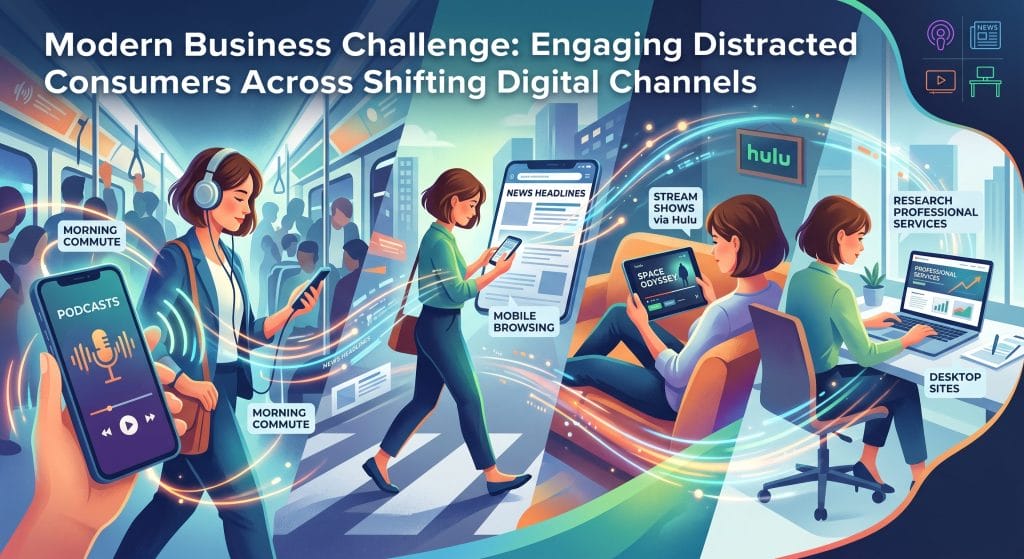
Modern businesses face a clear challenge: how to capture and keep distracted consumers across shifting digital channels. People don’t stick to one medium anymore. They listen to podcasts on morning commutes, read news on mobile browsers, stream shows on Hulu, and research professional services on desktop sites.
To reach them, enterprise and mid-market organizations have to connect those disparate touchpoints. Disjointed campaigns managed by separate vendors waste budget. Winning takes a unified, data-driven framework across every screen.
Full Force Ads, based in Utah, builds these multi-channel advertising solutions for brands across the United States to capture market share and grow revenue.
A successful advertising operation delivers messages where audiences spend time, using tailored formats to guide prospects from awareness to purchase.
Traditional broadcast television is fading. Connected TV (CTV) replaces it with precise, data-rich targeting on screens like Roku, Fire TV, and Hulu.
CTV combines television storytelling with digital precision. Instead of buying broad, wasteful broadcast footprints, you can target households using behavioral data, income brackets, purchase history, and intent. Unskippable 15- or 30-second ads build immediate credibility, which makes lower-funnel digital channels convert faster.
Digital video captures attention on desktops, laptops, and mobile devices. Pre-roll ads before videos, mid-roll ads during content, and outstream videos embedded in articles all help bridge the gap between brand awareness and direct engagement.
Combining sight, sound, and motion speeds up information retention. For involved B2B solutions or high-consideration consumer goods, a brief video clarifies a value proposition faster than text.
Digital audio reaches audiences during screen-free moments like driving, exercising, or doing housework. Ads on Spotify, Pandora, podcasts, and digital radio reach prospects during focused windows. Podcast listeners show high engagement and trust, which makes audio a cost-effective way to keep brand presence going without causing screen fatigue.
Smartphones go everywhere with users. Mobile ads served through apps, mobile-optimized sites, and location services reach consumers on the move. Mobile advertising works as the connective tissue of a campaign, giving you clickable options right after a user runs into a CTV or audio ad.
Banner ads across websites and mobile apps give you cost-effective reach and form the foundation for retargeting. Display ads back up messaging from CTV and video by keeping your brand visible as prospects read news, blogs, and websites.
Native ads match the visual style and editorial layout of the surrounding content on publishing platforms. Because they blend into the organic reading experience, they get past traditional ad resistance, which makes them highly effective for thought leadership and educational content.
Channels decide where ads show up. Targeting decides who sees them. High-quality creative is wasted if it reaches people who don’t need your product.
Geofencing draws virtual boundaries around physical locations to serve ads to people who walk into those perimeters. You can target competitor storefronts, industry trade shows, conventions, corporate headquarters, or specific neighborhoods. For example, a B2B provider can geofence a regional industry convention and serve ads to attendees’ devices for weeks after the event ends.
Addressable targeting maps offline data (CRM systems, lead lists, physical mail addresses) directly to digital devices. The system matches physical addresses with the internet routers in those households. You can then serve CTV, video, and display ads to specific homes, cutting waste.
Most first-time website visitors leave without converting. Site retargeting tracks those visitors and serves them tailored ads as they browse other websites. That keeps your brand visible and addresses specific objections to bring prospects back to convert.
Search retargeting finds users who search for what you offer but haven’t visited your website yet. It serves display, video, or native ads to people based on the specific keywords they enter into major search engines.
Contextual targeting places ads next to relevant digital content. The system analyzes text and themes across publishers. If a prospect reads an article about corporate tax strategies or home renovations, your ad shows up next to that text, matching their immediate focus.
A single approach to advertising leads to inefficiency. Strategies have to match the buying cycles and consumer behaviors of your specific market sector.
Legal advertising runs on immediacy and trust. Prospects often face high-stress situations and evaluate firms based on perceived authority.
Healthcare marketing takes building community trust while staying inside patient privacy rules.
Vehicle shoppers run extensive online research, comparing models and specials across multiple sites before walking onto a lot.
HVAC, roofing, plumbing, and solar businesses depend on seasonality, weather, and emergencies.
B2B sales involve long cycles and multiple corporate stakeholders who need proof of investment returns.
Persuasion takes matching your business objective with the right mix of channels.
| Core Business Goal | Recommended Channel Mix | Strategic Targeting Layers | Expected Outcome |
| Local Awareness | Geofencing, Display, Mobile | Competitor Footprints, Neighborhoods | Local brand recall when buying decisions happen. |
| Conquest Competitors | Geofencing, Addressable | Competitor Storefronts, Customer Lists | Market-share acquisition by intercepting prospects. |
| Brand Building | Streaming TV, Video, Audio | Behavioral Tracking, Demographics | Lifted credibility and reduced price sensitivity. |
| Website Traffic | Display, Native, Search Retargeting | Keyword Tracking, Contextual Placements | A predictable stream of qualified visitors. |
| Retarget Past Visitors | Site Retargeting, Display, Video | First-Party Web Traffic, Product Pages | Higher conversion rates from abandoned traffic. |
| Activate Customer Lists | Addressable, Streaming TV, Display | Uploaded CRM Database, Postal Addresses | Nurturing past clients to drive repeat business. |
Running separate vendors for social ads, search, and video creates conflicting reports and misaligned creative. Full Force Ads pulls planning, execution, and optimization across streaming TV, video, audio, mobile, display, and native formats into a single platform.
Programmatic multi-channel advertising takes systematic optimization to adjust to shifting consumer habits and new ad inventory.
[1. Discovery Call] ──► [2. Custom Strategy] ──► [3. Swift Launch] ──► [4. Optimize & Scale]
                                                                               │
                                                                               └─── (Feedback Loop) ──┘
Digital advertising takes an integrated ecosystem that reaches prospects with cohesive visual, textual, and auditory experiences based on real-time intent data.
Whether you want to dominate local market share by geofencing competitors, reactivate a CRM database, or build national recognition on streaming screens, an integrated media partner cuts the friction of fragmented vendor networks.
Contact Full Force Ads today to book a strategy evaluation, map your competitive market, and build an advertising operation customized for your business.