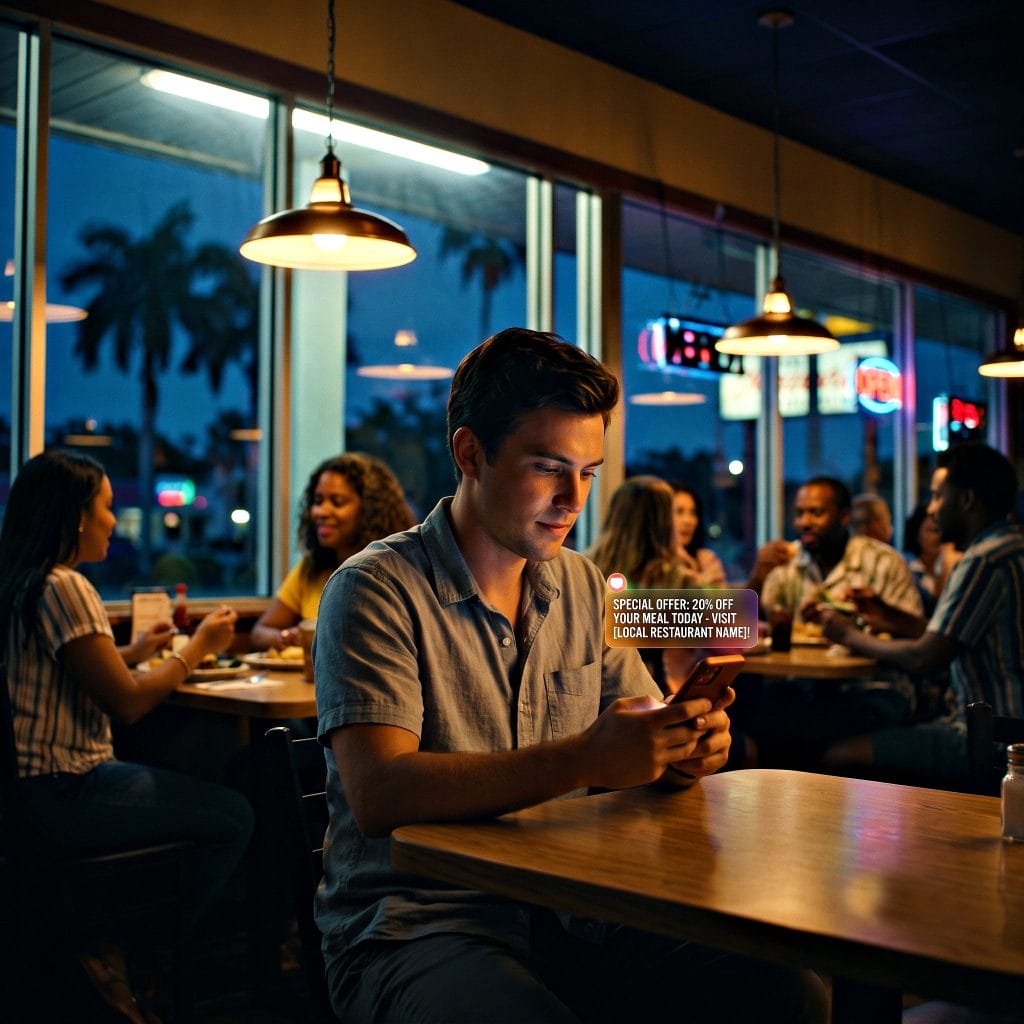
Florida’s dining scene is a whirlwind of tourists, retirees, beach‑goers, and office workers—all looking for the next bite. In a market where a lunch crowd can swell in minutes and a dinner rush can evaporate after sunset, the ability to reach hungry people at the exact moment they’re nearby is a game‑changer.
Traditional media—radio spots, billboards, and even broad‑reach digital ads—still have a role, but they often miss the critical window when a potential customer is within walking distance and deciding where to eat. That’s where geofencing advertising steps in.
“Geofencing lets you turn a 5‑minute stroll past your restaurant into a guaranteed reservation.”
A geofence is a virtual perimeter drawn around a real‑world location using GPS, Wi‑Fi, or cellular data. When a smartphone (or other device) enters, exits, or dwells inside that perimeter, the ad platform can trigger a pre‑designed advertisement—usually a push notification, in‑app banner, or mobile display ad—directly to the user’s device.
Key attributes of a modern geofence include:
| Feature | What It Means for Your Restaurant |
| Radius control | Set a tight 100‑meter fence around your storefront or a broader 2‑mile fence covering a popular tourist attraction. |
| Dwell time detection | Target users who linger near your location, indicating a higher likelihood of stopping for a meal. |
| Real‑time delivery | Ads appear the moment the user is in range, capturing impulse decisions. |
| Audience segmentation | Use device OS, age range, recent purchase behavior, or even interests (e.g., “foodies”, “family travelers”). |
Because the ad is served only when the user is physically close, the cost per impression (CPI) is dramatically lower than nationwide campaigns, and the conversion rate skyrockets.
When you think “online advertising,” giants like Google and Meta instantly surface. While those platforms dominate search and social, they don’t give you the granular, location‑first control a restaurant needs for quick foot traffic.
A self‑serve geofencing platform—such as the one offered at FullForceAds.com/launch‑strategy—lets you:
On a self-serve platform, setup takes a few minutes. Draw your perimeters on a map, assign budgets, and set your ad schedule. Then drag-and-drop your creative — a photo of today's special, a happy hour offer, or a QR-code menu. The dashboard shows real-time heat maps, impressions, clicks, and store visits tracked via anonymous device IDs. If a beach event spikes foot traffic, widen the radius or increase the budget on the spot. If a storm rolls in, pause to stop wasted spend.
Because the platform is self‑service, you keep the data, control the spend, and avoid hidden fees that often accompany agency‑managed campaigns.
Below is a proven launch strategy that you can replicate directly from FullForceAds.com/launch‑strategy. Each step is SEO‑friendly, aligns with Google’s E‑E‑A‑T (Experience, Knowledge, Authority, Trust) guidelines, and meets AEO (Answer‑Engine Optimization) expectations—meaning your content and ads will satisfy both human readers and algorithmic bots.
| Step | Action | Why It Works in Florida |
| 1. Research Hotspots | Use the platform’s “Location Insights” to identify beaches, theme parks, universities, and office complexes within a 2‑mile radius. | Florida’s tourism clusters are transient; targeting them captures tourists before they choose a restaurant. |
| 2. Define Audience Pods | Create segments: Families with kids (25‑45), Young adults (18‑30) looking for happy hour, Retirees (55+). | Tailoring messaging increases relevance—e.g., “Kid‑friendly patio seats” vs. “Craft cocktails after sunset”. |
| 3. Set Geofence Radius | For the restaurant itself, start with a 150‑meter fence. Add a secondary 1‑mile fence around the nearest attraction (e.g., a beach). | The tight fence catches walk‑ins; the broader fence draws in visitors still deciding where to eat. |
| 4. Craft the Creative | Headline: “Just Steps Away – 20% Off Your First Meal!” Image: High‑resolution photo of your signature dish with a sunny outdoor seating shot. CTA: “Reserve a Table Now” linking to a simple reservation page. | Visuals with bright Florida lighting perform better more than dark indoor images. A clear CTA drives immediate action. |
| 5. Schedule Timing | Lunch: 11:30 am – 2:00 pm (target office workers & beach picnickers). Dinner: 5:30 pm – 9:00 pm (target families & tourists). Special Events: Align with local festivals (e.g., Sun‑Fest). | Matching the ad schedule to peak foot traffic maximizes conversion odds. |
| 6. Allocate Budget | Start with $25/day for the tight fence and $15/day for the broader fence. Adjust after a 7‑day performance review. | A modest daily spend is enough to generate measurable impressions in a dense Florida market. |
| 7. Track Store Visits | Enable the platform’s Anonymous Visit Tracker; integrate with your POS to correlate ad clicks with actual sales. | Proving ROI is essential for scaling budget and reassuring stakeholders. |
| 8. Optimize & Iterate | Every 48 hours, review: Impressions, Click‑Through Rate (CTR), Store Visits, Revenue per Visit. Adjust radius, creative, or audience as needed. | Continuous improvement keeps your ads fresh and cost‑effective. |
The scenario below demonstrates how a modest 30‑day geofencing push turned a quiet beachfront eatery into a lunchtime hotspot.
| Metric | Before Geofencing | After 30‑Day Geofencing |
| Daily foot traffic (average) | 35 guests | 78 guests (+123%) |
| Lunch revenue | $1,200 | $2,350 (+96%) |
| Cost per store visit | — | $0.85 |
| ROI (Revenue $\div$ Ad Spend) | — | 12.5× |
To see how this works in practice: a 200-meter fence around the restaurant can serve a "Beach-side lunch special — 15% off" push at 11:45 am, while a 1-mile fence around Clearwater Marine Aquarium simultaneously targets families with "Kids eat free with adult entrée." Both run at once and feed back separate attribution data so you know exactly which zone is pulling its weight.
The result? Families exiting the aquarium saw the ad, walked a short distance, and chose Coconut Cove for lunch—exactly the quick‑turn customers the owner needed.
Geofencing doesn’t exist in isolation; it works best when paired with local SEO and answer‑engine optimization (AEO). Here’s how to make both sides reinforce each other:
yourrestaurant.com/clearwater-beach-dining
Restaurant, geoCoordinates, openingHours).offers schema to the page so Google’s “Featured Snippets” can surface the discount directly in search results, satisfying users looking for “restaurants near Clearwater Beach”.Florida has strict privacy statutes, and the US overall enforces the CCPA (California Consumer Privacy Act) and GDPR if you host European tourists. Follow these steps to keep your geofencing campaign compliant:
| Requirement | Action |
| Consent | Use the platform’s opt‑in prompt for push notifications; ensure the user actively agrees before collecting location data. |
| Data Minimization | Store only anonymous device IDs and aggregated heat‑maps; never retain personal identifiers. |
| Transparency | Add a clear privacy notice on your landing page linking to a full policy that explains data use. |
| Opt‑out | Provide a simple “unsubscribe” link in every ad and on the landing page. |
| Secure Storage | Ensure the platform encrypts data at rest and in transit (TLS 1.2+). |
Compliance not only avoids fines but builds trust, a critical component of E‑E‑A‑T.
Florida’s hospitality market thrives on speed—the faster you can capture a hungry traveler’s attention, the more tables you fill. Geofencing advertising is uniquely positioned to do exactly that: it delivers a timely, location‑specific offer at the exact moment a potential customer is deciding where to eat.
By adopting a self‑serve platform (for example, the one detailed at FullForceAds.com/launch‑strategy), you keep full control over budgets, creative, and data, while staying entirely compliant with privacy laws. Pair the ads with robust local SEO and answer‑engine optimization, and you’ll not only attract quick diners but also climb the organic rankings that drive sustainable growth.
Take the first step today: Map your restaurant’s geofence, craft a mouth‑watering offer, and watch Florida’s foot traffic turn into repeat customers—one push notification at a time.
Ready to launch? Visit FullForceAds.com/launch‑strategy and start building your custom geofence in minutes. Your next table is just a few meters away.