Consumers switch screens constantly. The same person might stream music during their commute, scroll through mobile apps at lunch, browse websites at their desk, and watch Connected TV (CTV) at night. Running ads on just one or two channels means you're invisible for most of that time.
Most brands try to solve this by hiring separate vendors for video, audio, social, and display. That approach creates disjointed reporting, duplicate targeting, and inconsistent messaging. Full Force Ads consolidates everything into a single platform.
Splitting media buying across specialized agencies creates three concrete problems.
Full Force Ads manages six channels from one platform.
Place unskippable ads on Roku, Fire TV, and Hulu. Instead of broadcasting to entire zip codes like traditional cable, you target specific households using behavioral data. Your budget reaches the right screen without wasted impressions.
Video ads run across the web and mobile apps in two formats:
Audio spots run on Spotify, Pandora, digital radio, and podcasts. These reach people during commutes, workouts, and other screen-free moments when other ad formats can't.
In-app placements, mobile web banners, and location-based targeting on smartphones.
Banner ads across websites build awareness and support retargeting campaigns.
Native ads match the visual style of the page they appear on. Because they blend into editorial feeds, they bypass banner fatigue and tend to drive higher click-through rates.
Channels determine where your ad appears. Targeting determines who sees it.
| Targeting method | How it works | Best used for |
| Geofencing | Draws a virtual perimeter around physical locations to capture mobile device IDs. | Local awareness, competitor foot traffic, event marketing. |
| Addressable Programmatic | Matches physical mailing addresses to digital IP addresses across household devices. | Account-based marketing, customer list activation. |
| Search Retargeting | Serves ads to users who typed specific keywords into search engines. | Reaching high-intent buyers outside standard search results. |
| Site Retargeting | Tracks website visitors and serves follow-up ads as they browse other sites. | Conversion optimization, reducing abandoned sessions. |
| Contextual Targeting | Reads page content to place ads next to relevant editorial topics. | Brand safety, cookieless advertising, niche content alignment. |
Geofencing is worth calling out specifically: by mapping a boundary around competitor storefronts, trade shows, or specific neighborhoods, you capture the device IDs of people who physically visited those locations, then serve them ads afterward.
A lot of programmatic platforms hide spend and obscure what's actually happening. Full Force Ads doesn't.
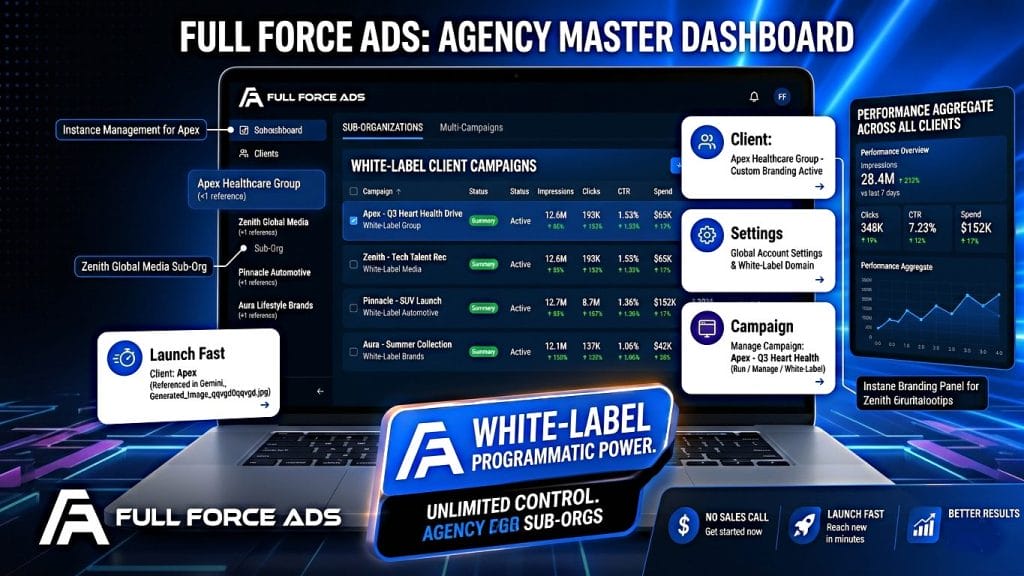
Managing multiple client accounts across separate campaigns creates operational bottlenecks. Full Force Ads offers a dedicated sub-organization dashboard for agencies, letting you run and manage independent programmatic campaigns for multiple clients under one login.
Agencies can also white-label the platform with their own branding, logos, and style guidelines, presenting it as a proprietary solution to clients while Full Force Ads handles execution on the back end.
Ready to consolidate your media buying? Schedule a demo at FullForceAds.com.