The car dealership playbook used to be simple: an inflatable tube man out front, a neon banner across the windshields, a late-night TV spot, maybe a billboard on the interstate. That playbook still exists. It just does not work the way it used to.
Today's buyer does most of their shopping before they ever walk onto a lot. They stream a podcast on the drive to work, watch a full truck review on their living room TV, scroll local news on their phone, and compare specs on a forum at midnight. The hard part of dealership marketing is no longer beating the dealer down the street on price. It is getting a slice of attention from someone who is watching four screens and trusting none of them completely.
In high-volume markets like the Texas auto malls, the packed corridors of California, Florida's sprawling metros, or the legacy hubs of Michigan and Ohio, that competition for attention gets loud fast. When a few thousand dealerships are chasing the same regional buyers, a 30-second cable spot starts looking like an expensive way to reach people who were never going to buy from you anyway.
Shouting louder through the old channels does not fix that. What works instead is a targeted, unified digital presence that shows up wherever the buyer already is, whether that is a streaming app, a podcast feed, or a phone screen at a red light. Consolidating advertising into one system also strips out a lot of the operational weight of running five vendors at once, and it gives dealerships a level of targeting precision that turns ad spend from a gamble into something closer to a predictable source of floor traffic.
Ask any dealership marketing director what wears them down day to day and you will hear the same complaint: too many vendors.
A typical week might involve juggling:
Each of those relationships comes with its own onboarding call, its own creative portal, its own invoice, and its own dashboard that does not talk to the others. The display agency reports on impressions. The TV rep reports on estimated household reach. The search team reports on click-through rate. None of those numbers connect to each other, so the marketing team ends up with four spreadsheets and no real answer to the only question that matters: which dollar actually got someone to walk in and ask for a test drive.
A single platform fixes this by pulling every digital channel into one dashboard. Streaming TV, or CTV/OTT, runs unskippable commercials on Roku, Fire TV, and Hulu, putting the message on the biggest screen in the house. Online video adds pre-roll, mid-roll, and outstream placements on automotive sites and apps, while digital audio reaches people on Spotify, Pandora, and podcasts during the commute or the gym session, when they are not looking at a screen at all. Mobile and display round it out with the everyday, low-cost visual presence across websites and apps that anchors a retargeting strategy, and native advertising blends in with the editorial content on the blogs and news sites people already read while researching a purchase.
                  ┌──────────────────────────────────────────┐
                  │          UNIFIED AD PLATFORM             │
                  └────────────────────┬─────────────────────┘
                                       │
         ┌───────────────┬─────────────┼─────────────┬───────────────┐
         ▼               ▼             ▼             ▼               ▼
   Streaming TV        Video         Audio        Mobile          Native
  (Hulu/Roku/Fire)  (Pre/Mid-Roll) (Spotify)    (In-App/Web)   (Contextual)
With everything under one roof, creative can move between channels in hours instead of weeks, and the reporting stops inflating itself. If a buyer sees a streaming TV ad at home, checks inventory on their phone the next morning, then clicks a native ad before filling out a credit application, a unified platform can actually trace that path instead of crediting three different vendors for the same lead.
That is what Full Force Ads' advertising solutions are built to do: get dealerships out of the business of managing five disconnected vendors so the marketing team can spend its time on the things that matter, like moving slow inventory, pushing seasonal lease deals, and keeping the dealership's name in front of buyers across its territory.
A great ad is wasted if it lands on someone who cannot afford a new vehicle, does not drive, or lives three states away. In a crowded automotive market, the real profit driver is cutting ad waste, meaning you stop paying to show inventory to people who were never going to buy it.
Targeting has moved well past age, gender, and zip code. A few layers do most of the work now.
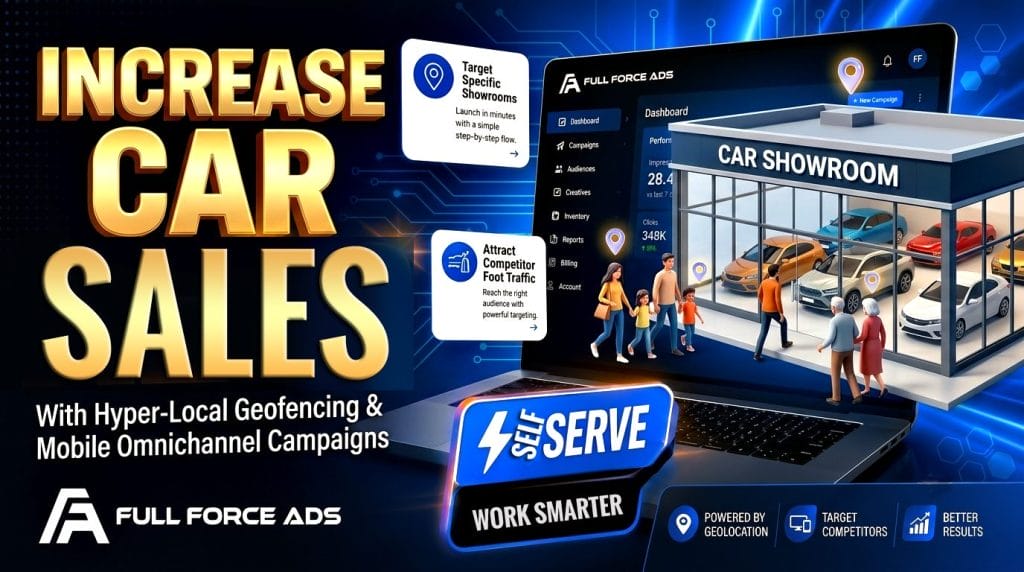
Geofencing is one of the sharper tools in a dealership's kit. You draw a boundary around a real-world location, and the platform picks up the mobile device IDs of people who walk into it.
A tier-3 dealer, for example, can fence the lots of every rival dealership within 30 miles. When a shopper walks a competitor's lot and checks out window stickers, their device gets flagged. Over the next few days, as they browse the web or stream a show at home, that person starts seeing your ads: your matching inventory, your financing terms, your warranty. You are reaching a buyer at the exact moment they are deciding.
  [ Competitor Lot ] ──(Customer Enters Fence)──> [ Device ID Captured ]
                                                            │
                                                            ▼
  [ Customer Home ] <───(Targeted Ads Served)────── [ Unified Platform ]
(Display/Video/Audio)Every dealership already has a CRM full of past buyers, expired leases, and service-only customers sitting on it. Addressable targeting takes that mailing list and maps it to the IP addresses and devices inside those exact households.
Instead of mailing a postcard that lands in the recycling bin, you can put a streaming TV ad or a desktop banner in front of the household whose lease expires in 90 days. It is direct mail with the response rate of digital.
The buying journey rarely goes in a straight line. Someone searches "best three-row SUV lease deals near me," clicks a blog post, browses your inventory for ten minutes, then closes the tab because their kid needed a ride somewhere. Without retargeting, that person is gone for good.
Search retargeting serves ads to people based on the searches they just ran, even if they never landed on your site. Site retargeting follows the visitors who did land on your site, keeping the specific vehicle they looked at in front of them until they come back and submit a lead form.
Context matters too. If someone is reading a long-form truck review on a major automotive site, a contextual campaign puts your truck inventory right next to that article. You are showing a truck ad to someone actively reading about trucks, which is about as close to guaranteed relevance as advertising gets.
There is no single channel that solves everything. The strongest campaigns stack channels depending on the goal.
| Core Business Objective | Primary Recommended Channels | Integrated Targeting Layer | Strategic Execution Focus |
|---|---|---|---|
| Local Brand Awareness & Foot Traffic | Geofencing + Display + Mobile | Competitor Lots, Auto Malls, High-Income Neighborhoods | Cover regional apps and sites so your showroom stays visible to active local shoppers. |
| Direct Competitor Conquesting | Geofencing + Addressable | Rival Franchise Locations & Selected Target Geographies | Pick up device IDs from competing showrooms and follow up with counter-offers via display and video within 48 hours. |
| Top-of-Funnel Brand Building | Streaming TV + Video + Audio | Behavioral Data (In-Market Auto Buyers, Credit Tiers) | Put broadcast-quality video on the living room screen alongside audio spots during drive time. |
| High-Intent Inventory Conversion | Display + Native + Search Retargeting | Keyword Intent Mapping & Contextual Auto Sites | Catch shoppers searching specific trims and models with matching dynamic inventory ads. |
| Re-Engaging Ghost Traffic | Site Retargeting + Display + Video | First-Party Website Visitors (Dropped Lead Forms) | Remind visitors who abandoned a configuration page or trade-in tool of the exact vehicle they were looking at. |
| CRM Activation & Lease Retention | Addressable + Streaming TV + Display | Customer CRM Uploads (Expired Leases, Upgrades) | Match current owners due for an upgrade to their household screens, skipping the mail pile entirely. |
How aggressive your targeting needs to be depends a lot on where you sell cars. A handful of states carry most of the volume, and most of the competition.
  [Top US Automotive Epicenters by Volume & Dealership Density]
  ┌────────────────────────────────────────────────────────────────────────┐
  │  TEXAS       • Sprawling truck markets; hyper-regional geofencing req. │
  │  CALIFORNIA  • EV/Hybrid dominance; high programmatic ad competition.   │
  │  FLORIDA     • High seasonal demographic shifts; addressable CRM vital.│
  │  MICHIGAN    • Domestic brand strongholds; precise tier-conquesting.   │
  │  OHIO        • Saturated regional auto malls; cross-device attribution.│
  └────────────────────────────────────────────────────────────────────────┘
Texas. Truck and SUV volume is enormous here, and the distance between Houston, Dallas-Fort Worth, Austin, and San Antonio means a single dealership's real market can span 50 miles. Broadcast TV covers far more ground than that market needs, which wastes money. Hyper-local display paired with mobile geofencing lets a dealer target specific commercial zones, worksites, and rival truck lots without paying to reach three counties over.
California. Buyers here are digitally savvy and the EV and hybrid market is intensely competitive, especially around Los Angeles, San Francisco, and San Diego. Standing out usually means native ads on tech and environmental blogs, plus search retargeting that catches people comparing battery range, tax incentives, and autonomous features.
Florida. Population swings hard by season, from retirees on the Gulf Coast to the year-round density of Miami and Orlando. Addressable targeting matters most here because it lets a dealer keep scrubbing CRM data and running different messages for permanent residents versus winter visitors.
Michigan and Ohio. This is the historic core of domestic manufacturing, with a dense cluster of legacy dealerships. Brand loyalty runs deep, but so does in-family competition. Five dealerships from the same manufacturer within 25 miles of Detroit or Columbus is common, and streaming TV is often what gives one of them the edge when a lease comes up for renewal.
For years, one of the biggest reasons dealerships avoided serious digital investment was trust. The industry has a long history of "black box" reporting: you pay a large monthly bill and get back a generic PDF full of impressions and clicks, with no real connection to what happened on the lot.
Dealership owners do not deposit impressions. They deposit gross profit from vehicle sales and service repair orders. They need to know where the money went and what it actually produced.
A modern platform replaces the once-a-month summary with something closer to real-time reporting. You can see exact placement verification, meaning which apps, streaming networks, and publishers actually ran your ads, with no hidden networks or bot traffic padding the numbers. Foot traffic attribution takes it further: by matching device locations against active campaigns, the platform can flag when someone who saw an ad later walked onto your lot, drawing a direct line from a digital impression to a physical visit. And cross-device mapping traces a buyer's path across screens, like a video ad on an iPad that led to a search, which led to a lead form filled out on a desktop.
That level of visibility changes the conversation. Instead of arguing about abstract metrics, you are looking at data. If a luxury sedan campaign is not driving foot traffic, you will see it fast enough to move that budget into whatever is actually working, whether that is SUVs or a service center promotion.
The car business moves fast. A factory rebate can drop on a Thursday morning. A hailstorm can create overnight demand for dent repair. A truckload of new inventory can show up on a Friday afternoon with no warning.
Legacy advertising cannot keep up with that. Print a flyer or book a billboard and you are locked into that message for weeks, no matter what happens to your actual inventory in the meantime.
A digital, programmatic setup moves at a different speed. Budget reallocation happens instantly: if a weekend sale clears out your used inventory, you can shift that budget to new cars or service the same afternoon. Creative goes live fast too, so new rates, new incentives, and new seasonal graphics can be up across streaming TV, video, and mobile within days. And there is no long-term lock-in. Unlike traditional media contracts with big spending minimums, digital campaigns can start small, prove out foot traffic and lead volume, and scale up once the results are there.
That flexibility changes how a marketing team actually works day to day. Instead of executing a fixed media plan from three months ago, they can respond to what the GM needs this week.
If your dealership is stuck managing five vendors, struggling to prove what your ad spend is actually doing, or watching a competitor pull ahead with sharper targeting, the fix is not another internal meeting. It starts with a conversation.
Working with a unified media partner means auditing your current market position, finding where the ad spend is being wasted, and building a channel mix around your specific footprint, inventory, and goals.
Ready to see how it comes together? Visit the Full Force Ads Advertising Solutions page to look at what the platform can do, and take the first step toward owning your local market.